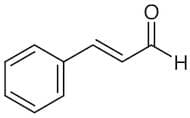
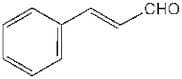
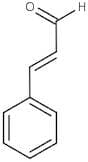
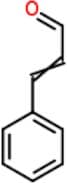
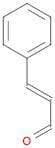
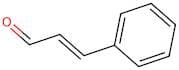
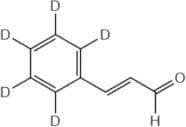
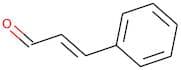
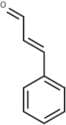
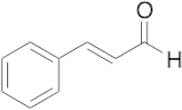
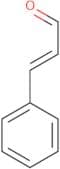
CAS 14371-10-9
:cinnamaldeide
Descrizione:
cinnamaldeide, con il numero CAS 14371-10-9, è un composto organico che funge da componente principale dell'olio di cannella, contribuendo al suo caratteristico sapore e aroma. È classificato come un aldeide, specificamente un fenilpropanoide, e ha la formula molecolare C9H8O. cinnamaldeide è un liquido incolore o giallo pallido a temperatura ambiente, che presenta un profumo dolce e speziato che ricorda la cannella. È solubile in solventi organici come etanolo ed etere, ma ha una solubilità limitata in acqua. Il composto è noto per le sue proprietà antimicrobiche e antifungine, rendendolo utile nella conservazione degli alimenti e come agente aromatizzante naturale. Inoltre, cinnamaldeide è stato studiato per i suoi potenziali benefici per la salute, inclusi effetti anti-infiammatori e antiossidanti. Tuttavia, può essere irritante per la pelle e le mucose, richiedendo cautela durante la manipolazione. In generale, cinnamaldeide è un composto versatile con applicazioni in alimenti, cosmetici e prodotti farmaceutici, riflettendo la sua importanza sia nell'industria che nella ricerca.
Formula:C9H8O
InChI:InChI=1/C9H8O/c10-8-4-7-9-5-2-1-3-6-9/h1-8H/b7-4-
InChI key:InChIKey=KJPRLNWUNMBNBZ-QPJJXVBHSA-N
SMILES:C(=C/C=O)\C1=CC=CC=C1
Sinonimi:- (2E)-3-Phenyl-2-propenal
- (2E)-3-phenylprop-2-enal
- (2Z)-3-phenylprop-2-enal
- (E)-3-Phenylacrolein
- (E)-3-Phenylprop-2-en-1-al
- (E)-3-Phenylprop-2-enal
- (E)-3-Phenylprop-2-enone
- (E)-3-Phenylpropenal
- (E)-Cinnamaldehyde
- 2-Phenylprop-2-Enal
- 2-Propenal, 3-phenyl-, (2E)-
- 2-Propenal, 3-phenyl-, (E)-
- 3-Phenyl-2-propenal
- 3-Phenylprop-2-Enal
- Cinnam Aldehyde
- Cinnamaldehyde, (E)-
- Cinnamic aldehyde
- Cinnamyl Aldehyde
- E-Cinnamyl aldehyde
- Natural Cinnamyl Aldehyde
- Zimtaldehyd
- trans-3-Phenyl-2-propenal
- trans-3-Phenylpropenal
- trans-Benzenepropenal
- trans-Cinnamaldehyde
- trans-Cinnamic aldehyde
- trans-Cinnamylaldehyde
- Synthetic Cinnamaldehyde
- STYRONE
- TRANS-PHENYLACRYLALDEHYDE
- LABOTEST-BB LT00939010
- 3-PHENYLPROPENAL
- TRANS-ALPHA CINNAMALDEHYDE
- (e)-2-propena
- AKOS B004060
- TRANS-3-PHENYL-2-PROPEN-1-AL
- CINNAMALDEHYDE, TRANS-
- AKOS BBS-00003207
- FEMA 2286
- TRANS-PHENYLACROLEIN
- TRANS-CINNAMAL
- Vedi altri sinonimi
Ordinare per
Purezza (%)
0
100
|
0
|
50
|
90
|
95
|
100
14 prodotti.
trans-Cinnamaldehyde
CAS:Formula:C9H8OPurezza:>98.0%(GC)Colore e forma:Colorless to Light orange to Yellow clear liquidPeso molecolare:132.16trans-Cinnamaldehyde, 98+%
CAS:trans-Cinnamaldehyde is used in the flavor and perfume industry. It is also used in medicine. It reacts with glutathione to get an adduct 1'-(glutathion-S-yl)-dihydrocinnamaldehyde. It is used to prepare cinnamylidene-bisacetamide by reacting with acetamide. Further, it inhibits xanthine oxidase. ThFormula:C9H8OPurezza:98+%Colore e forma:Clear colorless to yellow, LiquidPeso molecolare:132.16trans-Cinnamaldehyde
CAS:trans-Cinnamaldehyde analytical standard provided with chromatographic purity, to be used as reference material for qualitative determination.Formula:C9H8OPurezza:(GC) ≥95%Colore e forma:LiquidPeso molecolare:132.16Cinnamaldehyde
CAS:Cyclic aldehydes without other oxygen function not elsewhere specified or includedFormula:C9H8OColore e forma:Yellow Light Yellow LiquidPeso molecolare:132.057512-Propenal, 3-phenyl-, (2E)-
CAS:Formula:C9H8OPurezza:96%Colore e forma:LiquidPeso molecolare:132.1592Ref: 4Z-C-250001
5mgPrezzo su richiesta10mgPrezzo su richiesta25mgPrezzo su richiesta50mgPrezzo su richiesta100mgPrezzo su richiestatrans-Cinnamaldehyde
CAS:Trans-Cinnamaldehyde (Phenylacrolein) exhibits anti-inflammatory activities and antidepressant-like effects in stressed mid-aged rats as a COX-2 inhibitor.Formula:C9H8OPurezza:98.07%Peso molecolare:132.16trans-Cinnamaldehyde
CAS:Applications trans-Cinnamaldehyde is an aromatic aldehyde that is derived from Cinnamomi cortex, the dried bark of the Cinnamomum cassia tree. trans-Cinnamaldehyde is a known cause of allergic contact dermatitis (ACD) in humans and is a major component of cinnamon oil. trans-Cinnamaldehyde also exhibits cytotoxic effects on human leukemia cells.
References Hayashi, K., et al.: Antivir. Res., 74, 1 (2007); He, Z., et al.: J. Agr. Food Chem., 53, 2424 (2005); Peters, M. & Caldwell, J.: Food Chem. Toxicol., 32, 869 (1994); Smith, C., et al.: Toxicol. Appl. Pharm., 168, 189 (2000); Zhang, J., et al.: Acta. Pharm. Sinic., 31, 861 (2010)Formula:C9H8OColore e forma:NeatPeso molecolare:132.16trans-Cinnamaldehyde
CAS:Cinnamaldehyde is a natural compound that has shown to have antiviral and antimicrobial properties. It has been shown to inhibit the toll-like receptor, which is a protein on the surface of cells that detects bacteria and other microorganisms. Cinnamaldehyde is also able to inhibit c. glabrata growth in vitro at concentrations between 10 and 100 μM, as well as copper-mediated cell death in hl-60 cells. Cinnamaldehyde has been shown to cause neuronal death by interfering with cellular physiology. This compound can be used in the treatment of infectious diseases because it inhibits bacterial dna gyrase, dna topoisomerase, and rna synthesis.Formula:C9H8OPurezza:Min. 95%Colore e forma:PowderPeso molecolare:132.16 g/mol