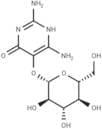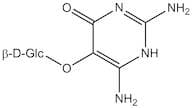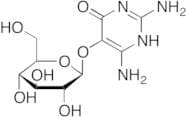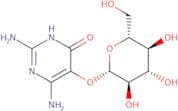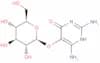
CAS 152-93-2
:Vicino
Descrizione:
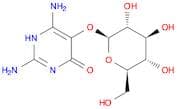
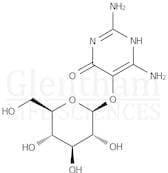
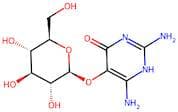
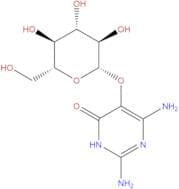
Vicino è un alcaloide che si trova naturalmente principalmente nei semi di Vicia faba, comunemente noti come fave. È classificato come un glicoside ed è noto per la sua somiglianza strutturale con altri composti come conVicino. Vicino è caratterizzato dal suo potenziale di causare stress ossidativo in alcuni individui, in particolare quelli con una carenza nell'enzima glucosio-6-fosfato deidrogenasi (G6PD), portando ad anemia emolitica. Il composto ha una formula molecolare che riflette la sua struttura complessa, che include più gruppi funzionali. Vicino è solubile in acqua e presenta un sapore amaro. Si pensa che il suo ruolo nella fisiologia vegetale sia legato ai meccanismi di difesa contro erbivori e patogeni. Oltre alla sua importanza biologica, Vicino è stato studiato per i suoi potenziali effetti farmacologici, sebbene la sua sicurezza e efficacia nelle applicazioni terapeutiche richiedano ulteriori indagini. In generale, Vicino è un composto importante sia in contesti nutrizionali che medici, richiedendo una considerazione attenta nelle scelte dietetiche, specialmente per gli individui con specifiche condizioni di salute.
Formula:C10H16N4O7
InChI:InChI=1S/C10H16N4O7/c11-7-6(8(19)14-10(12)13-7)21-9-5(18)4(17)3(16)2(1-15)20-9/h2-5,9,15-18H,1H2,(H5,11,12,13,14,19)/t2-,3-,4+,5-,9+/m1/s1
InChI key:InChIKey=KGNGTSCIQCLKEH-SYCVNHKBSA-N
SMILES:O(C1=C(N)NC(N)=NC1=O)[C@@H]2O[C@H](CO)[C@@H](O)[C@H](O)[C@H]2O
Sinonimi:- 2,6-Diamino-4-Oxo-1,4-Dihydropyrimidin-5-Yl Hexopyranoside
- 2,6-Diamino-5-(β-<span class="text-smallcaps">D</span>-glucopyranosyloxy)-4(1H)-pyrimidinone
- 2,6-diamino-4-oxo-1,4-dihydropyrimidin-5-yl beta-D-glucopyranoside
- 4(1H)-Pyrimidinone, 2,6-diamino-5-(β-<span class="text-smallcaps">D</span>-glucopyranosyloxy)-
- Divicine β-<span class="text-smallcaps">D</span>-glucopyranoside
- NSC 95092
- Vicine
- Vicioside
- 2,6-Diamino-5-(β-D-glucopyranosyloxy)-4(1H)-pyrimidinone
- Divicine β-D-glucopyranoside
- 4(1H)-Pyrimidinone, 2,6-diamino-5-(β-D-glucopyranosyloxy)-
Ordinare per
Purezza (%)
0
100
|
0
|
50
|
90
|
95
|
100
8 prodotti.
2,6-diamino-5-(β-D-glucopyranosyloxy)-(1H)-pyrimidin-4-one
CAS:Formula:C10H16N4O7Purezza:99%Colore e forma:SolidPeso molecolare:304.2566Vicine
CAS:Vicine is important natural fungicide. "High levels" of vicine or convicine or both might have shortened the birds' survival time by enhancing the neurotoxicity induced by "lower levels" of beta-cyanoalanine.Formula:C10H16N4O7Purezza:95%~99%Peso molecolare:304.259Vicine
CAS:Vicine, an alkaloid found in fava beans, is toxic in individuals and may cause haemolytic anaemia.Formula:C10H16N4O7Purezza:99.82% - >99.99%Colore e forma:SolidPeso molecolare:304.26Vicine
CAS:Natural alkaloidFormula:C10H16N4O7Purezza:≥ 95.0 % (HPLC)Colore e forma:PowderPeso molecolare:304.26Vicine
CAS:Applications Vicine is a pyrimidine glycosides, a precursor of the aglycons divicine and isouramil which is main factors of favism. It is found in faba/fava bean. Also, it is derived from Ethyl Glyoxylate (E918550), which is used as a reagent in the synthesis of a new class of cinnamyl-triazole compounds which can be used as selective inhibitors of human aromatase (cytochrome P 450 19A1)
References Rizzello, C. G., et al.: Sci. Rep., 6, 32452 (2016); Pulkkinen, M., et al.: Food Chem., 212, 10-19 (2016); McNulty, J., et al.: Bioorg. Med. Chem. Lett., 24, 4586 (2014)Formula:C10H16N4O7Colore e forma:White To Light BeigePeso molecolare:304.26Vicine
CAS:Vicine is a plant toxin that inhibits the activity of the enzyme hydroxylase, which is essential for the synthesis of the amino acid tyrosine. Vicine also inhibits proteins involved in the metabolism of carbohydrates, fatty acids, and proteins. Vicine is found in plants such as beans, peas, lentils, and soybeans. It has been shown to inhibit glomerular filtration rate and may be used to treat metabolic disorders such as hyperglycemia or fatty acid oxidation disorder.Formula:C10H16N4O7Purezza:Min. 95%Peso molecolare:304.26 g/mol