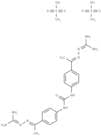
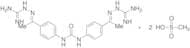
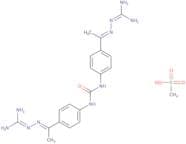
![1,3-bis(4-{(1E)-1-[(diaminomethylidene)hydrazinylidene]ethyl}phenyl)urea methanesulfonate (1:2)](/_next/image/?url=https%3A%2Fstatic.cymitquimica.com%2Fcas-image%2Fthumb-webp%2F383308-13-bis-4-1e-1-diaminomethylidene-hydrazinylidene-ethyl-phenyl-urea-methanesulfonate-1-2.webp&w=3840&q=75)
CAS 15427-93-7
:1,3-bis(4-{(1E)-1-[(diaminometilidene)idrazinilidene]etil}fenil)urea metansulfonato (1:2)
Descrizione:
1,3-bis(4-{(1E)-1-[(diaminometilidene)idrazinilidene]etil}fenil)urea metansulfonato (1:2), con numero CAS 15427-93-7, è un composto organico complesso caratterizzato dalle sue uniche caratteristiche strutturali, inclusi più gruppi funzionali che contribuiscono alla sua reattività e solubilità. Questa sostanza contiene gruppi di urea e metansulfonato, che migliorano le sue potenziali applicazioni in vari campi, inclusi i prodotti farmaceutici e gli agrochimici. La presenza di derivati della idrazina suggerisce una potenziale attività biologica, possibilmente come precursore per ulteriori trasformazioni chimiche o come ingrediente farmaceutico attivo. La solubilità del composto in solventi polari è probabilmente dovuta al gruppo metansulfonato, che può facilitare interazioni con sistemi biologici. Inoltre, la presenza di più anelli aromatici può contribuire alla sua stabilità e potenziale per interazioni di stacking π-π. In generale, la struttura intricata e la diversità funzionale di questo composto lo rendono un argomento di interesse per la ricerca in chimica medicinale e scienza dei materiali.
Formula:C21H32N10O7S2
InChI:InChI=1/C19H24N10O.2CH4O3S/c1-11(26-28-17(20)21)13-3-7-15(8-4-13)24-19(30)25-16-9-5-14(6-10-16)12(2)27-29-18(22)23;2*1-5(2,3)4/h3-10H,1-2H3,(H4,20,21,28)(H4,22,23,29)(H2,24,25,30);2*1H3,(H,2,3,4)/b26-11+,27-12+;;
Ordinare per
Purezza (%)
0
100
|
0
|
50
|
90
|
95
|
100
3 prodotti.
NSC 109555
CAS:NSC 109555 is a selective, reversible, ATP-competitive Chk2 inhibitor (IC50 = 0.2 μM) that displays no effect on a range of other kinases including Chk1 (IC50Formula:C21H32N10O7S2Colore e forma:SolidPeso molecolare:600.67NSC 109555
CAS:Prodotto controllatoApplications NSC 109555 is an inhibitor of checkpoint kinase 2 (Chk2), a serine/threonine kinase involved in the ATM-Chk2 checkpoint pathway. Drugs that target Chk2 in combination with DNA-damaging agents can be beneficial in cancer therapy. Studies in mice, rats, rabbits, dogs, and monkeys have shown that NSC 109555 displays toxic effects. A singe injection of the drug at a concentration of 12.5-25 mg/kg caused acute paralysis leading to apnea and death.
References Lountos, G. et al.: Protein Sci., 18, 92 (2009); Mihich, E. et al.: Canc. Res., 29, 1056 (1969)Formula:C19H24N10O·2C7H8O3SColore e forma:NeatPeso molecolare:752.864NSC109555
CAS:NSC109555 is a small molecule that is chemically synthesized. It has been shown to inhibit the uptake of sodium citrate by mitochondria, which inhibits cellular energy production. NSC109555 also has anti-cancer properties and may be used as a diagnostic agent for cancer. It is activated when it binds to DNA as a template and prevents the formation of dna strands, which prevents the replication of cells. NSC109555 can also cross cell membranes and enter into cells, where it prevents repair mechanisms such as DNA repair from occurring. The chemical structure of this drug is not yet known, but its mechanism of action may involve the response pathway in cancer cells that regulates cell cycle progression, gene expression, and apoptosis.Formula:C19H24N10O·2CH3SO3HPurezza:Min. 95%Peso molecolare:600.67 g/mol