![1-[4-[2-Hydroxy-5-(2-propen-1-yl)phenoxy]phenyl]-1-propanone](/_next/image/?url=https%3A%2Fstatic.cymitquimica.com%2Fcas-image%2Fthumb-webp%2F346431-1-4-2-hydroxy-5-2-propen-1-yl-phenoxy-phenyl-1-propanone.webp&w=3840&q=75)
CAS 155709-41-4
:1-[4-[2-Idrossi-5-(2-propen-1-il)fenossi]fenil]-1-propanone
Descrizione:
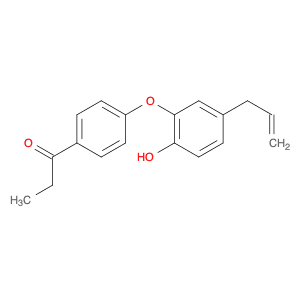
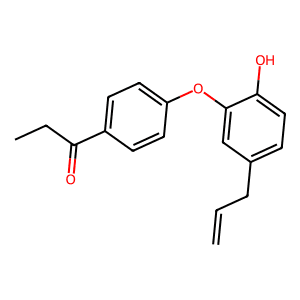
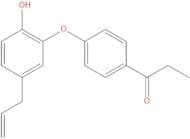
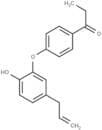
1-[4-[2-Idrossi-5-(2-propen-1-il)fenossi]fenil]-1-propanone, noto anche con il suo numero CAS 155709-41-4, è un composto organico caratterizzato dalla sua struttura complessa che include un gruppo funzionale chetone e più anelli aromatici. Questo composto presenta una parte di propanone attaccata a un gruppo fenile, che è ulteriormente sostituito da un gruppo idrossile e un gruppo propenile, contribuendo alla sua reattività e potenziali applicazioni. La presenza del gruppo idrossile suggerisce che potrebbe mostrare capacità di legame idrogeno, influenzando la sua solubilità e interazione con altre molecole. Inoltre, il sostituente propenile può partecipare a varie reazioni chimiche, come polimerizzazione o reazioni di addizione. Questo composto potrebbe essere di interesse in campi come la sintesi organica, la scienza dei materiali o la farmacologia, dove le sue caratteristiche strutturali uniche potrebbero essere sfruttate per applicazioni specifiche. La sua stabilità, reattività e potenziale attività biologica dipenderebbero dalle condizioni circostanti e dalla presenza di altri reagenti o solventi.
Formula:C18H18O3
InChI:InChI=1S/C18H18O3/c1-3-5-13-6-11-17(20)18(12-13)21-15-9-7-14(8-10-15)16(19)4-2/h3,6-12,20H,1,4-5H2,2H3
InChI key:InChIKey=LVHHYWFCRQIOJG-UHFFFAOYSA-N
SMILES:O(C1=CC(CC=C)=CC=C1O)C2=CC=C(C(CC)=O)C=C2
Sinonimi:- 1-[4-[2-Hydroxy-5-(2-propen-1-yl)phenoxy]phenyl]-1-propanone
- Isomagnolone
- 1-Propanone, 1-[4-[2-hydroxy-5-(2-propenyl)phenoxy]phenyl]-
- 1-Propanone, 1-[4-[2-hydroxy-5-(2-propen-1-yl)phenoxy]phenyl]-
Ordinare per
Purezza (%)
0
100
|
0
|
50
|
90
|
95
|
100
6 prodotti.
Ref: IN-DA00AKXM
20mgPrezzo su richiesta50mgPrezzo su richiesta100mgPrezzo su richiesta200mgPrezzo su richiesta1mg168,00€5mg554,00€10mg574,00€Isomagnolone
CAS:Isomagnolone is a natural product isolated from Illicium burmanicum and has anti-inflammatory activity.Formula:C18H18O3Purezza:99.97%Colore e forma:SolidPeso molecolare:282.33Ref: TM-TN1785
1mg149,00€5mg361,00€1mL*10mM (DMSO)371,00€10mg515,00€25mg767,00€50mg1.035,00€100mg1.395,00€200mg1.783,00€Isomagnolone
CAS:Isomagnolone is an organic compound that is a white solid at room temperature. It has been shown to have bacteriostatic properties and can be used as a reagent for the synthesis of various organic compounds. Isomagnolone has been shown to inhibit the growth of certain bacteria, including Staphylococcus aureus and Escherichia coli. The antibacterial property of isomagnolone may be due to its ability to react with nitro groups on proteins, which may be present in the cell wall or cytoplasmic membrane. The chemical structure of this compound is similar to that of phenoxy herbicides, which are known for their antibacterial activity. Isomagnolone has also been found in tobacco plants and other natural sources.Formula:C18H18O3Purezza:Min. 95%Peso molecolare:282.3 g/mol