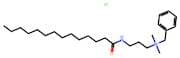
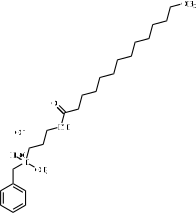
![benzyldimethyl[3-[(1-oxotetradecyl)amino]propyl]ammonium chloride](/_next/image/?url=https%3A%2Fstatic.cymitquimica.com%2Fcas-image%2Fthumb-webp%2F363059-miramistin.webp&w=3840&q=75)
CAS 15809-19-5
:cloruro di benzyldimetil[3-[(1-ossotetradecil)amino]propil]ammonio
- Ammonium, benzyldimethyl(3-myristamidopropyl)-, chloride
- Benzenemethanaminium, N,N-dimethyl-N-(3-((1-oxotetradecyl)amino)propyl)-, chloride
- Benzenemethanaminium, N,N-dimethyl-N-[3-[(1-oxotetradecyl)amino]propyl]-, chloride (1:1)
- Benzyldimethyl(3-tetradecamidopropyl)ammonium chloride
- Benzyldimethyl[3-(myristoylamino)propyl]ammonium chloride
- DT 2 (surfactant)
- Miramistin
- Miramystin
- Myramistin
- DT 2
- Benzyldimethyl(3-((1-oxotetradecyl)amino)propyl)ammonium chloride
- Einecs 239-908-9
- [3-[(1oxotetradecyl)aMino]propyl]aMMoniuM chloride
- N-benzyl-N,N-diMethyl-3-tetradecanaMidopropan-1-aMiniuM chloride
- myramstin/benzyldiMethyl
- miramistin-001-R
- benzyldimethyl(3-((1-oxotetradecyl)amino)propyl)ammonium chl
- myramstin
- Vedi altri sinonimi
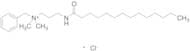
Benzyldimethyl[3-(myristoylamino)propyl]ammonium chloride
CAS:Formula:C26H47ClN2OPurezza:98%Colore e forma:SolidPeso molecolare:439.1172N-Benzyl-N,N-dimethyl-3-tetradecanamidopropan-1-aminium chloride
CAS:N-Benzyl-N,N-dimethyl-3-tetradecanamidopropan-1-aminium chloridePurezza:98%Peso molecolare:439.13g/molMiramistin
CAS:Stability Hygroscopic
Applications Miramistin is antibacterial surfactant used in stabilization of silver nanoparticles, and various drug delivery.
References Pires, P., El Seoud, O.: Prog. Colloid Polym. Sci., 133, 131 (2006); Vertelov, G., et al.: Nanotechnology, 19, 355707 (2008);Formula:C26H47N2O·ClColore e forma:Light YellowPeso molecolare:439.12Miramistin
CAS:Miramistin is a biocompatible polymer that has antimicrobial properties. It is used for the prevention of infection in humans. Miramistin is a natural compound and belongs to the family of polyhydroxylated coumarins. It has shown antibacterial efficacy against a range of bacteria, including human pathogenic strains such as Staphylococcus aureus, Escherichia coli, Pseudomonas aeruginosa, and Salmonella enterica. Miramistin also shows activity against fungi and Gram-positive bacteria such as Clostridium difficile and Enterococcus faecalis. The antimicrobial activity of miramistin is related to its ability to inhibit bacterial protein synthesis by binding to ribosomes and interfering with the ribosomal translocation step. This leads to bacterial cell death by inhibiting DNA synthesis or preventing cell division. Miramistin has been shown not be active against Gram-negative bacteria such
Formula:C26H47ClN2OPurezza:Min. 95 Area-%Colore e forma:PowderPeso molecolare:439.12 g/mol
![Benzyldimethyl[3-(myristoylamino)propyl]ammonium chloride](/_next/image/?url=https%3A%2Fstatic.cymitquimica.com%2Fproducts%2FIN%2Fthumb%2FDA00AC06.jpg&w=3840&q=75)