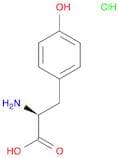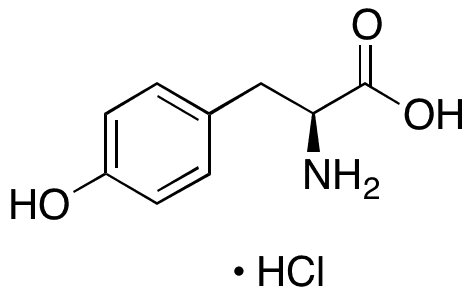
CAS 16870-43-2
:L-Tirosina, cloridrato (1:1)
- (1S)-1-carboxy-2-(4-hydroxyphenyl)ethanaminium chloride
- (S)-2-Amino-3-(4-hydroxyphenyl)propanoic acid hydrochloride
- <span class="text-smallcaps">L</span>-Tyrosine, hydrochloride
- <span class="text-smallcaps">L</span>-Tyrosine, hydrochloride (1:1)
- Tyrosine hydrochloride
- Tyrosine hydrogen chloride
- Tyrosine, hydrochloride, <span class="text-smallcaps">L</span>-
- L-Tyrosine, hydrochloride (1:1)
- L-Tyrosine, hydrochloride
- Tyrosine, hydrochloride, L-
(S)-2-Amino-3-(4-hydroxyphenyl)propanoic acid hydrochloride
CAS:Formula:C9H12ClNO3Purezza:95%Peso molecolare:217.65L-Tyrosine Hydrochloride
CAS:Prodotto controllatoFormula:C9H11NO3·ClHColore e forma:NeatPeso molecolare:217.649L-Tyrosine hydrochloride
CAS:L-Tyrosine hydrochloride is a pharmaceutical preparation that has been used clinically in the treatment of infectious diseases, cancer, and autoimmune diseases. Tyrosine is an amino acid with a hydroxyl group on its side chain. Tyrosine can be synthesized from phenylalanine by hydroxylation of the phenolic group and decarboxylation of the carboxylic acid group. It is also a precursor to catecholamines and other important biological molecules. L-Tyrosine hydrochloride is used as an intermediate in the production of monoclonal antibodies for use in cancer research. In addition, it has been shown to be an effective inhibitor of virus replication when combined with ester hydrochloride, which prevents the release of progeny virus particles from infected cells.
Formula:C9H11NO3·HClPurezza:Min. 95%Peso molecolare:217.65 g/mol