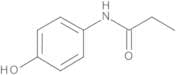
CAS 1693-37-4
:parapropamol
Descrizione:
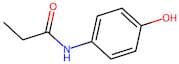
parapropamol, noto anche come 1-(3-idrossipropile)-2-metil-2-fenilpropan-1-one, è un composto chimico riconosciuto principalmente per le sue proprietà analgesiche e antipiretiche. È classificato come analgesico non oppioide ed è spesso utilizzato nel trattamento del dolore e della febbre da lieve a moderata. La sostanza presenta una solubilità moderata in acqua ed è più solubile nei solventi organici, il che è tipico di molti composti organici. parapropamol agisce inibendo la sintesi delle prostaglandine nel sistema nervoso centrale, riducendo così la percezione del dolore. La sua farmacocinetica include l'assorbimento orale, con il metabolismo che avviene principalmente nel fegato. Sebbene generalmente considerato sicuro se usato secondo le indicazioni, può avere effetti collaterali, tra cui disturbi gastrointestinali e reazioni allergiche in alcune persone. A causa della sua struttura chimica, parapropamol può anche interagire con altri farmaci, richiedendo cautela in situazioni di polifarmacia. In generale, è importante utilizzare parapropamol sotto supervisione medica per garantire sicurezza ed efficacia.
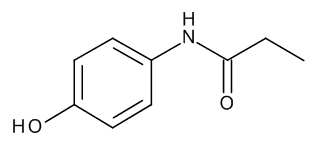
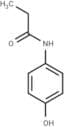
Formula:C9H11NO2
InChI:InChI=1S/C9H11NO2/c1-2-9(12)10-7-3-5-8(11)6-4-7/h3-6,11H,2H2,1H3,(H,10,12)
InChI key:InChIKey=SSMYTAQHMUHRSK-UHFFFAOYSA-N
SMILES:N(C(CC)=O)C1=CC=C(O)C=C1
Sinonimi:- 4'-Hydroxypropionanilid
- 4-(Propionylamino)phenol
- 4-Propionamidophenol
- 4′-Hydroxypropionanilide
- N-(4-Hydroxyphenyl)propionamide
- N-(4-hydroxyphenyl)propanamide
- N-(p-Hydroxyphenyl)propionamide
- Parapropamol [INN:DCF]
- Parapropamolo
- Parapropamolo [DCIT]
- Parapropamolum
- Parapropamolum [INN-Latin]
- Parapropanol
- Propanamide, N-(4-hydroxyphenyl)-
- Propionanilide, 4′-hydroxy-
- Solvodol
- Unii-I729P6N0P7
- p-Hydroxypropionanilide
- p-Propionamidophenol
- Parapropamol
- Vedi altri sinonimi
Ordinare per
Purezza (%)
0
100
|
0
|
50
|
90
|
95
|
100
11 prodotti.
Acetaminophen Related Compound B (N-(4-hydroxyphenyl)propanamide)
CAS:Aromatic cyclic amides (including cyclic carbamates) and their derivatives; salts thereofFormula:C9H11NO2Colore e forma:White Brown PowderPeso molecolare:165.07898N-(4-Hydroxyphenyl);propionamide
CAS:Formula:C9H11NO2Purezza:98%Colore e forma:SolidPeso molecolare:165.1891Ref: IN-DA007AMN
1g278,00€5gPrezzo su richiesta10gPrezzo su richiesta25gPrezzo su richiesta100mg116,00€250mg185,00€Paracetamol (Acetaminophen) EP Impurity B (Acetaminophen USP Related Compound B)
CAS:Formula:C9H11NO2Colore e forma:White To Off-White SolidPeso molecolare:165.19N-(4-Hydroxyphenyl)propanamide (N-Propionyl-4-aminophenol)
CAS:Formula:C9H11NO2Colore e forma:NeatPeso molecolare:165.194-Propionamidophenol
CAS:4-Propionamidophenol is a kind of analog of p-acetamidophenol.Formula:C9H11NO2Purezza:99.64%Colore e forma:Pale Purple SolidPeso molecolare:165.19Ref: ST-EA-CP-A7005
10mgPrezzo su richiesta25mgPrezzo su richiesta50mgPrezzo su richiesta100mgPrezzo su richiestaRef: ST-EA-CP-P10002
10mgPrezzo su richiesta25mgPrezzo su richiesta50mgPrezzo su richiesta100mgPrezzo su richiesta4-Propionamidophenol (Acetaminophen Impurity B)
CAS:Impurity Paracetamol EP Impurity B, Acetaminophen Related Compound B (USP)
Applications 4-Propionamidophenol (Acetaminophen Impurity B) is an impurity of Acetaminophen (A161220) (1). Acetaminophen is an analgesic and antipyretic agent and used as a pain reliever to treat headache, muscle aches, and arthritis (2,3).
References (1) Hajduk, P., et al.: Science, 278, 497 (2) McGill, M. R. and Jaeschke, H. Pharm Res. 30, 2174 (2013)(3) Fairbrother, J.E., et al.: Anal. Profiles Drug Subs., 3, 1 (1974)Formula:C9H11NO2Colore e forma:WhitePeso molecolare:165.19N-(4-Hydroxyphenyl)propanamide
CAS:The N-(4-hydroxyphenyl)propionamide (HPPA) is a synthetic drug that binds to the human liver. It has been shown to be effective in preventing implantation of fertilized eggs, and can be used as a diagnostic agent for determining the presence of HPPA in human liver tissue. HPPA is also used as a diluent for other drugs. The HPPA binds to chromatographic components and can be detected using electrochemical detection, which allows it to be used as a targetable probe for cancer research. HPPA is also used to study iontophoretic transport of ions across reconstituted membranes in vitro.Formula:C9H11NO2Purezza:(%) Min. 97%Peso molecolare:165.19 g/mol