CAS 17912-87-7
:Miricitrina
Descrizione:
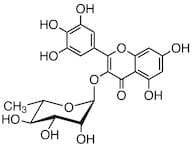
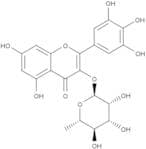
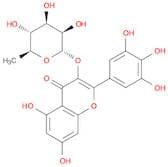
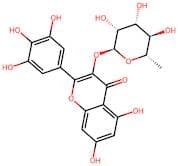
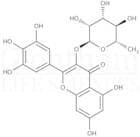
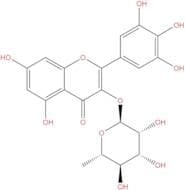
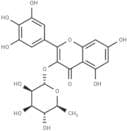
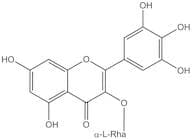
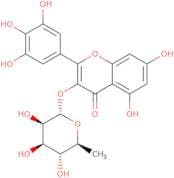
Miricitrina, con il numero CAS 17912-87-7, è un glicoside flavonoide trovato principalmente in varie piante, in particolare nelle specie di Myrica. È caratterizzato dalla sua struttura, che consiste in un aglicone di miricetina legato a una porzione di zucchero rhamnosio. Miricitrina mostra diverse attività biologiche, comprese proprietà antiossidanti, antinfiammatorie e potenzialmente antimicrobiche, rendendolo di interesse nella ricerca farmacologica. Il composto è tipicamente solubile in solventi polari, riflettendo la sua natura glicosidica, ed è spesso studiato per i suoi benefici per la salute, in particolare nella medicina tradizionale. Inoltre, Miricitrina è stato studiato per il suo ruolo nella protezione delle cellule dallo stress ossidativo e il suo potenziale di modulare varie vie biochimiche. La sua presenza in fonti dietetiche suggerisce che potrebbe contribuire ai benefici per la salute associati a diete a base vegetale. In generale, Miricitrina rappresenta un composto significativo nel campo dei prodotti naturali e della fitochimica, con ricerche in corso sulle sue applicazioni terapeutiche.
Formula:C21H20O12
InChI:InChI=1/C21H20O12/c1-6-14(26)17(29)18(30)21(31-6)33-20-16(28)13-9(23)4-8(22)5-12(13)32-19(20)7-2-10(24)15(27)11(25)3-7/h2-6,14,17-18,21-27,29-30H,1H3
InChI key:InChIKey=DCYOADKBABEMIQ-OWMUPTOHSA-N
SMILES:O(C1=C(OC=2C(C1=O)=C(O)C=C(O)C2)C3=CC(O)=C(O)C(O)=C3)[C@H]4[C@H](O)[C@H](O)[C@@H](O)[C@H](C)O4
Sinonimi:- 17912-87-7
- 3,3′,4′,5,5′,7-Hexahydroxyflavone, 3-rhamnoside
- 3-O-Rhamnosylmyricetin
- 3-[(6-Deoxy-α-<span class="text-smallcaps">L</span>-mannopyranosyl)oxy]-5,7-dihydroxy-2-(3,4,5-trihydroxyphenyl)-4H-1-benzopyran-4-one
- 4H-1-Benzopyran-4-one, 3-[(6-deoxy-α-<span class="text-smallcaps">L</span>-mannopyranosyl)oxy]-5,7-dihydroxy-2-(3,4,5-trihydroxyphenyl)-
- 4H-1-benzopyran-4-one, 3-[(6-deoxy-alpha-L-mannopyranosyl)oxy]-5,7-dihydroxy-2-(3,4,5-trihydroxyphenyl)-
- 5,7-Dihydroxy-3-{[(2S,3R,4R,5R,6S)-3,4,5-trihydroxy-6-methyltetrahydro-2H-pyran-2-yl]oxy}-2-(3,4,5-trihydroxyphenyl)-4H-chromen-4-on
- 5,7-Dihydroxy-3-{[(2S,3R,4R,5R,6S)-3,4,5-trihydroxy-6-methyltetrahydro-2H-pyran-2-yl]oxy}-2-(3,4,5-trihydroxyphenyl)-4H-chromen-4-one
- 5,7-Dihydroxy-4-oxo-2-(3,4,5-trihydroxyphenyl)-4H-chromen-3-yl 6-deoxy-a-L-mannopyranoside
- 5,7-Dihydroxy-4-oxo-2-(3,4,5-trihydroxyphenyl)-4H-chromen-3-yl 6-deoxy-alpha-L-mannopyranoside
- 5,7-dihydroxy-4-oxo-2-(3,4,5-trihydroxyphenyl)-4H-chromen-3-yl 6-deoxyhexopyranoside
- 6-Désoxy-alpha-L-mannopyranoside de 5,7-dihydroxy-4-oxo-2-(3,4,5-trihydroxyphényl)-4H-chromén-3-yle
- Myricetin 3-O-rhamnopyranoside
- Myricetin 3-O-rhamnoside
- Myricetin 3-O-α-<span class="text-smallcaps">L</span>-rhamnopyranoside
- Myricetin 3-O-α-<span class="text-smallcaps">L</span>-rhamnoside
- Myricetin 3-O-α-<span class="text-smallcaps">L</span>-rhamnpyronoside
- Myricetin 3-O-α-rhamnopyranoside
- Myricetin 3-rhamnoside
- Myricetin-3-O-α-rhamnoside
- Myricetin-3-O-β-rhamnopyranoside
- Myricitrin
- Myricitrine
- Myricitroside
- NSC 19803
- 4H-1-Benzopyran-4-one, 3-[(6-deoxy-α-L-mannopyranosyl)oxy]-5,7-dihydroxy-2-(3,4,5-trihydroxyphenyl)-
- 3-[(6-Deoxy-α-L-mannopyranosyl)oxy]-5,7-dihydroxy-2-(3,4,5-trihydroxyphenyl)-4H-1-benzopyran-4-one
- MYRICITRIN WITH HPLC
- MIRICITRIN
- 3-[(6-Deoxy-alpha-L-Mannopyranosyloxy)]-5,7-dihydroxy-2-(3,4,5-trihydroxyphenyl)-4H-chroMen-4-one
- CANNABISCITRIN
- 3,3′,4′,5,5′,7-Hexahydroxyflavone 3-O-rhamnoside
- Myricetin 3-O-α-L-rhamnopyranoside
- mannopyranosyl)oxy]-5,7-dihydroxy-2-(3,4,5-trihydroxyphenyl)-
- MYRICITRIN HPLC 98+%
- YRICITRIN
- Myricitrin(Myricitrine)
- MYRICITRIN(MYRICETIN-3-O-RHAMNOSIDE)(SH)
- 5,7-dihydroxy-3-((2s,3r,4r,5r,6s)-3,4,5-trihydroxy-6-methyl-tetrahydro-pyran-2-yloxy)-2-(3,4,5-trihydroxy-phenyl)-1-benzopyran-4-one
- 3-[(6-deoxy-alpha-L-mannopyranosyl)oxy]-5,7-dihydroxy-2-(3,4,5-trihydroxyphenyl)-4H-benzopyran-4-one
- Myricitrin, froM Myrica rubra
- Myricetin 3-α-L-rhamnopyranoside
- MYRICETIN-3-O-RHAVINOSIDE
- 5,7-Dihydroxy-3-((2S,3R,4R,5R,6S)-3,4,5-trihydroxy-6-methyl-tetrahydro-pyran-2-yloxy)-2-(3,4,5-trihydroxy-phenyl)-1-benzopyran-4-one
- 3',4',5,5',7-Pentahydroxy-3-(α-L-rhamnopyranosyloxy)flavone
- 4H-1-Benzopyran-4-one,3-[(6-deoxy-α-L-
- 3-[(6-deoxy-α-L-mannopyranosyl)oxy]-5,7-dihydroxy-2-(3,4,5-trihydroxyphenyl)-4H-benzopyran-4-one
- Myricetrin
- Vedi altri sinonimi
Ordinare per
Purezza (%)
0
100
|
0
|
50
|
90
|
95
|
100
10 prodotti.
Myricitrin
CAS:Formula:C21H20O12Purezza:>98.0%(HPLC)Colore e forma:Light yellow to Yellow to Orange powder to crystalPeso molecolare:464.38Myricitrin
CAS:Myricitrin analytical standard provided with w/w absolute assay, to be used for quantitative titration.Formula:C21H20O12Purezza:(HPLC) ≥99%Colore e forma:PowderPeso molecolare:464.38Myricitrin
CAS:Formula:C21H20O12Purezza:(HPLC) ≥ 98.0%Colore e forma:White to light yellow powderPeso molecolare:464.38Myricetrin
CAS:Myricitrin exhibits hepatoprotective, anti-inflammatory,antioxidant, anti-allergic, antinociception, anxiolytic-like, and antipsychotic-like effects. Myricitrin can be used as a drug candidate for the treatment of cardiovascular diseases, by effectively protecting cells from ox-LDL-induced endothelial cell apoptosis and reducing atherosclerotic plaque formation. Myricitrin is also a nitric oxide (NO) and protein kinase C (PKC) inhibitor that has central nervous system activity.Formula:C21H20O12Purezza:95%~99%Peso molecolare:464.379Myricitrin
CAS:Myricitrin (Myricitrine), a flavonoid compound isolated from the root bark of Myrica cerifera, exerts antinociceptive effects.Formula:C21H20O12Purezza:99.72%Colore e forma:Light Yellow To Off-White Crystalline PowderPeso molecolare:464.38Myricitrin
CAS:Natural glycosideFormula:C21H20O12Purezza:≥ 95.0 % (HPLC)Colore e forma:PowderPeso molecolare:464.38Myricitrin
CAS:Myricitrin is a natural compound that is found in the bark of the Myrica tree. It has been shown to have antioxidant effects and pro-apoptotic activities. Myricitrin has been shown to induce apoptosis in HL-60 cells through activation of the caspase-3 pathway, which includes cleavage of poly (ADP-ribose) polymerase and activation of caspases. In addition, myricitrin induces apoptosis by binding to DNA and inhibiting transcription. The physiological effects of myricetin are similar to those of myricitrin due to their structural similarity. However, there is no data available on the anti-inflammatory properties or hypoglycemic effect of myricetin.Formula:C21H20O12Purezza:Min. 95%Colore e forma:White PowderPeso molecolare:464.38 g/mol