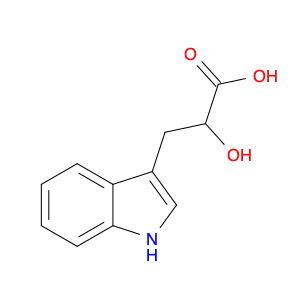
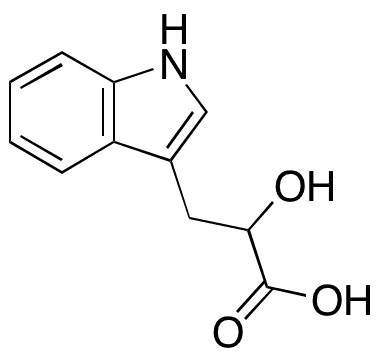
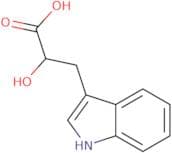
CAS 1821-52-9
:Acido indolo-3-lattico
- 1H-Indole-3-propanoic acid, α-hydroxy-
- 2-Hydroxy-3-(1H-indol-3-yl)propanoic acid
- 2-Hydroxy-3-(3-indolyl)propanoic acid
- 3-(3-Indolyl)-2-hydroxypropionic acid
- 3-(3-Indolyl)-<span class="text-smallcaps">DL</span>-lactic acid
- 3-Indole-lactic acid
- 3-Indolyllactic acid
- <span class="text-smallcaps">DL</span>-Indole-3-lactic acid
- Indole-3-lactic acid
- Indolelactic acid
- Indolelacticacid
- α-Hydroxy-1H-indole-3-propanoic acid
- β-(3-Indolyl)lactic acid
- Vedi altri sinonimi
1H-Indole-3-propanoic acid, α-hydroxy-
CAS:Formula:C11H11NO3Purezza:97%Colore e forma:SolidPeso molecolare:205.2099Indolelactic acid
CAS:Indolelactic acid is a metabolite of tryptophan in Azotobacter vinelandii cultures.Formula:C11H11NO3Purezza:98.93% - 99.76%Colore e forma:SolidPeso molecolare:205.21DL-Indole-3-lactic Acid
CAS:Applications DL-Indole-3-lactic Acid is used as a reagent in the synthesis of 2-hydroxy-1-(1H-indol-3-yl)-4-methylpentan-3-one which has weak antibacterial activity against 16 bacterial strains, including Escherichia coli, Bacillus subtilis and Staphylococcus aureus. DL-Indole-3-lactic Acid is also used in the preparation of Monatin, a natural sweet peptidomimetic.
References Nguyen, S.T., et al.: Bioorg. Med. Chem. Lett., 20, 5739 (2010); Nakamura, K., et al.: Peptide Sci., 40, 61 (2003)Formula:C11H11NO3Colore e forma:NeatPeso molecolare:205.21DL-Indole-3-lactic acid
CAS:DL-Indole-3-lactic acid is a versatile building block that can be used in the synthesis of complex compounds such as pharmaceuticals and research chemicals. It is also a reagent, speciality chemical, useful building block, and reaction component. DL-Indole-3-lactic acid is an intermediate for the synthesis of indigo dye, which was used widely in textile industries. This compound has been shown to have high quality and can be used as a scaffold for drug design.Formula:C11H11NO3Purezza:Min. 98.5 Area-%Peso molecolare:205.22 g/mol2-Hydroxy-3-(1H-indol-3-yl)propanoic acid
CAS:Formula:C11H11NO3Purezza:98%Colore e forma:No data available.Peso molecolare:205.213DL-Indole-3-lactic acid
CAS:Indole-3-lactic acid is a plant hormone that is produced in the leaves of the plant when they are under stress. It has been shown to have activity against bowel diseases and metabolic disorders. Indole-3-lactic acid has been isolated from plants like Caproicum album, which is used in vitro to measure its effect on caproic acid production. This compound has also been detected in human serum and wastewater treatment. Indole-3-lactic acid inhibits tryptophan degradation by competing with indolecarboxylase for substrate. The effect of indole-3-lactic acid on dextran sulfate and glomerular filtration rate was studied using a rat model, where it was found that it had no significant effects.
Formula:C11H11NO3Purezza:Min. 95%Colore e forma:PowderPeso molecolare:205.21 g/mol