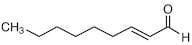
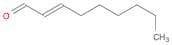
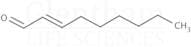
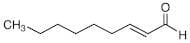
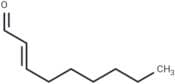
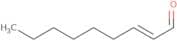
CAS 18829-56-6
:(E)-2-Nonenale
- (2E)-2-Nonenal
- (2E)-Non-2-enal
- (2E)-Nonen-1-al
- (2E)-Nonenal
- (E)-2-Nonen-1-al
- (E)-2-Nonenal
- (E)-Nonen-1-al
- (E)-non-2-enal
- 2-Nonenal, (E)-
- 2-trans-Nonenal
- Non-2-Enal, (E)-
- trans-2-Nonen-1-al
- trans-2-Nonenal
- BRN 1722170
- CCRIS 9203
- 2-Nonenal
- 4-01-00-03502 (Beilstein Handbook Reference)
- 2-Nonenal, (2E)-
- Vedi altri sinonimi
trans-2-Nonenal
CAS:Formula:C9H16OPurezza:>95.0%(GC)Colore e forma:Colorless to Light orange to Yellow clear liquidPeso molecolare:140.23trans-2-Nonenal, 97%
CAS:trans-2-Nonenal reacts with acetic acid hydrazide to produce acetic acid non-2-enylidene-hydrazide. This Thermo Scientific Chemicals brand product was originally part of the Alfa Aesar product portfolio. Some documentation and label information may refer to the legacy brand. The original Alfa AesarFormula:C9H16OPurezza:97%Colore e forma:Clear colorless to pale yellow, LiquidPeso molecolare:140.23Trans-2-Nonenal
CAS:Trans-2-NonenalFormula:C9H16OPurezza:98%Colore e forma: clear. faint brown liquidPeso molecolare:140.22g/moltrans-2-Nonenal
CAS:Formula:C9H16OPurezza:≥ 95.0%Colore e forma:Clear, colourless to yellow liquidPeso molecolare:140.22trans-2-Nonenal (contains trans-2-Nonenal Diethyl Acetal) (ca. 10% in Ethanol, ca. 0.57mol/L)
CAS:Formula:C9H16OColore e forma:Colorless to Light yellow to Light orange clear liquidPeso molecolare:140.23trans-2-Nonenal
CAS:trans-2-Nonenal exhibits antibacterial activity against Staphylococcus aureus, Escherichia coli, and fungi, and can be used in related research in the field of life sciences.Formula:C9H16OColore e forma:SolidPeso molecolare:140.22Ref: 4Z-F-106127
5mgPrezzo su richiesta10mgPrezzo su richiesta25mgPrezzo su richiesta50mgPrezzo su richiesta100mgPrezzo su richiestatrans-2-Nonenal
CAS:Prodotto controllatoApplications trans-2-Nonenal is an unsaturated aldehyde that is a product of fatty acid peroxidation (and also has a grassy, cucumber smell). trans-2-Nonenal is naturally found in mushrooms, coffee and is also a constituent of carrot root. It also exhibits insecticidal effects.
References Chamberlain, D., et al.: J. Chem. Ecol., 17, 615 (1991); Guerin, P. & Ryan, M.: Experentia, 36, 1387 (1980); Parliment, T., et al.: J. Agr. Food Chem., 21, 485 (1973); Wood, W., et al.: Mycologia, No vol. given, 561 (1994)Formula:C9H16OColore e forma:NeatPeso molecolare:140.223Trans-2-nonenal
CAS:Trans-2-nonenal is a monoclonal antibody that recognizes the physiological function of cardiac and rat liver microsomes. It has been shown to inhibit enzyme activities in both cell lines. Trans-2-nonenal has also been shown to protect against ischemia/reperfusion injury in rats by reducing the release of intracellular Ca2+ and ATP levels. Trans-2-nonenal is genotoxic and induces oxidative injury, which may be due to its ability to react with caproic acid to form reactive oxygen species.
Formula:C9H16OPurezza:Min. 95%Peso molecolare:140.22 g/mol