CAS 1929-29-9
:Acido 3-(4-metossifenil)propionico
Descrizione:
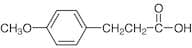
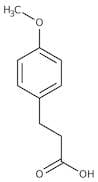
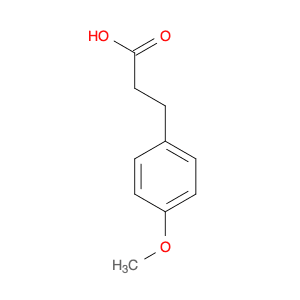
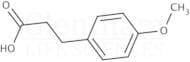
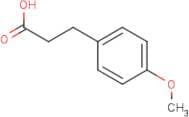
Acido 3-(4-metossifenil)propionico, con il numero CAS 1929-29-9, è un composto organico caratterizzato dalla sua struttura di acido propionico sostituito con un gruppo 4-metossifenile. Questo composto appare tipicamente come un solido cristallino bianco a bianco sporco. È solubile in solventi organici come etanolo e metanolo, ma ha una solubilità limitata in acqua. La presenza del gruppo metossile aumenta la sua lipofilia, il che può influenzare la sua attività biologica e le interazioni. Il composto presenta proprietà acide a causa del gruppo funzionale acido carbossilico, consentendogli di partecipare a varie reazioni chimiche, tra cui esterificazione e ammidazione. Può anche mostrare potenziali attività farmacologiche, rendendolo di interesse nella chimica medicinale. Inoltre, le sue caratteristiche strutturali suggeriscono che potrebbe impegnarsi in legami idrogeno e interazioni di stacking π-π, che sono rilevanti nei sistemi biologici. In generale, Acido 3-(4-metossifenil)propionico è un composto versatile con applicazioni nella ricerca e potenziali usi terapeutici.
Formula:C10H12O3
InChI:InChI=1S/C10H12O3/c1-13-9-5-2-8(3-6-9)4-7-10(11)12/h2-3,5-6H,4,7H2,1H3,(H,11,12)
InChI key:InChIKey=FIUFLISGGHNPSM-UHFFFAOYSA-N
SMILES:C(CC(O)=O)C1=CC=C(OC)C=C1
Sinonimi:- 3-(2-Methoxyphenyl)Propanoic Acid
- 3-(4-Methoxyphenyl)Propanoate
- 3-(4-Methoxyphenyl)Propanoic Acid
- 3-(p-Methoxyphenyl)propanoic acid
- 3-(p-Methoxyphenyl)propionic acid
- 3-[4-(Methyloxy)phenyl]propanoic acid
- 4-Methoxybenzenepropanoic acid
- 4-Methoxyhydrocinnamic acid
- 4-Methoxyphenylpropiinic Acid
- Benzenepropanoic acid, 4-methoxy-
- Hydrocinnamic acid, p-methoxy-
- NSC 33134
- NSC 51509
- p-Methoxybenzenepropionic acid
- p-Methoxyhydrocinnamic acid
- Vedi altri sinonimi
Ordinare per
Purezza (%)
0
100
|
0
|
50
|
90
|
95
|
100
8 prodotti.
3-(4-Methoxyphenyl)propionic Acid
CAS:Formula:C10H12O3Purezza:>98.0%(GC)(T)Colore e forma:White to Light yellow to Light orange powder to crystalPeso molecolare:180.203-(4-Methoxyphenyl)propionic acid, 98%
CAS:This Thermo Scientific Chemicals brand product was originally part of the Alfa Aesar product portfolio. Some documentation and label information may refer to the legacy brand. The original Alfa Aesar product / item code or SKU reference has not changed as a part of the brand transition to Thermo SciFormula:C10H12O3Purezza:98%Colore e forma:White to cream to brown, Crystalline powder or powderPeso molecolare:180.20Benzenepropanoic acid, 4-methoxy-
CAS:Formula:C10H12O3Purezza:97%Colore e forma:SolidPeso molecolare:180.20053-(4-Methoxyphenyl)propanoic acid
CAS:3-(4-Methoxyphenyl)propanoic acidPurezza:98%Peso molecolare:180.20g/mol3-(4-Methoxyphenyl)propanoic acid
CAS:3-(4-Methoxyphenyl)propanoic acid is a useful organic compound for research related to life sciences.Formula:C10H12O3Colore e forma:SolidPeso molecolare:180.2033-(4-Methoxyphenyl)propionic acid
CAS:3-(4-Methoxyphenyl)propionic acid is a nutrient solution that can be used to inhibit microbial growth by binding to the active site of enzymes such as carbonyl group, formation rate, acidic ph, chlorogenic acids, cinnamic acid derivatives. 3-(4-Methoxyphenyl)propionic acid has been shown to react with hydrogen bond and diltiazem hydrochloride in surface methodology experiments. This compound has also been shown to have activity against cavity microorganisms, including Streptococcus mutans and Lactobacillus acidophilus.
Formula:C10H12O3Purezza:Min. 95%Colore e forma:PowderPeso molecolare:180.2 g/mol3-(4-Methoxyphenyl)propionic acid
CAS:Formula:C10H12O3Purezza:97%Colore e forma:SolidPeso molecolare:180.203