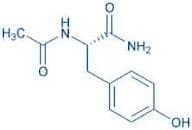
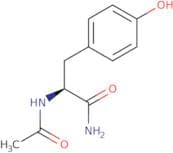
CAS 1948-71-6
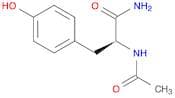
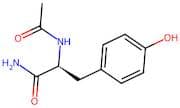
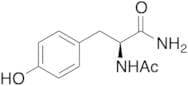
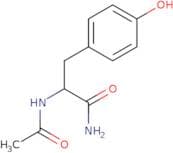
:N-Acetil-L-tirosinamide
- (2S)-2-Acetamido-3-(4-hydroxyphenyl)propanamide
- (S)alpha-(Acetylamino)-4-hydroxybenzenepropanamide
- (αS)-α-(Acetylamino)-4-hydroxybenzenepropanamide
- Ac-Tyr-Nh2
- Benzenepropanamide, alpha-(acetylamino)-4-hydroxy-, (S)-
- Benzenepropanamide, α-(acetylamino)-4-hydroxy-, (S)-
- Benzenepropanamide, α-(acetylamino)-4-hydroxy-, (αS)-
- Hydrocinnamamide, α-acetamido-p-hydroxy-, <span class="text-smallcaps">L</span>-
- N-Acetyl-4-hydroxy-<span class="text-smallcaps">L</span>-phenylalaninamide
- N-Acetyl-<span class="text-smallcaps">L</span>-tyrosinamide
- N-Acetyl-<span class="text-smallcaps">L</span>-tyrosine amide
- N-Acetyltyrosylamide
- N-acetyltyrosinamide
- Nalpha-acetyl-L-tyrosinamide
- Hydrocinnamamide, α-acetamido-p-hydroxy-, L-
- Vedi altri sinonimi
N-Acetyl-L-tyrosinamide
CAS:Formula:C11H14N2O3Purezza:98%Colore e forma:SolidPeso molecolare:222.2405(S)-2-Acetamido-3-(4-hydroxyphenyl)propanamide
CAS:(S)-2-Acetamido-3-(4-hydroxyphenyl)propanamidePurezza:98%Peso molecolare:222.24g/molN-Acetyl-L-tyrosine Amide
CAS:Prodotto controllatoApplications N-Acetyl-L-tyrosine Amide is an analogue of L-tyrosine which stimulate the transport of L-Tyr, mainly by the ASC system.
References Jara, J.R., et al.: Melanoma Res., 1(1), 15 (1991),Formula:C11H14N2O3Colore e forma:NeatPeso molecolare:222.24Ac-Tyr-NH2
CAS:Ac-Tyr-NH2 is a rotameric peptide that has been shown to inhibit the growth of bacteria. It is a neutral compound and does not have any detectable effect on human serum. Ac-Tyr-NH2 has been shown to react with tryptophan, which may be due to its acid hydrolysis. This peptide also has an active role in the production of reaction products and the formation of model proteins. Ac-Tyr-NH2 has been shown to have an optical property of fluorescence, which can be used for skin reactions or uv absorption.Formula:C11H14N2O3Purezza:Min. 95%Peso molecolare:222.24 g/molAc-Tyr-NH₂
CAS:N-Acetyl-L-tyrosinamide showed potential as an active ingredient in anti-wrinkle creams.Formula:C11H14N2O3Purezza:> 99%Colore e forma:White PowderPeso molecolare:222.24Acetyl-L-tyrosine amide
CAS:Acetyl-L-tyrosine amide is an analog of L-tyrosine that is used as an active substance in the field of uv absorption. Acetyl-L-tyrosine amide reacts with sodium hydroxide to form a soluble salt, which has been shown to have binding constants that are comparable to those of human serum. This compound also has fluorescence properties and can be used for the determination of neutral pH. The reaction products formed between acetyl-L-tyrosine amide and sodium hydroxide are hydrolyzed by acids and yield a molecule with rotameric properties. These rotameric properties can be modeled using a protein model without affecting the stability or function of the protein.
Formula:C11H14N2O3Purezza:Min. 95%Colore e forma:PowderPeso molecolare:222.24 g/molRef: 3D-FA47448
Prodotto fuori produzione