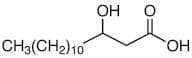
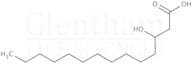
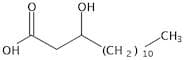
CAS 1961-72-4
:(±)-3-Idrossitetradecanoico
- (3RS)-3-Hydroxytetradecanoic acid
- (RS)-3-Hydroxytetradecanoic acid
- 3-Hydroxymyristic acid
- 3-Hydroxytetradecanoic acid
- Brn 1725372
- Tetradecanoic acid, 3-hydroxy-
- beta-Hydroxymyristic acid
- beta-Hydroxytetradecanoic acid
- β-Hydroxymyristic acid
- β-Hydroxytetradecanoic acid
- 3-03-00-00660 (Beilstein Handbook Reference)
3-Hydroxymyristic Acid
CAS:Formula:C14H28O3Purezza:>98.0%(GC)(T)Colore e forma:White to Almost white powder to crystalPeso molecolare:244.38R-(3)-HYDROXYMYRISTIC ACID
CAS:Formula:C14H28O3Purezza:98%Colore e forma:SolidPeso molecolare:244.3703DL-β-Hydroxymyristic acid
CAS:Formula:C14H28O3Purezza:≥ 98.0%Colore e forma:White powderPeso molecolare:244.373-Hydroxytetradecanoic acid
CAS:Formula:C14H28O3Purezza:>98%Colore e forma:SolidPeso molecolare:244.373-Hydroxytetradecanoic acid
CAS:3-Hydroxytetradecanoic acid is a natural saturated fatty acid and a component of bacterial LPS, composition of lipids and the synthesis of surfactantsFormula:C14H28O3Colore e forma:SolidPeso molecolare:244.373-Hydroxytetradecanoic Acid
CAS:Prodotto controllatoApplications 3-Hydroxytetradecanoic Acid is used in the preparation of liposomes coated with N-acylated molecular-weight. Also used in the synthesis of pseudomycin side-chain analogs. Also used in the study of Lipid A, a major constituent of the lipopolysaccharides, which are responsible for the toxicity of gram negative bacteria.
References Naberezhnykh, G. et al.: Chem. Nat. Comp., 46, 852 (2011); Chen, S. et al.: Bioorg. Med. Chem. Lett., 10, 2107 (2000); Carillo, S. et al.: Marine Drugs., 11, 184 (2013);Formula:C14H28O3Colore e forma:NeatPeso molecolare:244.373-Hydroxymyristic Acid
CAS:3-Hydroxymyristic acid is a fatty acid that has been shown to inhibit the activity of esterases and lipases, which are enzymes involved in the hydrolysis of esters and triglycerides. It has also been shown to have antioxidant properties, as well as being a structural component of mitochondrial membranes. 3-Hydroxymyristic acid has been shown to reverse the inhibition of mitochondrial membrane potential by bacterial strains such as Listeria monocytogenes and Escherichia coli. This compound can be synthesized by a chemoselective reaction between myristic acid and 3-hydroxypentanoic acid, which is catalyzed by an asymmetric synthesis. The synthesis can be carried out in a high yield with good optical purity using wild-type strains of bacteria or experimental models such as rat liver cells or human erythrocytes.
Formula:C14H28O3Purezza:Min. 95%Colore e forma:PowderPeso molecolare:244.38 g/mol