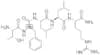
CAS 197794-83-5
:TFLLR-NH2
- H-Thr-Phe-Leu-Leu-Arg-Nh2
- Thr-Phe-Leu-Leu-Arg-Nh2
- Thrombin Receptor (Par-1), Hybride Human-Xenope
- Tfllr-Amide
- (Thr1)-TRAP-5 amide
(Thr¹)-PAR-1 (1-5) amide (human)
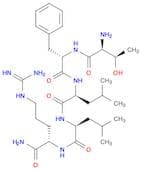
CAS:TFLLR-amide, a selective agonist of PAR-1.Formula:C31H53N9O6Purezza:98.4%Colore e forma:White LyophilisatePeso molecolare:647.82H-Thr-Phe-Leu-Leu-Arg-NH2
CAS:H-Thr-Phe-Leu-Leu-Arg-NH2 is a peptide that has been shown to reduce the severity of lung inflammation and injury in rats with pulmonary hypertension. It also prevents the release of proinflammatory cytokines such as tumor necrosis factor alpha (TNFα) and interleukin 6 (IL6). This peptide also induces an antibody response against collagen gel, which is used to treat fibrotic diseases and wounds. The peptide binds to the soybean trypsin inhibitor, preventing it from inhibiting protease enzymes, thereby allowing for protein synthesis. H-Thr-Phe-Leu-Leu-Arg-NH2 has been shown to have antiapoptotic effects by restoring mitochondrial membrane potential in cancer cells. This peptide can be used as a therapeutic agent for various diseases including primary pulmonary hypertension, cancer tissues, and mitochondrial disorders.Formula:C31H53N9O6Purezza:Min. 95%Colore e forma:White PowderPeso molecolare:647.81 g/molH-Thr-Phe-Leu-Leu-Arg-NH2
CAS:The endothelium is a layer of cells that lines the inner surface of blood vessels and lymphatic vessels, forming a barrier between circulating blood or lymph and the rest of the body. It is involved in maintaining vascular homeostasis as well as in inflammation. The endothelium regulates vascular tone and blood pressure through release of nitric oxide (NO) and other substances, such as prostacyclin, vasoactive peptides, endothelin-1, tumor necrosis factor-α, interleukin-1β, and thromboxane A2. Endothelial cells are activated by various means such as increased intracellular Ca2+ concentration or basic fibroblast growth factor (bFGF). This activation can be inhibited by receptor antagonists such as neurokinin-1 receptor antagonists.Formula:C31H53N9O6Purezza:Min. 95%Peso molecolare:647.81 g/molPAR-1 agonist/ TRAP6
CAS:Protease activated receptors (PARs) are a distinctive four-member family of seven transmembrane G protein-coupled receptors (GPCRs) widely expressed in inflammatory cells. PARs are cleaved by certain serine proteases to expose a tethered ligand domain, this ligand domain then binds to and activates the receptors to initiate multiple signalling cascades. These PAR-activating proteases therefore represent PAR agonists. This PAR-1 agonist peptide represents the sequence of the 'tethered ligand' and is therefore capable of activating the receptor independently of N-terminal proteolysis. TFLLR-NH2 is more selective to PAR-1 than the PAR-1 agonist SFLLRN-NH2.Activation of PAR-1 induces platelet aggregation and IL-6 release from monocytes and T cells, as well as several other cellular pathways including those involved in allergic inflammation, neurogenic inflammation and the potentiation of NMDA receptor activity in the hippocampus.
Formula:C31H53N9O6Purezza:Min. 95%Peso molecolare:647.8 g/mol