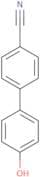
CAS 19812-93-2
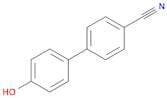
:4'-Idrossi-4-bifenilcarbonitrile
- (Hydroxyphenyl-4)-4 Benzonitrile
- 4'-Hydroxy-[1,1'-Biphenyl]-4-Carbonitrile
- 4'-Hydroxybiphenyl-4-Carbonitrile
- 4-(4-Cyanophenyl)phenol
- 4-(4-Hydroxyphenyl)benzonitrile
- 4-Biphenylcarbonitrile, 4′-hydroxy-
- 4-Cyano-4'-hydroxybiphenyl
- 4-Hydro-4′-cyanobiphenyl
- 4-Hydroxy-4′-cyanobiphenyl
- 4′-Cyano-4-biphenol
- 4′-Cyanobiphenyl-4-ol
- 4′-Hydroxy-4-biphenylylcarbonitrile
- 4′-Hydroxy-4-cyano-1,1′-biphenyl
- 4′-Hydroxybiphenyl-4-nitrile
- [1,1′-Biphenyl]-4-carbonitrile, 4′-hydroxy-
- 4′-Hydroxy-4-biphenylcarbonitrile
- 4'-CYANO-4-BIPHENYLOL
- 4-CYANO-4'-HYDROXY-1,1'-BIPHENYL
- TIMTEC-BB SBB008418
- CYANOHYDROXYBIPHENYL
- AKOS BAR-0830
- 4-Hydroxy-Biphenylcarbonitrile
- cyanophenyl phenol
- 4-Cyano-4'-hydroxydiphenyl
- 4-(4-cyanophenyl)phenyl
- 4'-HYDROXYBIPHENYL-4-CARBONITRIL
- 4'-HYDROXY-4-BIPHENYLCARBONITRILE 97%
- Vedi altri sinonimi
4-Cyano-4'-hydroxybiphenyl
CAS:Formula:C13H9NOPurezza:>98.0%(GC)(T)Colore e forma:White to Light yellow powder to crystalPeso molecolare:195.224'-Hydroxybiphenyl-4-carbonitrile, 99%
CAS:This Thermo Scientific Chemicals brand product was originally part of the Alfa Aesar product portfolio. Some documentation and label information may refer to the legacy brand. The original Alfa Aesar product / item code or SKU reference has not changed as a part of the brand transition to Thermo SciFormula:C13H9NOPurezza:99%Colore e forma:White to cream or pale yellow to pale brown, Crystals or powder or crystalline powderPeso molecolare:195.224′-Hydroxy-4-biphenylcarbonitrile
CAS:Formula:C13H9NOPurezza:≥ 98.0%Colore e forma:White to yellow or tan powderPeso molecolare:195.224'-Hydroxy-[1,1'-biphenyl]-4-carbonitrile
CAS:4'-Hydroxy-[1,1'-biphenyl]-4-carbonitrileFormula:C13H9NOPurezza:95%Colore e forma: white powderPeso molecolare:195.22g/mol4-Cyano-4'-hydroxybiphenyl
CAS:4-Cyano-4'-hydroxybiphenyl is a phenolic compound that belongs to the family of compounds known as polycyclic aromatic hydrocarbons. It has been shown to bind to a variety of receptors and is used in sample pretreatment for assays. 4-Cyano-4'-hydroxybiphenyl also has a number of uses in polymerization reactions, including cationic polymerization, which involves the reaction of an electron donor with an electrophile. The electron donor is typically a Lewis acid, such as trifluoroacetic acid or formyl chloride. 4-Cyano-4'-hydroxybiphenyl can be used as an amide coupling agent, which involves the reaction of an amine with another organic compound to form an amide bond. It also reacts with chlorine gas in iodination reactions to produce hypochlorous acid.
Formula:C13H9NOPurezza:Min. 96.5 Area-%Colore e forma:PowderPeso molecolare:195.22 g/mol
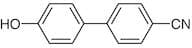




![4'-Hydroxy-[1,1'-biphenyl]-4-carbonitrile](/_next/image/?url=https%3A%2Fstatic.cymitquimica.com%2Fproducts%2F54%2Fthumb%2FOR13997.jpg&w=3840&q=75)