CAS 1988-11-0
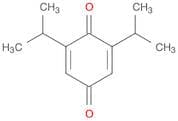
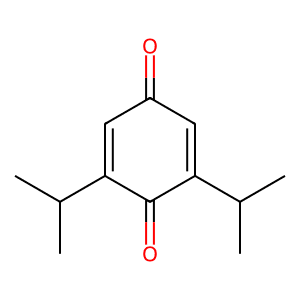
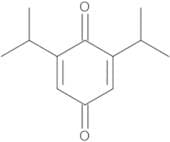
:2,6-Diisopropil-1,4-benzochinone
Descrizione:
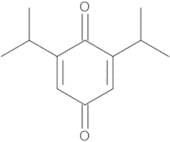
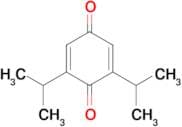
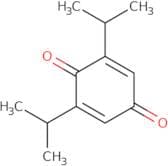
2,6-Diisopropil-1,4-benzochinone è un composto organico caratterizzato dalla sua struttura di chinone, che presenta un anello aromatico a sei membri con due gruppi isopropilici attaccati nelle posizioni 2 e 6. Questo composto è noto per il suo colore giallo brillante ed è tipicamente utilizzato nella sintesi organica e come reagente in varie reazioni chimiche. Mostra forti proprietà ossidanti grazie alla presenza del gruppo funzionale chinone, che gli consente di partecipare a reazioni redox. Il composto è relativamente stabile in condizioni standard, ma può subire ulteriori reazioni, come polimerizzazione o riduzione, a seconda dell'ambiente e dei reagenti presenti. La sua solubilità è generalmente maggiore nei solventi organici rispetto all'acqua, rendendolo adatto per applicazioni in chimica organica. Inoltre, 2,6-Diisopropil-1,4-benzochinone può avere implicazioni nei sistemi biologici, dove può agire come accettore di elettroni. Devono essere adottate precauzioni di sicurezza quando si maneggia questo composto, poiché può comportare rischi per la salute se inalato o ingerito.
Formula:C12H16O2
InChI:InChI=1S/C12H16O2/c1-7(2)10-5-9(13)6-11(8(3)4)12(10)14/h5-8H,1-4H3
InChI key:InChIKey=DDXYWFGBQZICBD-UHFFFAOYSA-N
SMILES:C(C)(C)C=1C(=O)C(C(C)C)=CC(=O)C1
Sinonimi:- 2,3-Diisopropyl-p-benzoquinone
- 2,5-Cyclohexadiene-1,4-dione, 2,6-bis(1-methylethyl)-
- 2,6-Bis(1-methylethyl)-2,5-cyclohexadiene-1,4-dione
- 2,6-Bis(propan-2-yl)cyclohexa-2,5-diene-1,4-dione
- 2,6-Di(propan-2-yl)cyclohexa-2,5-diene-1,4-dione
- 2,6-Diisopropyl-1,4-benzoquinone
- 2,6-Diisopropyl-p-benzoquinone
- 2,6-Diisopropylcyclohexa-2,5-diene-1,4-dione
- p-Benzoquinone, 2,6-diisopropyl-
Ordinare per
Purezza (%)
0
100
|
0
|
50
|
90
|
95
|
100
11 prodotti.
Propofol impurity J
CAS:Propofol impurity JFormula:C12H16O2Colore e forma:YellowPeso molecolare:192.2542Propofol Related Compound B (2,6-Diisopropyl-1,4-benzoquinone)
CAS:Other quinonesFormula:C12H16O2Colore e forma:Yellow LiquidPeso molecolare:192.115032,5-Cyclohexadiene-1,4-dione, 2,6-bis(1-methylethyl)-
CAS:Formula:C12H16O2Purezza:95%Colore e forma:LiquidPeso molecolare:192.25422,6-Diisopropylcyclohexa-2,5-diene-1,4-dione
CAS:2,6-Diisopropylcyclohexa-2,5-diene-1,4-dionePurezza:95%Peso molecolare:192.26g/molRef: 4Z-P-296
5mgPrezzo su richiesta10mgPrezzo su richiesta25mgPrezzo su richiesta50mgPrezzo su richiesta100mgPrezzo su richiestaRef: 4Z-P-296013
5mgPrezzo su richiesta10mgPrezzo su richiesta25mgPrezzo su richiesta50mgPrezzo su richiesta100mgPrezzo su richiestaRef: ST-EA-CP-P4010
10mgPrezzo su richiesta25mgPrezzo su richiesta50mgPrezzo su richiesta100mgPrezzo su richiesta2,6-Diisopropyl-1,4-benzoquinone
CAS:Impurity Propofol EP Impurity J
Applications 2,6-Diisopropyl-1,4-benzoquinone (Propofol EP Impurity J) is a Propofol (P829750) impurity.
Not a dangerous good if item is equal to or less than 1g/ml and there is less than 100g/ml in the package
References McMahon, R., et al.: J. Med. Chem., 22, 1100 (1979), Mamada, K., et al.: Drug Metab. Dispos., 14, 509 (1986),Formula:C12H16O2Colore e forma:NeatPeso molecolare:192.252,6-Diisopropyl-1,4-benzoquinone
CAS:2,6-Diisopropyl-1,4-benzoquinone is a diphenol that reacts with a variety of organic compounds in the presence of heat. It has been used as a mesoporous material to adsorb hydrogen gas and carbon dioxide in the water treatment process. 2,6-Diisopropyl-1,4-benzoquinone is also able to react with oxygen to form an n-oxide. This compound is most often used for the manufacture of phenolic antioxidants such as dibenzoyl peroxide and pentafluorobenzoic acid. The active site on this molecule is thought to be at the double bond between carbons 6 and 7. Impurities may include anisidine and other aromatic amines that can cause reactions with hydrogen peroxide when exposed to light or certain wavelengths of radiation.Formula:C12H16O2Purezza:Min. 95%Peso molecolare:192.25 g/mol