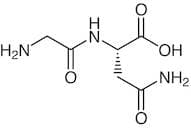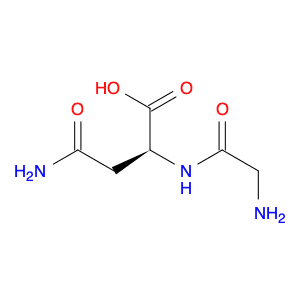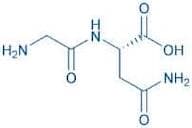
CAS 1999-33-3
:Glicil-L-asparagina
- (2S)-4-Amino-2-[(2-azaniumylacetyl)amino]-4-oxobutanoate
- 127: PN: US20130123467 SEQID: 152 claimed protein
- 222: PN: EP2161028 PAGE: 11 claimed protein
- 22: PN: WO2019144309 SEQID: 25 claimed protein
- 8: PN: WO2013001819 SEQID: 16 claimed protein
- <span class="text-smallcaps">L</span>-Asparagine, N<sup>2</sup>-glycyl-
- <span class="text-smallcaps">L</span>-Asparagine, glycyl-
- Asparagine, N<sup>2</sup>-glycyl-, <span class="text-smallcaps">L</span>-
- Glycyl-<span class="text-smallcaps">L</span>-asparagine
- Glycyl-L-asparagine
- Glycylasparagine
- H-Gly-Asn-OH
- N<sup>2</sup>-Glycylasparagine
- NSC 203810
- Asparagine, N2-glycyl-, L-
- L-Asparagine, N2-glycyl-
- Vedi altri sinonimi
Nα-Glycyl-L-asparagine
CAS:Formula:C6H11N3O4Purezza:>98.0%(T)Colore e forma:White to Almost white powder to crystalPeso molecolare:189.17Gly-Asn-OH
CAS:Gly-Asn-OH is an amide with a constant and ternary complex. It is acidic, containing an amino acid with a hydroxy group. This compound has a metal ion and zwitterion that binds to the hydroxy group. Gly-Asn-OH inhibits the growth of bacteria in infectious diseases by binding to the cell wall, which prevents the bacteria from synthesizing DNA. Gly-Asn-OH can be prepared by solid phase synthesis using L-tartaric acid as a starting material. The thermodynamic data for this compound has been reported in literature, which shows that it is stable at higher temperatures but unstable at lower temperatures. Gly-Asn-OH is soluble in water or organic solvents such as chloroform or methanol.br>br> Glycine (Gly) + Asparagine (Asn) + Hydroxyl (-OH)
Formula:C6H11N3O4Purezza:Min. 95%Colore e forma:PowderPeso molecolare:189.17 g/molH-Gly-Asn-OH
CAS:Bachem ID: 4001207.
Formula:C6H11N3O4Purezza:> 99%Colore e forma:White Crystalline PowderPeso molecolare:189.17