CAS 202933-49-1
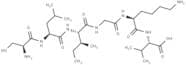
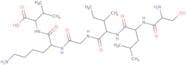
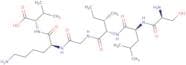
:H-Ser-Leu-Ile-Gly-Lys-Val-Oh
Descrizione:
La sostanza chimica nota come H-Ser-Leu-Ile-Gly-Lys-Val-Oh, con il numero CAS 202933-49-1, è un peptide composto da una sequenza di amminoacidi. Questo peptide presenta una combinazione di residui idrofili e idrofobici, che contribuisce alla sua potenziale attività biologica e interazioni. La presenza di serina (Ser), leucina (Leu), isoleucina (Ile), glicina (Gly), lisina (Lys) e valina (Val) indica una vasta gamma di proprietà, inclusa la capacità di partecipare a legami idrogeno e interazioni idrofobiche. Il gruppo idrossile terminale (OH) suggerisce che potrebbe avere una solubilità migliorata in ambienti acquosi. Peptidi come questo possono svolgere ruoli significativi in vari processi biologici, comprese le vie di segnalazione e le funzioni enzimatiche. Inoltre, la sequenza specifica di amminoacidi può influenzare la conformazione, stabilità e reattività del peptide, rendendolo di interesse in campi come biochimica, farmacologia e biotecnologia. Ulteriori studi sarebbero necessari per chiarire le sue funzioni e applicazioni specifiche.
Ordinare per
Purezza (%)
0
100
|
0
|
50
|
90
|
95
|
100
4 prodotti.
PAR-2 (1-6) (human)
CAS:PAR-2 (1-6) (human) (SLIGKV), a peptide ligand, is a PAR-2 agonist [1] .Formula:C28H53N7O8Colore e forma:SolidPeso molecolare:615.76H-Ser-Leu-Ile-Gly-Lys-Val-OH
CAS:H-Ser-Leu-Ile-Gly-Lys-Val-OH is a potent inhibitor of the enzyme soybean trypsin. It is a member of the class of chemical inhibitors that are active against enzymes that regulate cell signaling and inflammatory responses. H-Ser-Leu-Ile-Gly-Lys-Val-OH inhibits toll receptor signaling, which triggers an inflammatory response in cells. This compound has been shown to be effective in animal models for bowel disease and asthma. H Ser Leu Ile Gly Lys Val OH also has low potency, which may be due to its ability to form covalent bonds with other molecules, such as DNA polymerase.Formula:C28H53N7O8Purezza:Min. 95%Peso molecolare:615.76 g/molPAR-2 (1-6) (human) trifluoroacetate salt
CAS:PAR-2 is a cytosolic protein that is activated by calcium. PAR-2 activation induces the synthesis of prostaglandins and other inflammatory mediators, which stimulate the release of substances from cells such as cytokines and chemokines. PAR-2 also has an important role in cell proliferation, differentiation, apoptosis, and cancer development. PAR-2 activation is induced by proteases such as trypsin or soybean trypsin inhibitor. The trifluoroacetate salt form of PAR-2 (1-6) has been used to inhibit protease activity in colon cancer cells and prostate cancer cells. PAR-2 (1-6) (human) trifluoroacetate salt H-Ser-Leu-Ile-Gly-Lys-Val-OH trifluoroacetate salt is a potent chemical inhibitor of trypsin activity with IC50 values of 0.5 µM for soybean trypsin inhibitorFormula:C28H53N7O8Purezza:Min. 95%Peso molecolare:615.76 g/molPAR-2 (1-6) (human)
CAS:The PAR-2 agonist SLIGKV can be used for the investigation of receptor functions.
Formula:C28H53N7O8Purezza:98.6%Colore e forma:White LyophilisatePeso molecolare:615.77