CymitQuimica logo

CAS 20525-62-6

:

dibutil(dietil)stannano

Descrizione:
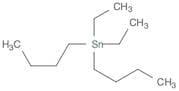
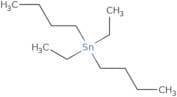
dibutil(dietil)stannano, con il numero CAS 20525-62-6, è un composto organostannico caratterizzato dalla sua struttura, che include due gruppi butile e due gruppi etile legati a un atomo di stagno. Questo composto appare generalmente come un liquido incolore o giallo pallido ed è noto per la sua volatilità relativamente bassa e alta stabilità in condizioni standard. È utilizzato principalmente nella sintesi organica e come reagente in varie reazioni chimiche, in particolare nel campo della chimica organometallica. dibutil(dietil)stannano presenta proprietà tipiche dei composti organostannici, come la potenziale tossicità e le preoccupazioni ambientali, in particolare riguardo alla sua bioaccumulazione e agli effetti sulla vita acquatica. Le precauzioni di sicurezza sono essenziali quando si maneggia questa sostanza, poiché può comportare rischi per la salute attraverso l'inalazione o il contatto con la pelle. Inoltre, è importante notare che i composti organostannici sono soggetti a scrutinio normativo a causa del loro impatto ambientale, portando a restrizioni in alcune applicazioni. In generale, dibutil(dietil)stannano funge da strumento prezioso nella chimica sintetica, richiedendo un'attenta manipolazione e considerazione della sua impronta ecologica.
Formula:C12H28Sn
InChI:InChI=1/2C4H9.2C2H5.Sn/c2*1-3-4-2;2*1-2;/h2*1,3-4H2,2H3;2*1H2,2H3;/rC12H28Sn/c1-5-9-11-13(7-3,8-4)12-10-6-2/h5-12H2,1-4H3
SMILES:CCCC[Sn](CC)(CC)CCCC
Sinonimi:
  • Dibutyldiethylstannane
  • Stannane, dibutyldiethyl-
  • Dibutyl(diethyl)stannane
Ordinare per

Purezza (%)
0
100
|
0
|
50
|
90
|
95
|
100
4 prodotti.
  • Stannane, dibutyldiethyl-

    CAS:
    Formula:C12H28Sn
    Colore e forma:Liquid
    Peso molecolare:291.0517

    Ref: IN-DA0029Z7

    ne
    Prezzo su richiesta
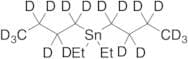
  • Dibutyldiethyltin-d18

    Prodotto controllato
    CAS:
    <p>Applications Dibutyldiethyltin belongs to a class of organotin compounds that are commonly used as pesticides and fungicides and as plastics additives.<br> Not a dangerous good if item is equal to or less than 1g/ml and there is less than 100g/ml in the package<br>References Krupp, E.M. et al.: Environ. Sci. Technol., 45, 943 (2011);<br></p>
    Formula:C12H10D18Sn
    Colore e forma:Colourless
    Peso molecolare:309.17

    Ref: TR-D429457

    5mg
    256,00€
    50mg
    1.690,00€
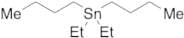
  • Dibutyldiethyltin

    Prodotto controllato
    CAS:
    <p>Applications Dibutyldiethyltin belongs to a class of organotin compounds that are commonly used as pesticides and fungicides and as plastics additives.<br>References Krupp, E.M. et al.: Environ. Sci. Technol., 45, 943 (2011)<br></p>
    Formula:C12H28Sn
    Colore e forma:Neat
    Peso molecolare:291.06

    Ref: TR-D429455

    1g
    2.060,00€
    100mg
    318,00€
  • Dibutyldiethyltin

    CAS:
    <p>Dibutyldiethyltin is a divalent hydrocarbon that has been used as an agrochemical to control weeds. It is a monomer that can be polymerized to form polydibutyldiethyltin (PDDBT). Dibutyldiethyltin has optical properties, such as a high refractive index and low viscosity, which make it useful for specialty optical applications. The chemical structure of PDDBT consists of a chlorine atom and two fluorine atoms attached to two ethyl groups. PDDBT also contains two methyl groups with ether linkages. This compound is insoluble in water, but soluble in organic solvents and deionized water. Hydrogenation of PDDBT yields a ring-opening product known as dibutyltindiacetate.</p>
    Formula:C12H28Sn
    Purezza:Min. 95%
    Peso molecolare:291.1 g/mol

    Ref: 3D-VAA52562

    10mg
    Prezzo su richiesta
    25mg
    Prezzo su richiesta
    50mg
    Prezzo su richiesta
    100mg
    Prezzo su richiesta
    250mg
    Prezzo su richiesta