CAS 210289-72-8
:Ordinare per
Purezza (%)
0
100
|
0
|
50
|
90
|
95
|
100
5 prodotti.
Ref: 4Z-A-2317
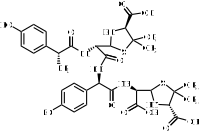
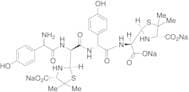
5mgPrezzo su richiesta10mgPrezzo su richiesta25mgPrezzo su richiesta50mgPrezzo su richiesta100mgPrezzo su richiestaAmoxicillin Dimer tri-Sodium Salt (penicilloic acid form)(Mixture of Diastereomers)
CAS:Prodotto controllatoStability Hygroscopic
Applications Amoxicillin dimer tri-Sodium Salt (penicilloic acid form) is an impurity of Amoxicillin (A634235), a β-lactam family antibiotic that is commonly used in conjunction with clavulanic acid (C56370) to the treat bacterial infections.
References Gurwith, M., et al.: Antimicrob. Agents Ch., 24, 716 (1983); Kumar, A., et al.: J. Mater. Chem., 20, 10152 (2010);Formula:C32H37N6Na3O11S2Colore e forma:NeatPeso molecolare:814.77Amoxicillin EP Impurity K
CAS:Amoxicillin EP Impurity K is a synthetic impurity found in amoxicillin. Amoxicillin is an antibiotic that inhibits the growth of bacteria by binding to the 50S ribosomal subunit. Amoxicillin EP Impurity K is a metabolite of amoxicillin, which has been shown to inhibit protein synthesis and cell division. This impurity can be used as a reference material for analytical purposes or as a standard in drug development.Formula:C32H40N6O11S2Purezza:Min. 95%Peso molecolare:748.82 g/molAmoxicillin EP impurity K
CAS:Amoxicillin EP impurity K is a research and development impurity standard. It is a synthetic ampicillin-derived beta-lactam antibiotic that is a metabolite of amoxicillin. Amoxicillin EP impurity K has been shown to be an inhibitor of bacterial protein synthesis, which may be due to its ability to inhibit the activity of ribosomes and 50S subunits. This product can be custom synthesized and is available at high purity. Amoxicillin EP impurity K is used in the manufacture of pharmaceutical products, such as tablets and capsules, for drug development.Purezza:Min. 95%Amoxicillin trihydrate impurity K
CAS:Amoxicillin trihydrate impurity K is an analytical impurity that is found as a sodium salt in amoxicillin sodium. The impurity can be identified by a titration method, which involves the use of phenolphthalein. This product has been shown to have antimicrobial activity against both Gram-positive and Gram-negative bacteria. Impurity K is produced during the synthetic process, which consists of the following steps: 1) Amoxicillin sodium is dissolved in water and then treated with glycopeptide (glycine), 2) The mixture is heated in order to hydrolyze glycopeptide into glycocoll and N-acetylglycocoll, 3) The mixture is then cooled to produce two layers - an upper layer consisting of water and glycocoll, and a lower layer consisting of N-acetylglycocoll, 4) The upper layer is drained off and purified using liquid chromatography.Formula:C32H40N6O11S2Purezza:Min. 95%Peso molecolare:748.83 g/mol