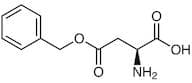
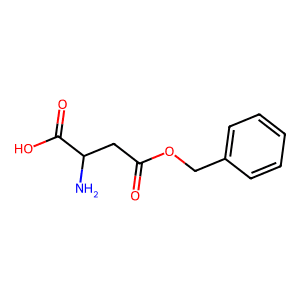
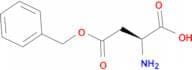
CAS 2177-63-1
:4-(Fenilmetil) idrogeno L-aspartato
Descrizione:
4-(Fenilmetil) idrogeno L-aspartato, noto anche con il suo numero CAS 2177-63-1, è un derivato di aminoacido che presenta un gruppo fenilmetile attaccato alla struttura dell'aspartato. Questo composto è caratterizzato dalla sua complessità strutturale, che include un gruppo funzionale acido carbossilico e un gruppo amminico, tipici degli aminoacidi. La presenza del gruppo fenilmetile contribuisce alle sue caratteristiche idrofobiche, influenzando la sua solubilità e interazione con i sistemi biologici. Questo composto è di interesse nella ricerca biochimica, in particolare negli studi relativi alla neurotrasmissione e alle vie metaboliche, poiché l'aspartato svolge un ruolo cruciale come neurotrasmettitore nel sistema nervoso centrale. Inoltre, i suoi derivati possono mostrare potenziali proprietà farmacologiche, rendendolo oggetto di indagine in chimica medicinale. La stabilità e la reattività di 4-(Fenilmetil) idrogeno L-aspartato possono essere influenzate dal pH e dalla temperatura, che sono fattori importanti da considerare nelle applicazioni sperimentali. In generale, questo composto esemplifica l'intricata relazione tra struttura e funzione nei contesti biochimici.
Formula:C11H13NO4
InChI:InChI=1S/C11H13NO4/c12-9(11(14)15)6-10(13)16-7-8-4-2-1-3-5-8/h1-5,9H,6-7,12H2,(H,14,15)/t9-/m0/s1
InChI key:InChIKey=VGALFAWDSNRXJK-VIFPVBQESA-N
SMILES:C(OC(C[C@@H](C(O)=O)N)=O)C1=CC=CC=C1
Sinonimi:- (2S)-2-Amino-4-(benzyloxy)-4-oxobutanoic acid
- (2S)-2-Amino-4-oxo-4-phenylmethoxybutanoic acid
- (2S)-2-amino-3-benzyloxy-3-oxo-propanoic acid
- (2S)-2-amino-4-(benzyloxy)-4-oxobutanoic acid (non-preferred name)
- (3S)-3-ammonio-4-(benzyloxy)-4-oxobutanoate
- 2-Amino-4-(Benzyloxy)-4-Oxobutanoic Acid (Non-Preferred Name)
- 3-Amino-4-(Benzyloxy)-4-Oxobutanoic Acid (Non-Preferred Name)
- 4-(Phenylmethyl) hydrogen <span class="text-smallcaps">L</span>-aspartate
- 4-Benzyl <span class="text-smallcaps">L</span>-aspartate
- <span class="text-smallcaps">L</span>-Aspartic acid 4-O-benzyl ester
- <span class="text-smallcaps">L</span>-Aspartic acid 4-benzyl ester
- <span class="text-smallcaps">L</span>-Aspartic acid β-benzyl ester
- <span class="text-smallcaps">L</span>-Aspartic acid, 4-(phenylmethyl) ester
- Aspartic acid β-benzyl ester
- Aspartic acid, 4-benzyl ester, <span class="text-smallcaps">L</span>-
- Benzyl aspartate
- H-Asp(OBzl)-OH
- H-Asp-OBzl
- L-Aspartic acid b-benzyl ester
- L-Aspartic acid benzyl ester
- NSC 524167
- β-Benzyl <span class="text-smallcaps">L</span>-aspartate
- β-Benzyl aspartate
- Aspartic acid, 4-benzyl ester, L-
- 4-(Phenylmethyl) hydrogen L-aspartate
- L-Aspartic acid, 4-(phenylmethyl) ester
- Vedi altri sinonimi
Ordinare per
Purezza (%)
0
100
|
0
|
50
|
90
|
95
|
100
10 prodotti.
4-Benzyl L-Aspartate
CAS:Formula:C11H13NO4Purezza:>98.0%(T)Colore e forma:White to Almost white powder to crystalPeso molecolare:223.23L-Aspartic acid 4-benzyl ester, 98%
CAS:L-Aspartic acid -benzyl ester is used in the synthesis of peptides with a 1,4-diazepine-2,5-dione ring structure and in development of block copolymers. This Thermo Scientific Chemicals brand product was originally part of the Alfa Aesar product portfolio. Some documentation and label information maFormula:C11H13NO4Purezza:98%Colore e forma:Powder, WhitePeso molecolare:223.23H-Asp(OBzl)-OH
CAS:Bachem ID: 4000257.
Formula:C11H13NO4Purezza:98.6%Colore e forma:WhitePeso molecolare:223.23L-Aspartic acid 4-O-benzyl ester
CAS:Formula:C11H13NO4Purezza:98%Colore e forma:SolidPeso molecolare:223.2252L-Aspartic Acid 4-Benzyl Ester
CAS:L-Aspartic Acid 4-Benzyl EsterPurezza:98%Peso molecolare:223.23g/molL-Aspartic Acid 4-Benzyl Ester
CAS:L-Aspartic Acid 4-Benzyl EsterPurezza:≥98%Peso molecolare:223.23g/molL-Aspartic Acid 4-Benzyl Ester
CAS:L-Aspartic Acid 4-Benzyl Ester chelates metals, studies enzyme activity, and gene regulation.Formula:C11H13NO4Purezza:98.69%Colore e forma:White PowderPeso molecolare:223.23L-Aspartic acid b-benzyl ester
CAS:L-Aspartic acid b-benzyl ester (L-ABE) is a cytostatic drug that is biodegradable and can be used in a variety of animal species. It has been shown to inhibit the growth of cancer cells in vitro and in vivo, as well as micelles. L-ABE inhibits the action of dehydroascorbic acid reductase, an enzyme that reduces dehydroascorbic acid to ascorbic acid. This inhibition leads to an increase in the concentration of dehydroascorbic acid, which may cause cell death by damaging DNA. L-ABE also has been shown to inhibit P-glycoprotein (Pgp), leading to increased accumulation of anticancer drugs such as doxorubicin, which can lead to cell death.Formula:C11H13NO4Purezza:Min. 95%Colore e forma:White PowderPeso molecolare:223.23 g/molH-Asp(OBzl)-OH
CAS:M03009 - H-Asp(OBzl)-OH
Formula:C11H13NO4Purezza:98%Colore e forma:White powderPeso molecolare:223.228