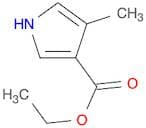
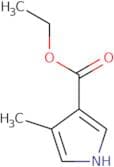
CAS 2199-49-7
:Etil 4-metilpirrolo-3-carbossilato
Descrizione:
Etil 4-metilpirrolo-3-carbossilato è un composto organico caratterizzato dalla sua struttura ad anello di pirrolo, che è un eterociclo aromatico a cinque membri contenente azoto. Questo composto presenta un gruppo funzionale di estere etilico, che contribuisce alle sue proprietà di reattività e solubilità. La presenza del gruppo metile nella posizione 4 dell'anello di pirrolo influenza le sue proprietà elettroniche e l'ostruzione sterica, che possono influenzare la sua reattività in varie reazioni chimiche. Etil 4-metilpirrolo-3-carbossilato è tipicamente un liquido o solido incolore o giallo pallido, a seconda della sua purezza e forma. È solubile in solventi organici, rendendolo utile nella sintesi organica e come intermediario nella produzione di prodotti farmaceutici e agrochimici. Il composto può mostrare attività biologica, che è di interesse nella chimica medicinale. I dati di sicurezza devono essere consultati per la manipolazione, come con qualsiasi sostanza chimica, per garantire che vengano adottate le precauzioni appropriate durante l'uso.
Formula:C8H11NO2
InChI:InChI=1/C8H11NO2/c1-3-11-8(10)7-5-9-4-6(7)2/h4-5,9H,3H2,1-2H3
SMILES:CCOC(=O)c1c[nH]cc1C
Sinonimi:- ethyl 4-methyl-1H-pyrrole-3-carboxylate
Ordinare per
Purezza (%)
0
100
|
0
|
50
|
90
|
95
|
100
5 prodotti.
Ethyl 4-methyl-1H-pyrrole-3-carboxylate
CAS:Formula:C8H11NO2Purezza:97%Colore e forma:SolidPeso molecolare:153.1784Ethyl 4-methyl-1H-pyrrole-3-carboxylate
CAS:Ethyl 4-methyl-1H-pyrrole-3-carboxylatePurezza:95%Peso molecolare:153.181g/molEthyl 4-methyl-1H-pyrrole-3-carboxylate
CAS:Formula:C8H11NO2Purezza:95%Colore e forma:SolidPeso molecolare:153.181Ethyl 4-methylpyrrole 3-carboxylate
CAS:Ethyl 4-methylpyrrole 3-carboxylate is a monomer that belongs to the group of functional groups. It is used in the polymerization process and has been shown to be able to imprint or introduce other functional groups into polymers. The following are some of its properties: it can be used as an operational group, it has chemical interactions with other functional groups, and it can be used for selectivity techniques. It also has isomeric properties, which depend on the type of functional group attached. Some examples of these properties are electrochemical polymerization and electropolymerization. The molecule also interacts with different polarities depending on the type of functional group attached.Formula:C8H11NO2Purezza:Min. 95%Colore e forma:Yellow PowderPeso molecolare:153.18 g/molRef: ST-EA-CP-C24019
10mgPrezzo su richiesta25mgPrezzo su richiesta50mgPrezzo su richiesta100mgPrezzo su richiesta