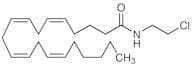
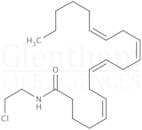
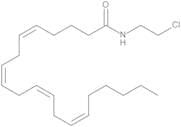
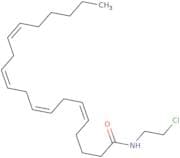
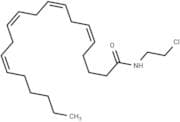
CAS 220556-69-4
:ACEA
Descrizione:
ACEA, con il numero CAS 220556-69-4, è un composto chimico che appartiene alla classe delle piccole molecole spesso studiate per le loro potenziali attività biologiche. Sebbene caratteristiche specifiche come la sua formula molecolare, struttura e proprietà fisiche possano variare, composti come ACEA sono tipicamente caratterizzati dalle loro interazioni con bersagli biologici, che possono includere recettori o enzimi. Si sa che ACEA mostra effetti farmacologici specifici, rendendolo di interesse nella chimica medicinale e nello sviluppo di farmaci. La sua solubilità, stabilità e reattività possono essere influenzate da vari fattori, tra cui pH e temperatura. Inoltre, ACEA può subire trasformazioni metaboliche nei sistemi biologici, il che può influenzare la sua efficacia e il profilo di sicurezza. I ricercatori spesso indagano il suo meccanismo d'azione, le potenziali applicazioni terapeutiche e qualsiasi tossicità associata. In generale, ACEA rappresenta una classe di composti che sono preziosi nell'esplorazione di nuove vie terapeutiche in farmacologia.
Formula:C22H36ClNO
InChI:InChI=1S/C22H36ClNO/c1-2-3-4-5-6-7-8-9-10-11-12-13-14-15-16-17-18-19-22(25)24-21-20-23/h6-7,9-10,12-13,15-16H,2-5,8,11,14,17-21H2,1H3,(H,24,25)/b7-6-,10-9-,13-12-,16-15-
InChI key:InChIKey=SCJNCDSAIRBRIA-DOFZRALJSA-N
SMILES:C(C/C=C\C/C=C\C/C=C\C/C=C\CCCCC)CC(NCCCl)=O
Sinonimi:- (5Z,8Z,11Z,14Z)-N-(2-Chloroethyl)-5,8,11,14-eicosatetraenamide
- Acea
- Arachidonyl-2-chloroethylamide
- 5,8,11,14-Eicosatetraenamide, N-(2-chloroethyl)-, (5Z,8Z,11Z,14Z)-
Ordinare per
Purezza (%)
0
100
|
0
|
50
|
90
|
95
|
100
6 prodotti.
Arachidonyl-2-chloroethylamide
CAS:Formula:C22H36ClNOPurezza:>98.0%(HPLC)Colore e forma:Colorless to Brown clear liquidPeso molecolare:365.99Arachidonyl-2''-chloroethylamide hydrate
CAS:Formula:C22H36ClNO·xH2OPurezza:≥ 97.0%Colore e forma:Colourless oilPeso molecolare:365.98 (anhydrous)Arachidonyl-2-chloroethylamide
CAS:Prodotto controllatoApplications Arachidonyl-2-chloroethylamide is a synthetic cannabinoid receptor 1 (CB1R) and cannabinoid receptor 2 (CB2R) agonist (1,2). It exhibits higher affinity for CB1R than CB2R.
References (1) Hillard, C.J. et al.: J. Pharmacol. Exp. Therap., 289, 1427 (1999) (2) Luszczki, J.J. et al.: Prog Neuropsychopharmacol Biol Psychiatry. 34, 18 (2010)Formula:C22H36ClNOColore e forma:NeatPeso molecolare:365.98ACEA, 5mg/ml solution in ethanol
CAS:Cannabinoid type 1 (CB1) receptor agonist. Anti-depressant activity demonstrated in vivo alone, as well as enhancing the effect of fluoxetine. In the brain, ACEA activates CB1 receptors expressed in the mitochondria of neuronal cells to elicit neuroprotective effects. This is mediated by inducing glycogen synthase kinase-3β (GSK-3β) phosphorylation and inhibiting the opening of mitochondrial permeability transition pore (MPTP). Sold by weight of solidFormula:C22H36ClNOPurezza:Min. 95%Colore e forma:Clear LiquidPeso molecolare:365.98 g/molACEA
CAS:ACEA is a selective CB1 agonist with Ki of 1.4 nM for CB1 and >2,000 nM for CB2, induces hypothermia in mice, and may be metabolized by FAAH.Formula:C22H36ClNOColore e forma:SolidPeso molecolare:365.98