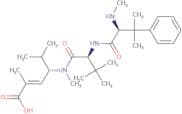
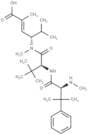
![N,β,β-Trimethyl-L-phenylalanyl-N-[(1S,2E)-3-carboxy-1-(1-methylethyl)-2-buten-1-yl]-N,3-dimethyl-L…](/_next/image/?url=https%3A%2Fstatic.cymitquimica.com%2Fcas-image%2Fthumb-webp%2F464767-n-b-b-trimethyl-l-phenylalanyl-n-1s-2e-3-carboxy-1-1-methylethyl-2-buten-1-yl-n-3-dimethyl-l-valinamide.webp&w=3840&q=75)
CAS 228266-40-8
:N,β,β-Trimetil-L-fenilalanil-N-[(1S,2E)-3-carbossi-1-(1-metiletil)-2-buten-1-il]-N,3-dimetil-L-valinamide
Descrizione:
N,β,β-Trimetil-L-fenilalanil-N-[(1S,2E)-3-carbossi-1-(1-metiletil)-2-buten-1-il]-N,3-dimetil-L-valinamide, con numero CAS 228266-40-8, è un composto sintetico che appartiene alla classe dei derivati degli aminoacidi. Questa sostanza presenta una struttura complessa caratterizzata da molteplici centri chirali, che contribuiscono alla sua potenziale attività biologica. La presenza dei gruppi di fenilalanina e valina suggerisce che potrebbe interagire con sistemi biologici, influenzando possibilmente la sintesi proteica o l'attività enzimatica. I gruppi funzionali di acido carbossilico e alchene del composto indicano una reattività potenziale, rendendolo di interesse nella chimica medicinale e nel design di farmaci. La sua stereochimica specifica potrebbe anche svolgere un ruolo cruciale nelle sue proprietà farmacologiche, influenzando l'affinità di legame e la selettività per obiettivi biologici. Come molti composti sintetici, comprendere la sua solubilità, stabilità e reattività in diverse condizioni è essenziale per applicazioni nella ricerca e nello sviluppo. Ulteriori studi sarebbero necessari per chiarire il suo profilo biologico completo e i potenziali usi terapeutici.
Formula:C27H43N3O4
InChI:InChI=1S/C27H43N3O4/c1-17(2)20(16-18(3)25(33)34)30(10)24(32)22(26(4,5)6)29-23(31)21(28-9)27(7,8)19-14-12-11-13-15-19/h11-17,20-22,28H,1-10H3,(H,29,31)(H,33,34)/b18-16+/t20-,21-,22-/m1/s1
InChI key:InChIKey=CNTMOLDWXSVYKD-PSRNMDMQSA-N
SMILES:[C@H](C(C)(C)C1=CC=CC=C1)(C(N[C@H](C(N([C@H](/C=C(/C(O)=O)\C)C(C)C)C)=O)[C@@](C)(C)C)=O)NC
Sinonimi:- <span class="text-smallcaps">L</smallcap>-Valinamide, N,β,β-trimethyl-<smallcap>L</span>-phenylalanyl-N-[(1S,2E)-3-carboxy-1-(1-methylethyl)-2-buten-1-yl]-N,3-dimethyl-
- <span class="text-smallcaps">L</smallcap>-Valinamide, N,β,β-trimethyl-<smallcap>L</span>-phenylalanyl-N-[(1S,2E)-3-carboxy-1-(1-methylethyl)-2-butenyl]-N,3-dimethyl-
- Hti 286
- N,beta,beta-Trimethyl-L-phenylalanyl-N-[(1S,2E)-3-carboxy-1-(1-methylethyl)-2-butenyl]-N,3-dimethyl-L-valinamide
- N,β,β-Trimethyl-<span class="text-smallcaps">L</smallcap>-phenylalanyl-N-[(1S,2E)-3-carboxy-1-(1-methylethyl)-2-buten-1-yl]-N,3-dimethyl-<smallcap>L</span>-valinamide
- Spa 110
- L-Valinamide, N,β,β-trimethyl-L-phenylalanyl-N-[(1S,2E)-3-carboxy-1-(1-methylethyl)-2-buten-1-yl]-N,3-dimethyl-
- N,β,β-Trimethyl-L-phenylalanyl-N-[(1S,2E)-3-carboxy-1-(1-methylethyl)-2-buten-1-yl]-N,3-dimethyl-L-valinamide
- L-Valinamide, N,β,β-trimethyl-L-phenylalanyl-N-[(1S,2E)-3-carboxy-1-(1-methylethyl)-2-butenyl]-N,3-dimethyl-
Ordinare per
Purezza (%)
0
100
|
0
|
50
|
90
|
95
|
100
3 prodotti.
L-Valinamide,N,b,b-trimethyl-L-phenylalanyl-N-[(1S,2E)-3-carboxy-1-(1-methylethyl)-2-butenyl]-N,3-dimethyl-
CAS:Formula:C27H43N3O4Purezza:99.65%Peso molecolare:473.6480Taltobulin
CAS:<p>Taltobulin is a nitrogen-containing analog that binds to the α subunit of the renal tubular adenylate cyclase and inhibits its activity. This results in decreased levels of cyclic AMP and less activation of protein kinases, which are important for regulating cellular functions. Taltobulin has been shown to inhibit cancer cells in culture as well as bladder and other cancers in animal studies. It also has minimal toxicity, with most side effects being mild and reversible. Taltobulin is used to treat autoimmune diseases such as lupus erythematosus, rheumatoid arthritis, and multiple sclerosis. Antibodies against taltobulin have been found in patients who were treated with this drug. These antibodies were found to be specific for the α subunit of the renal tubular adenylate cyclase and may be used as a diagnostic marker for patients who have been exposed to taltobulin or other similar drugs.</p>Formula:C27H43N3O4Purezza:Min. 98 Area-%Colore e forma:PowderPeso molecolare:473.65 g/molTaltobulin
CAS:Taltobulin (HTI-286) is a synthetic analog of the tripeptide cysteine, a microtubule protein inhibitor that inhibits liver tumor cell proliferation in vitro and tumor growth in vivo.Taltobulin is cytotoxic, induces mitotic arrest and apoptosis, and may be used in the study of breast cancer and microtubule tissue-related diseases.Formula:C27H43N3O4Purezza:99.86%Colore e forma:SolidPeso molecolare:473.65
![L-Valinamide,N,b,b-trimethyl-L-phenylalanyl-N-[(1S,2E)-3-carboxy-1-(1-methylethyl)-2-butenyl]-N,3-…](/_next/image/?url=https%3A%2Fstatic.cymitquimica.com%2Fproducts%2FIN%2Fthumb%2FDA00BF4U.jpg&w=3840&q=75)