CAS 2306-33-4
:Ftalato di monoetile
Descrizione:
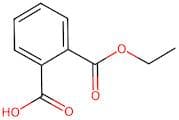
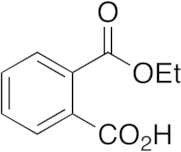
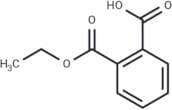
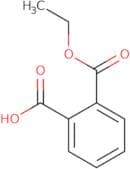
Ftalato di monoetile (MEP), con il numero CAS 2306-33-4, è un composto organico appartenente alla famiglia dei ftalati, che sono esteri dell'acido ftalico. Il MEP è caratterizzato dalla sua forma liquida incolore e inodore, ed è solubile in solventi organici ma ha una solubilità limitata in acqua. Viene utilizzato principalmente come plastificante nella produzione di cloruro di polivinile (PVC) e altri polimeri, migliorando la loro flessibilità e durabilità. Il MEP è anche utilizzato in vari prodotti di consumo, tra cui cosmetici, articoli per la cura personale e adesivi. In termini di struttura chimica, il MEP consiste in uno scheletro di ftalato con un gruppo etile attaccato a uno dei gruppi carbossilici, che influenza le sue proprietà fisiche e chimiche. Sebbene il MEP sia considerato a bassa tossicità acuta, sono state sollevate preoccupazioni riguardo ai suoi potenziali effetti dirompenti endocrini e alla sua persistenza ambientale. Le agenzie di regolamentazione monitorano il suo uso, in particolare nei prodotti che possono entrare in contatto con alimenti o essere utilizzati da bambini.
Formula:C10H10O4
InChI:InChI=1S/C10H10O4/c1-2-14-10(13)8-6-4-3-5-7(8)9(11)12/h3-6H,2H2,1H3,(H,11,12)
InChI key:InChIKey=YWWHKOHZGJFMIE-UHFFFAOYSA-N
SMILES:C(OCC)(=O)C1=C(C(O)=O)C=CC=C1
Sinonimi:- 1,2-Benzenedicarboxylic Acid, Monoethyl Ester
- 1,2-Benzenedicarboxylic acid, 1-ethyl ester
- Ethyl 2-carboxybenzoate
- Monoethyl phthalate
- Phthalic acid, ethyl ester
- Phthalic acid, monoethyl ester
Ordinare per
Purezza (%)
0
100
|
0
|
50
|
90
|
95
|
100
8 prodotti.
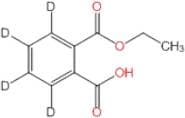
mono-Ethyl Phthalate-3,4,5,6-d4 (
CAS:Formula:HOOCC6D4COOCH2CH3Purezza:99 atom % DColore e forma:White SolidPeso molecolare:198.08302Ref: 4Z-P-368029
5mgPrezzo su richiesta10mgPrezzo su richiesta25mgPrezzo su richiesta50mgPrezzo su richiesta100mgPrezzo su richiestaMonoethyl Phthalate
CAS:Prodotto controllatoApplications Phthalate metabolite.
References Engel, S., et al.: NeuroToxicol., 30, 522 (2009), Aylward, L., et al.: Reg. Toxicol. Pharmacol., 55, 259 (2009), Blair, J., et al.: Environ., Sci. Technol., 43, 6262 (2009),Formula:C10H10O4Colore e forma:Light Pink To Off-WhitePeso molecolare:194.18Monoethyl Phthalate-d9
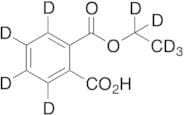
CAS:Prodotto controllatoApplications Monoethyl-d5 Phthalate-d4 is an isotope labeled analog of Monoethyl Phthalate, which is a Phthalate metabolite.
References Engel, S., et al.: NeuroToxicol., 30, 522 (2009), Aylward, L., et al.: Reg. Toxicol. Pharmacol., 55, 259 (2009), Blair, J., et al.: Environ., Sci. Technol., 43, 6262 (2009),Formula:C10HD9O4Colore e forma:Colourless OilyPeso molecolare:203.24Monoethyl phthalate
CAS:Monoethyl phthalate: diethyl phthalate metabolite, urinary biomarker for exposure, linked to thyroid issues.Formula:C10H10O4Purezza:99.79%Colore e forma:SolidPeso molecolare:194.18Ref: TM-T39836
2mg35,00€5mg52,00€10mg74,00€25mg137,00€50mg188,00€100mg283,00€500mg697,00€1mL*10mM (DMSO)52,00€Monoethyl phthalate
CAS:Monoethyl phthalate is a hydroxylated phthalic acid ester that is used in wastewater treatment. The compound is an endocrine disruptor and has been shown to cause allergic symptoms, such as dermatitis and asthma, in infants. It also affects maternal blood and can cause phthalate syndrome in humans. Monoethyl phthalate is a carcinogen and has been shown to cause adrenocortical carcinoma in rats. This compound also increases body mass index (BMI) in humans and decreases the glomerular filtration rate (GFR). Monoethyl phthalate can be detected by high performance liquid chromatography (HPLC) or gas chromatography-mass spectrometry (GC-MS) using analytical methods such as sample preparation and granulosa cells for analysis.Formula:C10H10O4Purezza:Min. 95%Colore e forma:White PowderPeso molecolare:194.18 g/mol