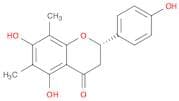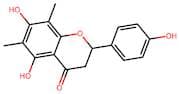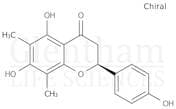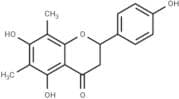
CAS 24211-30-1
:(-)-Farrerol
Descrizione:
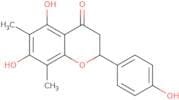
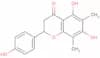
(-)-Farrerol, con il numero CAS 24211-30-1, è un composto flavonoide che si trova naturalmente in varie specie vegetali. È caratterizzato dalla sua struttura chirale, che contribuisce alle sue specifiche attività biologiche. Questo composto generalmente presenta proprietà antiossidanti, rendendolo di interesse nella ricerca farmacologica e nutraceutica. (-)-Farrerol è noto per i suoi potenziali effetti anti-infiammatori e anti-cancerogeni, così come per la sua capacità di modulare alcuni percorsi cellulari. In termini di solubilità, è generalmente solubile in solventi organici, ma può avere una solubilità limitata in acqua. La struttura molecolare del composto include più gruppi idrossilici, che ne aumentano la reattività e l'interazione con i sistemi biologici. Inoltre, la stereochimica di (-)-Farrerol gioca un ruolo cruciale nella sua attività biologica, poiché diversi enantiomeri possono mostrare effetti variabili. In generale, (-)-Farrerol è un composto di grande interesse nei campi della chimica dei prodotti naturali e della ricerca medicinale grazie alle sue diverse potenziali applicazioni.
Formula:C17H16O5
InChI:InChI=1S/C17H16O5/c1-8-15(20)9(2)17-14(16(8)21)12(19)7-13(22-17)10-3-5-11(18)6-4-10/h3-6,13,18,20-21H,7H2,1-2H3/t13-/m0/s1
InChI key:InChIKey=DYHOLQACRGJEHX-ZDUSSCGKSA-N
SMILES:CC1=C2C(C(=O)C[C@H](O2)C3=CC=C(O)C=C3)=C(O)C(C)=C1O
Sinonimi:- (2S)-2,3-Dihydro-5,7-dihydroxy-2-(4-hydroxyphenyl)-6,8-dimethyl-4H-1-benzopyran-4-one
- (2S)-5,7-Dihydroxy-2-(4-hydroxyphenyl)-6,8-dimethyl-2,3-dihydrochromen-4-one
- (2S)-5,7-dihydroxy-2-(4-hydroxyphenyl)-6,8-dimethyl-2,3-dihydro-4H-chromen-4-one
- (S)-2,3-dihydro-5,7-dihydroxy-2-(4-hydroxyphenyl)-6,8-dimethyl-4-benzopyrone
- 4H-1-Benzopyran-4-one, 2,3-dihydro-5,7-dihydroxy-2-(4-hydroxyphenyl)-6,8-dimethyl-, (2S)-
- 4H-1-Benzopyran-4-one, 2,3-dihydro-5,7-dihydroxy-2-(4-hydroxyphenyl)-6,8-dimethyl-, (S)-
- 5,7-dihydroxy-2-(4-hydroxyphenyl)-6,8-dimethyl-2,3-dihydro-4H-chromen-4-one
- 6,8-Dimethyl-4',5,7-Trihydroxyflavanone
- Flavanone, 4′,5,7-trihydroxy-6,8-dimethyl-, (-)-
- Farrerol
Ordinare per
Purezza (%)
0
100
|
0
|
50
|
90
|
95
|
100
8 prodotti.
6,8-DIMETHYL-4',5,7-TRIHYDROXYFLAVANONE
CAS:Formula:C17H16O5Purezza:98%Colore e forma:SolidPeso molecolare:300.3059(S)-5,7-Dihydroxy-2-(4-Hydroxyphenyl)-6,8-Dimethylchroman-4-One
CAS:(S)-5,7-Dihydroxy-2-(4-Hydroxyphenyl)-6,8-Dimethylchroman-4-OnePurezza:98%Peso molecolare:300.31g/molFarrerol
CAS:Farrerol has antioxidative, anti-bacterial, anti-inflammatory, antiangiogenic activities, it is a potential candidate for the intervention of endothelial-injury-associated cardiovascular diseases. Farrerol inactivates KEAP-1 or activates the Akt, p38 and ERK to facilitate the release of Nrf2 from Keap1 and subsequent reduces the intracellular production of reactive oxygen species via the induction of HO-1 expression. Farrerol can inhibit angiogenesis through down regulation of Akt/mTOR, Erk and Jak2/Stat3 signal pathway, and can inhibit IL-1β-induced inflammatory responses in osteoarthritis chondrocytes by blocking PI3K/Akt/NF-κB signaling pathway.Formula:C17H16O5Purezza:95%~99%Peso molecolare:300.31Farrerol
CAS:Farrerol shows antioxidative effects, modulates genes, fights S. aureus in cows, protects cells, and may prevent heart disease.Formula:C17H16O5Purezza:99.70% - 99.96%Colore e forma:SolidPeso molecolare:300.31Ref: TM-T6S0525
2mg40,00€5mg56,00€1mL*10mM (DMSO)67,00€10mg80,00€25mg114,00€50mg167,00€100mg240,00€200mg355,00€Cyrtopterinetin
CAS:Cyrtopterinetin is a naturally occurring flavonoid compound, which is derived from specific plant sources such as Cyrtomium species in Pteridaceae. This compound exerts its biological effects primarily through the modulation of various signaling pathways. It affects key molecular targets involved in the regulation of cell proliferation, apoptosis, and inflammation. The ability of cyrtopterinetin to influence these pathways is attributed to its capacity to bind with cellular proteins and alter gene expression.Formula:C17H16O5Purezza:Min. 98 Area-%Peso molecolare:300.31 g/mol5,7-Dihydroxy-2-(4-hydroxyphenyl)-6,8-dimethylchroman-4-one
CAS:Formula:C17H16O5Purezza:≥98%(HPLC)Peso molecolare:300.31