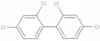
CAS 2437-79-8
:PCB 47
Descrizione:
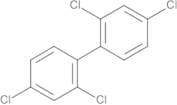
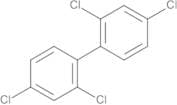
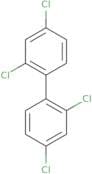
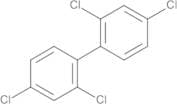
PCB 47, noto anche con il suo numero di registrazione del Chemical Abstracts Service (CAS) 2437-79-8, è un composto di bifenili policlorurati (PCB). I PCB sono un gruppo di sostanze chimiche organiche sintetiche composte da atomi di carbonio, idrogeno e cloro. PCB 47 è caratterizzato dalla sua struttura a bifenile, in cui due anelli di benzene sono collegati da un legame singolo, con atomi di cloro sostituiti in posizioni specifiche sugli anelli. Questo composto è tipicamente incolore o giallo chiaro ed è noto per la sua natura idrofobica, rendendolo insolubile in acqua ma solubile in solventi organici. I PCB, incluso PCB 47, sono noti per la loro stabilità e resistenza alla degradazione, il che ha portato al loro ampio utilizzo storico in apparecchiature elettriche, fluidi di trasferimento di calore e altre applicazioni industriali. Tuttavia, a causa della loro persistenza ambientale e dei potenziali rischi per la salute, inclusi effetti cancerogeni e interruzione endocrina, i PCB sono stati vietati o fortemente regolamentati in molti paesi. PCB 47, come altri PCB, presenta sfide per la bonifica ambientale e la salute pubblica.
Formula:C12H6Cl4
InChI:InChI=1S/C12H6Cl4/c13-7-1-3-9(11(15)5-7)10-4-2-8(14)6-12(10)16/h1-6H
InChI key:InChIKey=QORAVNMWUNPXAO-UHFFFAOYSA-N
SMILES:ClC1=C(C=CC(Cl)=C1)C2=C(Cl)C=C(Cl)C=C2
Sinonimi:- 1,1'-Biphenyl, 2,2',4,4'-tetrachloro-
- 1,1′-Biphenyl, 2,2′,4,4′-tetrachloro-
- 2,2',4,4'-Tetrachlorbiphenyl
- 2,2',4,4'-Tetrachlorobiphenyle
- 2,2',4,4'-Tetrachlorodiphenyl
- 2,2',4,4'-Tetraclorobifenilo
- 2,2′,4,4′-Tetrachloro-1,1′-biphenyl
- 2,2′,4,4′-Tetrachlorobiphenyl
- 2,2′,4,4′-Tetrachlorodiphenyl
- 2,4,2',4'-Tetrachlorobiphenyl
- Biphenyl, 2,2',4,4'-tetrachloro-
- Biphenyl, 2,2′,4,4′-tetrachloro-
- Cb 47
- Pcb 47
- Vedi altri sinonimi
Ordinare per
Purezza (%)
0
100
|
0
|
50
|
90
|
95
|
100
9 prodotti.
EPA Method 525.2 PCB Congeners Mixture 500 µg/mL in Acetone
CAS:Prodotto controllatoColore e forma:MixtureSVOC Mixture 1002 100-400 µg/mL in Acetone
CAS:Prodotto controllato- 103-23-1
- 117-81-7
- 118-74-1
- 120-12-7
- 121-14-2
- 129-00-0
- 131-11-3
- 15862-07-4
- 16605-91-7
- 191-24-2
- 193-39-5
- 205-99-2
- 2051-60-7
- 207-08-9
- 208-96-8
- 218-01-9
- 2437-79-8
- 40186-71-8
- 50-32-8
- 52663-71-5
- 53-70-3
- 56-55-3
- 60145-22-4
- 60233-25-2
- 606-20-2
- 77-47-4
- 78-59-1
- 84-66-2
- 84-74-2
- 85-01-8
- 85-68-7
- 86-73-7
- 87-86-5
Formula:C7H6N2O4Colore e forma:MixturePeso molecolare:182.13PCB No. 47 10 µg/mL in Isooctane
CAS:Prodotto controllatoFormula:C12H6Cl4Colore e forma:Single SolutionPeso molecolare:291.99Dry Color Manufacturer's Association (DCMA) Mixture 5-100 µg/mL in Hexane
CAS:Prodotto controllatoFormula:C12H6Cl4Colore e forma:MixturePeso molecolare:291.992,2',4,4'-Tetrachlorobiphenyl
CAS:Prodotto controllato2,2',4,4'-Tetrachlorobiphenyl is a congener of bisphenol A that has been shown to cause skin papillomas in rats. 2,2',4,4'-Tetrachlorobiphenyl has been found to enhance the effects of other substances such as phenyl groups in an interactive manner. This compound is metabolized by cytochrome P450 enzymes and interacts with the cox-2 gene to produce inflammatory mediators. 2,2',4,4'-Tetrachlorobiphenyl can be absorbed through the skin and can be detected in serum levels.br>br> The mechanisms of action for 2,2',4,4'-tetrachlorobiphenyl are not well understood. However it has been shown that this compound may interact with the cox-2 gene to produce inflammatory mediators. 2,2',4,4'-tetrachlorobFormula:C12H6Cl4Purezza:Min. 95%Peso molecolare:291.99 g/molPCB No. 47 100 µg/mL in Isooctane
CAS:Prodotto controllatoFormula:C12H6Cl4Colore e forma:Single SolutionPeso molecolare:291.99