CAS 2460-59-5
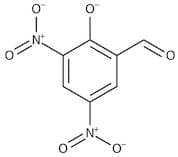
:3,5-Dinitrosalicilaldeide
- 2-Formyl-4,6-Dinitrophenolate
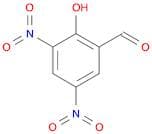
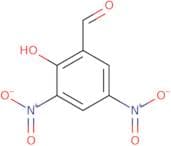
- 2-Hydroxy-3,5-Dinitrobenzaldehyde
- 3,5-Dinitrosalicylaldehyde
- Benzaldehyde, 2-hydroxy-3,5-dinitro-
- Salicylaldehyde, 3,5-dinitro-
- 3,5-Dinitro-2-hydroxybenzaldehyde
3,5-Dinitrosalicylaldehyde, 98%
CAS:It is used to produce 3-(2-hydroxy-3,5-dinitro-phenyl)-propenal with acetaldehyde. 3,5-Dinitrosalicylaldehyde has been used in the preparation of salicyldimine ligand via Schiff base condensation with allyl-substituted aniline, 3-hydroxycoumarins2, chromogenic proteinase substrates and ruthenium(II)Formula:C7H3N2O6Purezza:98%Colore e forma:Powder or crystalline powder, Pale yellow to yellow to orange or pale brownPeso molecolare:211.112-hydroxy-3,5-dinitrobenzaldehyde
CAS:Formula:C7H4N2O6Purezza:98%Colore e forma:SolidPeso molecolare:212.11653,5-Dinitrosalicylaldehyde
CAS:3,5-Dinitrosalicylaldehyde is an oxidizing agent that is used in organic chemistry to produce aldehydes or carboxylic acids. It reacts with the amino groups of lysine residues and converts them to nitro groups. 3,5-Dinitrosalicylaldehyde is also used as a reagent in the determination of the number of lysine residues in proteins by titration with hydrochloric acid. The reaction mechanism of 3,5-dinitrosalicylaldehyde involves formation of an electron deficient intermediate that oxidizes chloride ions to form water molecules and chloride radicals. These intermediates react with nitro groups on lysine residues, resulting in nitro compounds. Crystallography studies have shown that the molecular structure of 3,5-dinitrosalicylaldehyde has two nitro groups and one hydroxyl group.
Formula:C7H4N2O6Purezza:Min. 95%Colore e forma:Yellow PowderPeso molecolare:212.12 g/mol