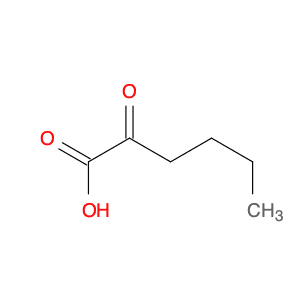
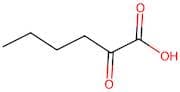
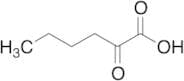
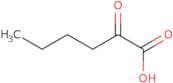
CAS 2492-75-3
:Acido 2-ossoesanoico
Descrizione:
Acido 2-ossoesanoico, noto anche come acido 6-oxoesanoico, è un acido carbossilico caratterizzato dalla presenza sia di un gruppo chetonico che di un gruppo carbossilico all'interno della sua struttura molecolare. Presenta una catena di sei carboni con un gruppo chetonico situato al secondo carbonio e un gruppo acido carbossilico al carbonio terminale. Questo composto è tipicamente un liquido o solido incolore o giallo pallido, a seconda del suo stato e della sua purezza. È solubile in acqua e in solventi organici, rendendolo versatile per varie applicazioni nella sintesi organica e nella ricerca chimica. Acido 2-ossoesanoico può partecipare a varie reazioni chimiche, tra cui esterificazione e condensazione, ed è spesso utilizzato come intermediario nella sintesi di prodotti farmaceutici, agrochimici e altri composti organici. Inoltre, può mostrare attività biologica, che può essere di interesse nella chimica medicinale. I dati di sicurezza devono essere consultati per la manipolazione, poiché può comportare rischi per la salute se ingerito o inalato.
Formula:C6H10O3
InChI:InChI=1S/C6H10O3/c1-2-3-4-5(7)6(8)9/h2-4H2,1H3,(H,8,9)
InChI key:InChIKey=XNIHZNNZJHYHLC-UHFFFAOYSA-N
SMILES:C(C(O)=O)(CCCC)=O
Sinonimi:- 2-Ketocaproic Acid
- 2-Ketohexanoic acid
- 2-Oxocaproic acid
- Alpha-Ketocaproic Acid
- Hexanoic Acid, 2-Oxo-
- α-Ketocaproic acid
- α-Ketohexanoic acid
- α-Oxo-n-caproic acid
- α-Oxocaproic acid
- 2-Oxohexanoic acid
- 2-Oxohexanoic acid
Ordinare per
Purezza (%)
0
100
|
0
|
50
|
90
|
95
|
100
5 prodotti.
2-Oxohexanoic Acid
CAS:Prodotto controllatoApplications 2-Oxohexanoic Acid (cas# 2492-75-3) has been useful in a biological study that investigated the impact of glutathione on wines oxidative stability.
References Nikolantonaki, M., et al.: Front. Chem. (Lausanne, Switzerland), 6, 182 (2018)Formula:C6H10O3Colore e forma:NeatPeso molecolare:130.142-Oxohexanoic acid
CAS:2-Oxohexanoic acid (2-OHBA) is a fatty acid that is synthesized from the amino acids lysine and methionine. It is involved in mitochondrial metabolism and has been found to be necessary for spermatozoa motility. 2-OHBA has been shown to inhibit the activity of glutamate dehydrogenase, an enzyme that catalyzes the conversion of glutamate to α-ketoglutarate, which is required for energy production. This inhibition leads to a decrease in ATP levels, which may cause a variety of symptoms, including fatigue and weight loss. Furthermore, 2-OHBA inhibits protein synthesis by blocking the incorporation of amino acids into proteins. The inhibition of this process can lead to high ammonia levels in the blood and accumulation of other nitrogenous wastes in tissues such as liver or muscle tissue. Analysis of urine samples has shown that 2-OHBA is excreted unchanged in urine.Formula:C6H10O3Purezza:Min. 95%Peso molecolare:130.14 g/mol