CAS 25322-68-3
:Polietilenglicole
Descrizione:
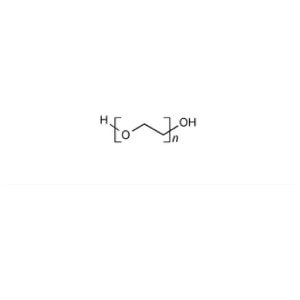
Polietilenglicole (PEG), con il numero CAS 25322-68-3, è un polimero versatile noto per le sue proprietà idrofili e biocompatibilità. È composto da unità ripetitive di ossido di etilene, risultando in una struttura che può variare in peso molecolare, il che influisce sulle sue caratteristiche fisiche e chimiche. Il PEG è tipicamente un liquido incolore, inodore e viscoso o un solido ceroso, a seconda del suo peso molecolare. È solubile in acqua e in molti solventi organici, rendendolo utile in un'ampia gamma di applicazioni, tra cui prodotti farmaceutici, cosmetici e alimentari. Il PEG funge da lubrificante, umettante ed emulsionante, ed è spesso utilizzato nelle formulazioni farmaceutiche per migliorare la solubilità e la biodisponibilità. Inoltre, la sua natura non tossica e la capacità di formare idrogeli lo rendono prezioso in applicazioni biomediche, come sistemi di somministrazione di farmaci e ingegneria dei tessuti. Tuttavia, le proprietà specifiche del PEG possono variare significativamente con il suo peso molecolare e formulazione, il che deve essere considerato quando si sceglie per applicazioni particolari.
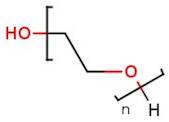
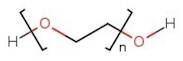
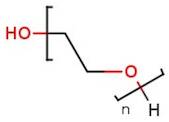
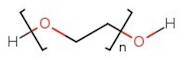
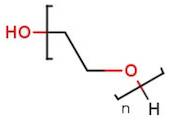
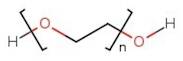
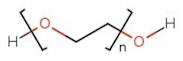
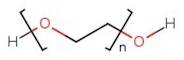
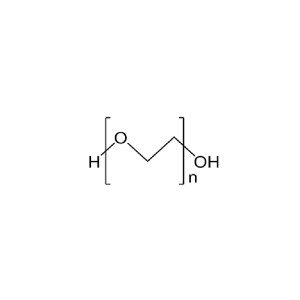
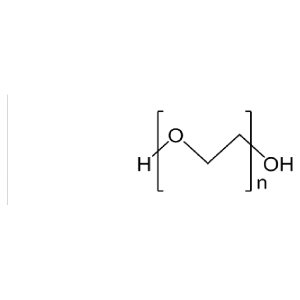
Formula:(C2H4O)nH2O
InChI:InChI=1S/C2H6O2/c3-1-2-4/h3-4H,1-2H2
InChI key:InChIKey=LYCAIKOWRPUZTN-UHFFFAOYSA-N
SMILES:C(CO[H])O
Sinonimi:- 1660O
- 1660S
- 3,6,9,12,15,18,21,24,27,30,33,36,39-Tridecaoxahentetracontane-1,41-diol
- 400Dab8
- Alkox
- Aquaffin
- Badimol
- Carbowachs
- Carbowax
- Colonsoft
- Db-Wax
- Duraseal
- FPR
- Forlax
- GlycoLax
- IW
- Isocolan
- KleanPrep
- Macrogol
- MiraLax
- Modopeg
- Muvinlax
- Nosilen
- Nycoline
- OEG
- PEB
- PEG
- PEG-(OH)<sub>2</sub>
- PEG-diol
- PEO
- PER
- Pegorion
- Peo-Pf
- Peo-Pfz
- Peo-Pfzr
- Peopo-A
- Polikol
- Poly(Oxy-1,2-Ethanediyl),A-Hydro-W-Hydroxy
- Poly(oxy-1,2-ethanediyl)
- Polyaethylenglykol
- Polyethox
- Polyethyleneglycol
- Polyetox
- Polygol
- Polyhydroxyethylene
- Polyosm
- Polyox
- Polyoxydin
- Polyoxyethylenediol
- Postonal
- Sed-Fix
- Slovapeg
- Solbase
- SpaceOAR
- Superox
- Ucarfloc
- α-Hydro-ω-hydroxypoly(oxy-1,2-ethanediyl)
- α-Hydro-ω-hydroxypoly(oxyethylene)
- PEG 6000
- Polyethylene glycol
- Polyethylene Glycol
- PEG 6000, MB Grade (1.12033)
- Poly(oxy-1,2-ethanediyl), α-hydro-ω-hydroxy-
- PEG 200
- Poly(ethylene oxide)
- Poly(ethylene glycol)
- Polyethyleneoxidemonomethacryloxymonotrimethylsiloxyterminated
- Poly ethylene glycol
- O-Methacryloxy(polyethyleneoxy)trimethylsilane
- poly(oxyethylene)
- Polyethylene glygcol
- PEG 200-8000
- Polyethylene glycol
- Ethylene oxide, homopolymer
- Polyethylene Glycol 5000000
- PolyethyleneoxideMW
- Aquacide III
- Polyethylene glycol series
- Tri-(2,3-Dibromopropyl) Phosphate
- Glycols, polyethylene
- Polyethylene glycol PEG
- Polyethylene glycol - 6000 grade
- Carmowax
- PEG 8000
- PEG 1000
- Ethylene glycol 8000 polymer
- PEG-400
- polyethylene oxide standard 511000
- Oxide Wax AN
- PEG 400
- Polyethylene Oxide
- PEG 600
- Vedi altri sinonimi
Filtra per
Percentuale di purezza
0
100
|
0
|
50
|
90
|
95
|
100
- Prezzo più basso
- Prezzo più alto
- Purezza più bassa
- Purezza più alta
- Consegna più veloce
Polyethylene glycol 600
CAS:Polyethylene glycol is used as a humectant in inks and adhesives. It acts as a solvent in soldering flux and as a dye carrier in inks. It is also useful as a modifier and binder in latex paint. It is used as an additive in synthetic lubricants, cutting oil and hydraulic fluids. It plays an importantFormula:(C2H4O)nColore e forma:Colorless, Liquid as melt or white low-melting solidPolyethylene glycol 1,000
CAS:Polyethylene glycol is used as an excipent in pharmaceutical products. It is used in the precipitation of proteins as well as in the separation and purification of biomolecules and in the induction of cell hybridization. It acts as a fusing agent to enhance the effect of macrophages on hybridoma; asFormula:(C2H4O)nColore e forma:Waxy solid, WhitePolyethylene Glycol 6000, Flakes, Ultrapure
CAS:Thermo Scientific Polyethylene Glycol 6000 Flakes UltrapureFormula:(C2H4O)nColore e forma:White or slightly yellowish, FlakesPeso molecolare:5400-6600Polyethylene glycol 10,000
CAS:Polyethylene glycol is used to modify therapeutic proteins and peptides to increase their solubility. In gas chromatography, it is used as a polar stationary phase. It is also useful in preserving objects obtained from the ocean. As a dispersant, it is used in toothpastes. It finds application in blFormula:(C2H4O)nColore e forma:White, Powder or crystals or flakesPolyethylene glycol 20,000
CAS:Substance is listed in TSCA inventoryFormula:(C2H4O)nColore e forma:White, Powder or flakePolyethylene glycol (PEG), 50% soln.
CAS:Polyethylene glycol is used as a thickening agent and gel binder in the pharmaceutical industry. It is used as a analytical reagents, substrates, flocculants, dispersants, lubricants, emulsifiers, moisturizers, food additives. This Thermo Scientific Chemicals brand product was originally part of theFormula:(C2H4O)nColore e forma:Liquid, Clear, colorlessPolyethylene glycol 1,500
CAS:Cell fusion induced by polyethylene glycol(PEG) has become a standard method in somatic cell genetics. PEG promoted cell fusion is involved in the production of hybridoma cells. This Thermo Scientific Chemicals brand product was originally part of the Alfa Aesar product portfolio. Some documentationFormula:(C2H4O)nColore e forma:White, Waxy flakesPolyethylene oxide, M.W. 100,000
CAS:Polyethylene oxide is used in conjunction with carbon black to form a conductive composite. It serves as thermoplastic material that is readily calendared, extruded, injection molded or cast, to provide even greater formulation and processing flexibility. It also provides binding, thickening, lubricFormula:(C2H4O)nColore e forma:White to off-white, PowderHIGH-MOLECULAR-MASS MACROGOL CRS
CAS:HIGH-MOLECULAR-MASS MACROGOL CRSFormula:C9H17NO3Peso molecolare:187.2362Polyethylene Glycol 4000
CAS:Polyethers, nesoiFormula:HOCH2CH2nOHColore e forma:White Off-White Waxy Solid FlakesPeso molecolare:3600 - 4400Polyethylene Glycol 3000
CAS:Polyethers, nesoiFormula:HOCH2CH2nOHColore e forma:Colorless FlakesPeso molecolare:187.2362Polyethylene Glycol 400
CAS:Polyethers, nesoiFormula:HOCH2CH2nOHColore e forma:Colorless Clear LiquidPeso molecolare:380 - 420Polyethylene Glycol 300
CAS:Polyethers, nesoiFormula:HOCH2CH2nOHColore e forma:LiquidPeso molecolare:285 - 315Polyethylene Glycol 200
CAS:Polyethers, nesoiFormula:HOCH2CH2OnHColore e forma:Colorless Clear LiquidPeso molecolare:About 200 (44.05 monomer)Polyethylene Oxide
CAS:Polyethers, nesoiFormula:(CH2CH2O)nColore e forma:White Off-White PowderPeso molecolare:5000000Polyethylene Glycol 1000
CAS:Polyethers, nesoiFormula:HOCH2CH2nOHColore e forma:White Waxy SolidPeso molecolare:950 - 1050Polyethylene Glycol 8000
CAS:Polyethers, nesoiFormula:HOCH2CH2nOHColore e forma:White GranularPeso molecolare:7000 - 9000Polyethylene Glycol 6000
CAS:Polyethers, nesoiFormula:HOC2H4nOHColore e forma:Colorless FlakesPeso molecolare:5400 - 6600