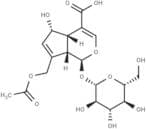
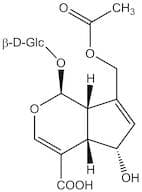
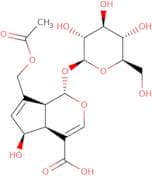
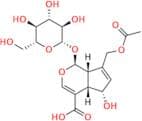
CAS 25368-11-0
:Acido asperulosidico
Descrizione:
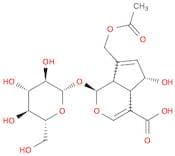
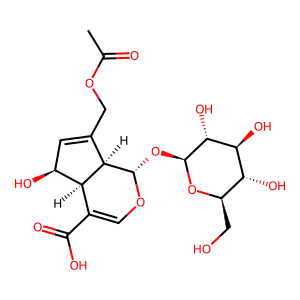
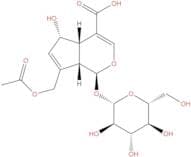
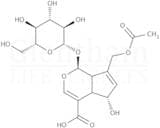
Acido asperulosidico è un glicoside iridoide che si trova naturalmente, principalmente in varie specie vegetali, in particolare nella famiglia Rubiaceae. È caratterizzato dalla sua complessa struttura molecolare, che include un gruppo zuccherino legato a un nucleo iridoide. Questo composto è noto per le sue potenziali proprietà farmacologiche, comprese attività antinfiammatorie, antiossidanti e antimicrobiche. Acido asperulosidico è spesso studiato per il suo ruolo nella medicina tradizionale e le sue potenziali applicazioni terapeutiche. È tipicamente solubile in solventi polari, il che facilita la sua estrazione da materiali vegetali. La stabilità e la reattività del composto possono essere influenzate da fattori ambientali come pH e temperatura. Inoltre, la sua presenza in formulazioni erboristiche evidenzia la sua importanza nella fitoterapia e nella ricerca di prodotti naturali. In generale, Acido asperulosidico rappresenta un argomento di studio interessante grazie alle sue proprietà bioattive e ai potenziali benefici per la salute.
Formula:C18H24O12
InChI:InChI=1S/C18H24O12/c1-6(20)27-4-7-2-9(21)12-8(16(25)26)5-28-17(11(7)12)30-18-15(24)14(23)13(22)10(3-19)29-18/h2,5,9-15,17-19,21-24H,3-4H2,1H3,(H,25,26)/t9-,10+,11+,12-,13+,14-,15+,17-,18-/m0/s1
InChI key:InChIKey=DGDWCRWJRNMRKX-DILZHRMZSA-N
SMILES:O([C@H]1[C@]2([C@@](C(C(O)=O)=CO1)([C@@H](O)C=C2COC(C)=O)[H])[H])[C@@H]3O[C@H](CO)[C@@H](O)[C@H](O)[C@H]3O
Sinonimi:- Cyclopenta[c]pyran-4-carboxylic acid, 1α-(β-D-glucopyranosyloxy)-1,4aα,5,7aα-tetrahydro-5β-hydroxy-7-(hydroxymethyl)-, 7-acetate
- (1S,4aS,5S,7aS)-7-[(Acetyloxy)methyl]-1-(β-D-glucopyranosyloxy)-1,4a,5,7a-tetrahydro-5-hydroxycyclopenta[c]pyran-4-carboxylic acid
- Cyclopenta[c]pyran-4-carboxylic acid, 7-[(acetyloxy)methyl]-1-(β-D-glucopyranosyloxy)-1,4a,5,7a-tetrahydro-5-hydroxy-, (1S,4aS,5S,7aS)-
- Asperulosidic acid
- Cyclopenta[c]pyran-4-carboxylic acid, 7-[(acetyloxy)methyl]-1-(β-D-glucopyranosyloxy)-1,4a,5,7a-tetrahydro-5-hydroxy-, [1S-(1α,4aα,5β,7aα)]-
Ordinare per
Purezza (%)
0
100
|
0
|
50
|
90
|
95
|
100
9 prodotti.
Asperulosidic acid
CAS:Asperulosidic acid has been recently used in chinese medicine as a useful drug against some tumors. It has anticlastogenic activity, since the anticlastogenic irridoids have an alpha-unsaturated carbonyl group, this structure is considered to play an important role in the anticlastogenicity. Asperulosidic acid can inhibit the seed germination and growth of seedlings of large crabgrass. Asperulosidic acid, and 6-O-(beta-D-glucopyranosyl)-1-O-octanoyl-beta-D-glucopyranose are effective in suppressing 12-O-tedtradecanoylphorbol-13-acetate (TPA)- or epidermal growth factor (EGF)-induced cell transformation and associated AP-1 activity.Formula:C18H24O12Purezza:95%~99%Colore e forma:PowderPeso molecolare:432.378Asperulosidic acid
CAS:Formula:C18H24O12Purezza:≥ 98.0%Colore e forma:White to off-white solidPeso molecolare:432.38Asperulosidic acid
CAS:Asperulosidic acid (ASPA) has anti-tumor, anti-oxidant, and anti-inflammatory activities. ASPA is related to the inhibition of inflammatory cytokines.Formula:C18H24O12Purezza:99.47%Colore e forma:SolidPeso molecolare:432.38Ref: TM-TN1410
1mg120,00€2mg170,00€5mg260,00€1mL*10mM (DMSO)286,00€10mg432,00€25mg708,00€50mg964,00€100mg1.288,00€Ref: 4Z-A-118001
5mgPrezzo su richiesta10mgPrezzo su richiesta25mgPrezzo su richiesta50mgPrezzo su richiesta100mgPrezzo su richiestaAsperulosidic acid
CAS:Natural glycosideFormula:C18H24O12Purezza:≥ 90.0 % (HPLC)Colore e forma:PowderPeso molecolare:432.38Asperulosidic acid
CAS:Asperulosidic acid is a glycoside derivative that belongs to the natural compounds. It has been shown to be an enzyme inducer in bacteria, yeast and plants. Asperulosidic acid can be found in the leaves of asperula odorata, a plant commonly known as sweet woodruff. It is also found in fructus asperuli, which is made from the fruit of asperula odorata. Asperulosidic acid has been shown to increase the activity of enzymes such as β-glucuronidase and esterase in bacteria, which may have an effect on their metabolism. This compound also increases the activity of proteases and other enzymes in plants and yeast. The matrix effect can be used to determine the concentration of this compound by measuring its effects on enzyme activity. Matrix effects can be measured using a plate test or by plasma mass spectrometry. Asperulosidic acid has been shown to have growthFormula:C18H24O12Purezza:Min. 95%Colore e forma:SolidPeso molecolare:432.38 g/molRef: ST-EA-CP-A243000
10mgPrezzo su richiesta25mgPrezzo su richiesta50mgPrezzo su richiesta100mgPrezzo su richiesta