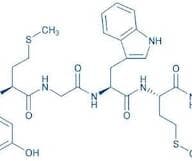
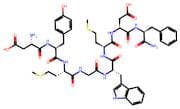
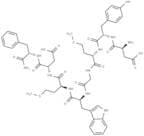
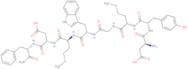
CAS 25679-24-7
:frammento di colecistochinina 26-33 amide*non solfatato
Descrizione:
Il frammento 26-33 della colecistochinina, non solfato, è un peptide derivato dalla molecola più grande di colecistochinina (CCK), che svolge un ruolo cruciale nella digestione e nella regolazione dell'appetito. Questo frammento specifico consiste in una sequenza di amminoacidi coinvolti nella stimolazione della contrazione della cistifellea e nella promozione del rilascio di enzimi digestivi dal pancreas. La forma non solfata indica che manca di modifiche solfato, che possono influenzare la sua attività biologica e le interazioni con i recettori. Il numero CAS 25679-24-7 identifica in modo univoco questo composto nei database chimici, facilitando il suo studio e applicazione nella ricerca. Caratteristicamente, questo peptide è solubile in acqua e mostra attività biologica a concentrazioni nanomolari, rendendolo significativo nei processi fisiologici. Il suo ruolo nel sistema gastrointestinale e le potenziali implicazioni nella regolazione dell'appetito e della sazietà lo rendono un argomento di interesse sia nella ricerca farmacologica che nutrizionale. Comprendere la sua struttura e funzione può fornire spunti su approcci terapeutici per disturbi digestivi e gestione dell'obesità.
Formula:C49H62N10O13S2
InChI:InChI=1/C49H62N10O13S2/c1-73-18-16-34(55-47(70)37(21-28-12-14-30(60)15-13-28)58-44(67)32(50)23-41(62)63)45(68)53-26-40(61)54-38(22-29-25-52-33-11-7-6-10-31(29)33)48(71)56-35(17-19-74-2)46(69)59-39(24-42(64)65)49(72)57-36(43(51)66)20-27-8-4-3-5-9-27/h3-15,25,32,34-39,52,60H,16-24,26,50H2,1-2H3,(H2,51,66)(H,53,68)(H,54,61)(H,55,70)(H,56,71)(H,57,72)(H,58,67)(H,59,69)(H,62,63)(H,64,65)
SMILES:CSCCC(C(=NCC(=NC(Cc1c[nH]c2ccccc12)C(=NC(CCSC)C(=NC(CC(=O)O)C(=NC(Cc1ccccc1)C(=N)O)O)O)O)O)O)N=C(C(Cc1ccc(cc1)O)N=C(C(CC(=O)O)N)O)O
Sinonimi:- Cholecystokinin Octapeptide (desulfated)
- H-Asp-Tyr-Met-Gly-Trp-Met-Asp-Phe-NH2
- N-[(2S)-2-hydrazino-3-phenylpropanoyl]-L-alpha-aspartyl-L-methionyl-L-tryptophylglycyl-N-[(1S,4S)-4-amino-5-carboxy-1-(4-hydroxybenzyl)-2,3-dioxopentyl]-L-methioninamide
- Alpha-Aspartyltyrosylmethionylglycyltryptophylmethionyl-Alpha-Aspartylphenylalaninamide
Ordinare per
Purezza (%)
0
100
|
0
|
50
|
90
|
95
|
100
6 prodotti.
Cholecystokinin Octapeptide (desulfated)
CAS:Bachem ID: 4003323.
Formula:C49H62N10O13S2Purezza:98.1%Colore e forma:White LyophilisatePeso molecolare:1063.22Cholecystokinin Octapeptide, desulfated
CAS:Cholecystokinin Octapeptide, desulfatedPurezza:≥95%Peso molecolare:1063.21g/molCholecystokinin Octapeptide, desulfated
CAS:Cholecystokinin Octapeptide, desulfated (CCK Octapeptide, non-sulfated) is an octapeptide composed of 8 amino acids from cholecystokinin-8.Formula:C49H62N10O13S2Purezza:97.12%Colore e forma:SolidPeso molecolare:1063.21CCK octapeptide Cholecystokinin (26-33)
CAS:The octapeptide cholecystokinin (26-33), known as CCK-8, has the full biological activity of the full-length cholecystokinin (CCK). CCK acts as a hormone and neurotransmitter and is found in the GI and central nervous systems. CCK-8 is a satiety peptide that inhibits food intake.CCK-8 can also inhibit amanitin uptake into hepatocytes.Formula:C49H62N10O13S2Peso molecolare:1,063.21 g/molCCK-Octapeptide (26-33) (Non-Sulfated Form)
CAS:CCK-Octapeptide (26-33) is a peptide that is a member of the cholecystokinin family of peptides. CCK-Octapeptide (26-33) is an activator of the CCK receptor and can be used for research purposes. This peptide has been shown to inhibit ion channels, which are proteins that regulate the flow of ions across cell membranes, and may be used as a pharmacological tool or research tool.
Formula:C49H62N10O13S2Purezza:Min. 95%Peso molecolare:1,063.2 g/molCholecystokinin Octapeptide (desulfated)
CAS:Cholecystokinin octapeptide (CCK-8) is a peptide hormone that is secreted from the pancreas. It is a conjugate of CCK and desulfated cholinesterase, which has been shown to have surfactant properties. The concentration-response curves for CCK-8 are biphasic, with an initial increase in contractility followed by a decrease. This response is caused by activation of both the B2 and B1 receptors in the paraventricular nucleus of the hypothalamus and subsequently release of pancreatic enzymes into the bloodstream. CCK-8 has also been shown to stimulate protein synthesis in gland cells such as those found in the pancreas.Formula:C49H62N10O13S2Purezza:Min. 95%Peso molecolare:1,063.21 g/mol