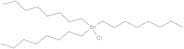
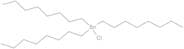
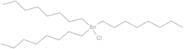
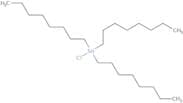
CAS 2587-76-0
:Cloruro di trioctiltina
Descrizione:
Cloruro di trioctiltina, con il numero CAS 2587-76-0, è un composto organostannico caratterizzato dai suoi tre gruppi ottile legati a un atomo di stagno, insieme a un ion cloruro. Si presenta come un liquido incolore a giallo pallido ed è noto per le sue proprietà idrofobiche, rendendolo insolubile in acqua ma solubile in solventi organici. Questo composto è utilizzato principalmente come stabilizzatore nella produzione di PVC e come biocida in varie applicazioni, comprese le vernici antifouling e i preservanti per legno. Cloruro di trioctiltina presenta tossicità, in particolare per gli organismi acquatici, e solleva preoccupazioni ambientali a causa del suo potenziale di bioaccumulo. È importante maneggiare questa sostanza con cura, seguendo i protocolli di sicurezza appropriati per ridurre al minimo l'esposizione e l'impatto ambientale. Inoltre, il suo uso è regolamentato in molte regioni a causa della sua natura pericolosa, richiedendo l'adesione a linee guida e regolamenti di sicurezza nelle applicazioni industriali.
Formula:C24H51ClSn
InChI:InChI=1S/3C8H17.ClH.Sn/c3*1-3-5-7-8-6-4-2;;/h3*1,3-8H2,2H3;1H;/q;;;;+1/p-1
InChI key:InChIKey=MCNGJXAXOJDJKO-UHFFFAOYSA-M
SMILES:[Sn](CCCCCCCC)(CCCCCCCC)(CCCCCCCC)Cl
Sinonimi:- Chloro(Trioctyl)Stannane
- Chlorotrioctylstannane
- Chlorotrioctyltin
- NSC 65479
- Stannane, chlorotrioctyl-
- Tin, chlorotrioctyl-
- Tri-n-octyltin chloride
- Trioctylchlorostannane
- Trioctyltin chloride
Ordinare per
Purezza (%)
0
100
|
0
|
50
|
90
|
95
|
100
4 prodotti.
Trioctyltin chloride 1000 µg/mL in Methanol
CAS:Prodotto controllatoFormula:C24H51ClSnColore e forma:Single SolutionPeso molecolare:493.82Trioctyltin chloride
CAS:Prodotto controllatoFormula:C24H51ClSnColore e forma:NeatPeso molecolare:493.82Tri-n-octylchlorotin
CAS:Prodotto controllatoStability Moisture Sensitive
Applications Tri-n-octylchlorotin is an octyltin compound used to study the growth and fatty acid of the microscopic fungus Cochliobolus lunatus. It is also an organotin reagents used to covalently functionalize oxide nanostructures and multi-walled C nanotubes.
Not a dangerous good if item is equal to or less than 1g/ml and there is less than 100g/ml in the package
References Felczak, A., et al.: Process Biochem., 49, 295-300 (2014); Gomathi, A., et al.: J. Mater. Chem., 19, 988-995 (2009);Formula:C24H51ClSnColore e forma:NeatPeso molecolare:493.82Trioctyltin chloride
CAS:Trioctyltin chloride is a polymer that is synthesized by the reaction of two equivalents of tributyltin chloride with fatty acids. Trioctyltin chloride is reactive and can be extracted from a variety of sources using a variety of solvents. It has been used to extract chloride ions from mesenchymal stromal cells, which are cells that are involved in tissue repair. The trioctyltin chloride polymer can be used as an analytical method for 3β-hydroxysteroid dehydrogenase, which catalyzes the conversion of 3β-hydroxysteroids into 3-keto steroids. This reaction is reversible and it produces hydrogen ions as a product. The hydrogen ions cause the polymer to undergo ring-opening reactions, leading to the formation of polymeric matrixes on solid surfaces. These matrices have been used in membrane systems as well as in microextraction experiments for solid phase extraction with gas chromatography (SPE).Formula:C24H51ClSnPurezza:Min. 95%Peso molecolare:493.82 g/mol