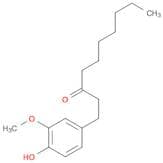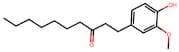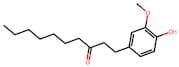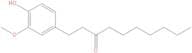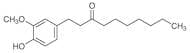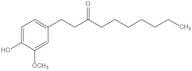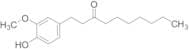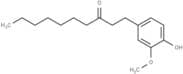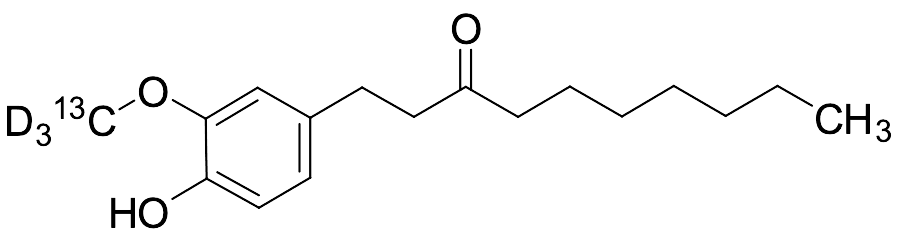
CAS 27113-22-0
:Paradol
Descrizione:
Paradol, con il numero CAS 27113-22-0, è un composto fenolico che è strutturalmente correlato al gingerolo, un componente bioattivo presente nello zenzero. È principalmente riconosciuto per la sua presenza in alcune spezie e i suoi potenziali benefici per la salute. Paradol presenta un sapore e un aroma piccanti caratteristici, contribuendo al suo utilizzo in applicazioni culinarie. Chimicamente, è noto per le sue proprietà antiossidanti, che possono aiutare a combattere lo stress ossidativo nei sistemi biologici. Inoltre, la ricerca ha indicato che Paradol potrebbe possedere effetti anti-infiammatori e analgesici, rendendolo di interesse negli studi farmacologici. La sua solubilità nei solventi organici e la relativamente bassa solubilità in acqua sono proprietà fisiche notevoli. Paradol è anche oggetto di indagine per il suo potenziale ruolo nella prevenzione del cancro e come agente terapeutico, sebbene siano necessari ulteriori studi per comprendere appieno i suoi meccanismi e la sua efficacia. In generale, Paradol rappresenta un composto affascinante con diverse applicazioni nella scienza alimentare e nella ricerca sulla salute.
Formula:C17H26O3
InChI:InChI=1S/C17H26O3/c1-3-4-5-6-7-8-15(18)11-9-14-10-12-16(19)17(13-14)20-2/h10,12-13,19H,3-9,11H2,1-2H3
InChI key:InChIKey=CZNLTCTYLMYLHL-UHFFFAOYSA-N
SMILES:C(CC(CCCCCCC)=O)C1=CC(OC)=C(O)C=C1
Sinonimi:- 1-(4-Hydroxy-3-Methoxyphenyl)Decan-3-One
- 1-(4-Hydroxy-3-methoxyphenyl)-3-decanone
- 3-Decanone, 1-(4-hydroxy-3-methoxyphenyl)-
- 5-Paradol
- 6-Paradol
- Brn 1984119
- Ccris 8519
- Heptyl 4-hydroxy-3-methoxyphenethyl ketone
- Paradol
- [6]-Gingerone
- 1-(4-Hydroxy-3-methoxyphenyl)decan-5-one
- Vedi altri sinonimi
Ordinare per
Purezza (%)
0
100
|
0
|
50
|
90
|
95
|
100
13 prodotti.
1-(4-hydroxy-3-methoxyphenyl)decan-5-one
CAS:Formula:C17H26O3Purezza:99%Colore e forma:SolidPeso molecolare:278.38651-(4-Hydroxy-3-Methoxyphenyl)Decan-3-One
CAS:1-(4-Hydroxy-3-Methoxyphenyl)Decan-3-OnePurezza:≥98%Peso molecolare:278.39g/molParadol
CAS:Formula:C17H26O3Purezza:>95.0%(HPLC)Colore e forma:White to Light yellow powder to crystalPeso molecolare:278.396-paradol
CAS:Ketone with other oxygen functionsFormula:C17H26O3Purezza:≥ 90.0 % (HPLC)Colore e forma:PowderPeso molecolare:278.39Paradol
CAS:Prodotto controllatoApplications Paradol is a Gingerol related compound from ginger with antioxidant activity and cancer preventive properties.
References Masuda, Y., et al.: BioFactors, 21, 293 (2004); Shukla, Y., Singh, M.: Food Chem. Toxicol., 45, 683 (2007);Formula:C17H26O3Colore e forma:NeatPeso molecolare:278.396-Paradol
CAS:6-Paradol is a natural drug that has been shown to have anti-inflammatory properties. It was found to inhibit the production of prostaglandin E2 (PGE2) and cyclooxygenase-2 (COX-2) in the presence of lipopolysaccharide in human monocytes. 6-Paradol also inhibits the production of inflammatory mediators such as nitric oxide and tumor necrosis factor α. This drug also has an effect on microglia cells, which are immune cells in the central nervous system, as well as on adipose tissue. 6-Paradol can be used for the treatment of diabetic neuropathy and squamous carcinoma.Formula:C17H26O3Purezza:Min. 95 Area-%Colore e forma:PowderPeso molecolare:278.39 g/molParadol
CAS:Paradol, a spicy compound in ginger, offers anti-cancer, anti-inflammatory, antioxidant, and neuroprotective benefits.Formula:C17H26O3Purezza:98.4% - 98.98%Colore e forma:SolidPeso molecolare:278.39