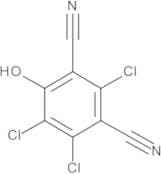
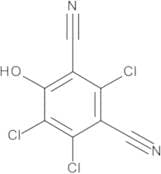
CAS 28343-61-5
:4-Idrossi-2,5,6-tricloroisofthalonitrile
Descrizione:
4-Idrossi-2,5,6-tricloroisofthalonitrile, con il numero CAS 28343-61-5, è un composto chimico caratterizzato dalla sua struttura, che include un gruppo idrossile e molteplici sostituti di cloro su un telaio di isoftalonitrile. Questo composto appare tipicamente come un solido ed è noto per la sua stabilità in varie condizioni. Mostra proprietà come alta stabilità termica e resistenza alla degradazione, rendendolo adatto per applicazioni nella scienza dei materiali, in particolare nello sviluppo di ritardanti di fiamma e polimeri. La presenza di atomi di cloro contribuisce alla sua reattività e al potenziale utilizzo nella sintesi, mentre il gruppo idrossile può partecipare a legami idrogeno, influenzando la sua solubilità e interazione con altre sostanze. Inoltre, a causa dei suoi gruppi nitrile, può presentare alcune proprietà tossicologiche, richiedendo un'attenta manipolazione e valutazione nelle applicazioni industriali. In generale, 4-Idrossi-2,5,6-tricloroisofthalonitrile è un composto di interesse sia nella ricerca che nelle applicazioni pratiche, in particolare nei campi della chimica e dell'ingegneria dei materiali.
Formula:C8HCl3N2O
InChI:InChI=1/C8HCl3N2O/c9-5-3(1-12)6(10)7(11)8(14)4(5)2-13/h14H
InChI key:InChIKey=MDQKYGOECVSPIW-UHFFFAOYSA-N
SMILES:C(#N)C1=C(Cl)C(C#N)=C(O)C(Cl)=C1Cl
Sinonimi:- 1,3-Benzenedicarbonitrile, 2,4,5-Trichloro-6-Hydroxy-
- 1,3-Dicyano-4-Hydroxy-2,5,6-Trichlorobenzene
- 2,4,5-Trichloro-6-hydroxy-1,3-benzenedicarbonitrile
- 2,4,5-Trichloro-6-hydroxyisophthalonitrile
- 2,5,6-Trichloro-4-hydroxy-1,3-benzenedicarbonitrile
- 28343-61-5
- 4-Hydroxy-2,5,6-trichloroisophthalonitrile
- 4-Hydroxychlorothalonil
- Hydroxychlorothalonil
- Isophthalonitrile, 2,4,5-trichloro-6-hydroxy-
- Sds 3701
- 2,5,6-Trichloro-4-
- Hydroxy Chlorothalonil Q: What is the storage condition of
- Hydroxy Chlorothalonil Q: What is the CAS Number of
- 2,4,5-Trichloro-6-hydroxy-
- Hydroxy Chlorothalonil
- Tribenoside Impurity 6
- Chlorothalonil Metabolite R182281
- hydroxy-1,3-benzenedicarbonitrile
- 4-hydroxy-2,5,6-trichloro-1,3-benzenedicarbonitrile
- Hydroxy ChlorothalonilQ: What is
- 4-hydroxy-2,5,6-trichloro-3-benzenedicarbonitrile
- Hydroxy Chlorothalonil Q: What are the applications of
- TPN-OH
- DRE-C11510400 Chlorothalonil-4-hydroxy
- isophthalonitrile
- Chlorothalonil-4-hydroxy 10.0 μg/ml Acetonitrile
- Vedi altri sinonimi
Ordinare per
Purezza (%)
0
100
|
0
|
50
|
90
|
95
|
100
5 prodotti.
Chlorothalonil-4-hydroxy 10 µg/mL in Acetonitrile
CAS:Formula:C8HCl3N2OColore e forma:Single SolutionPeso molecolare:247.47Chlorothalonil-4-hydroxy
CAS:Prodotto controllatoFormula:C8HCl3N2OColore e forma:NeatPeso molecolare:247.47Ref: 4Z-C-196003
5mgPrezzo su richiesta10mgPrezzo su richiesta25mgPrezzo su richiesta50mgPrezzo su richiesta100mgPrezzo su richiestaHydroxy Chlorothalonil
CAS:Prodotto controllatoApplications Hydroxychlorothalonil is a metabolite of Chlorothalonil (C411250).
Not a dangerous good if item is equal to or less than 1g/ml and there is less than 100g/ml in the package
References Katayama, A., et al.: J. Pest Sci., 22, 12 (1997), Godard, T., et al.: Mutat. Res., 444, 103 (1999), Zeng, L., et al.: Appl. Microbiol. Biotechnol., 79, 881 (2008), Wang, G., et al.: J. Bacteriol., 192, 2737 (2010),Formula:C8HCl3N2OColore e forma:Off-WhitePeso molecolare:247.472,4,5-Trichloro-6-hydroxyisophthalonitrile
CAS:2,4,5-Trichloro-6-hydroxyisophthalonitrile is a fungicide. It is used in the control of plant diseases such as powdery mildew, rust and blight. 2,4,5-Trichloro-6-hydroxyisophthalonitrile can be applied to plants through foliar spray or root drenching. It acts by inhibiting the enzyme activities of fungi that are responsible for cell growth. This compound has been shown to have genotoxic activity in vivo and in vitro models and may be carcinogenic to humans. The mechanism of action of 2,4,5-trichloro-6-hydroxyisophthalonitrile remains unclear due to its high resistance to degradation in vivo. 2,4,5-Trichloro-6-hydroxyisophthalonitrile has also shown synergistic effects when combined with zirconium oxide and matrixFormula:C8HCl3N2OPurezza:Min. 95%Peso molecolare:247.47 g/mol