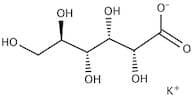
CAS 299-27-4
:Gluconato di potassio
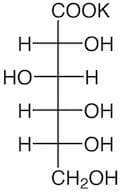
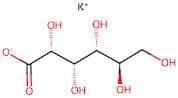
- (2,3,4,5,6-Pentahydroxy-3-Methyl-Hexanoyl)Oxypotassium
- <span class="text-smallcaps">D</span>-Gluconic acid, monopotassium salt
- <span class="text-smallcaps">D</span>-Gluconic acid, potassium salt (1:1)
- D-Gluconic acid monopotassium salt
- Gluconic acid potassium salt
- Gluconic acid, monopotassium salt, <span class="text-smallcaps">D</span>-
- Gluconsan K
- Helshas K
- K-Iao
- Kalimozan
- Kalium-Beta
- Katorin
- Katrin
- Potalium
- Potasoral
- Potassium <span class="text-smallcaps">D</span>-gluconate
- Potassuril
- Sirokal
- Tumil K
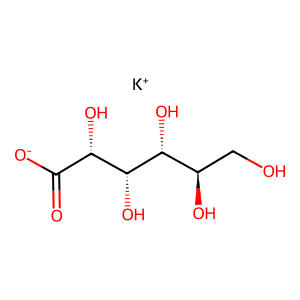
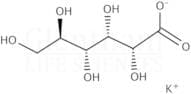
- potassium (2R,3S,4R,5R)-2,3,4,5,6-pentahydroxyhexanoate (non-preferred name)
- D-Gluconic acid, potassium salt (1:1)
- Potassium gluconate
- Gluconic acid, monopotassium salt, D-
- Vedi altri sinonimi
Potassium Gluconate
CAS:Formula:C6H11KO7Purezza:>99.0%(T)Colore e forma:White to Light yellow powder to crystalPeso molecolare:234.25Potassium D-gluconate, 99%
CAS:Potassium D-gluconate widely used as sequestering compounds for metal ions in alkaline systems. It is used in a newly developed process entitled ARS for the prevention of shrinkage in dyed wool fabric. Potassium gluconate has been shown to elevate lactate production, and ATP content, as well as indFormula:C6H11KO7Purezza:99%Colore e forma:White, Crystals or powder or crystalline powderPeso molecolare:234.25Potassium Gluconate
CAS:Gluconic acid, its salts and estersFormula:C6H11KO7Colore e forma:Yellow White PowderPeso molecolare:234.01418D-Gluconic acid, monopotassium salt
CAS:Formula:C6H12KO7Purezza:99%Colore e forma:SolidPeso molecolare:235.2536Potassium gluconate, USP grade, anhydrous
CAS:Formula:C6H11KO7Purezza:98.0 - 102.0 % (dried basis)Colore e forma:White crystalline powderPeso molecolare:234.25Potassium (2R,3S,4R,5R)-2,3,4,5,6-pentahydroxyhexanoate
CAS:Formula:C6H11KO7Purezza:95.0%Colore e forma:SolidPeso molecolare:234.245Potassium gluconate
CAS:Potassium gluconate (Potassium D-gluconate) is an oxidizing carboxylic acid with oral activity and chelating properties with bactericidal activity.Formula:C6H11KO7Purezza:99.62% - 99.63%Colore e forma:White Solid PowderPeso molecolare:234.25D-Gluconic Acid Potassium Salt
CAS:Formula:C6H11O7·KColore e forma:White To Off-WhitePeso molecolare:234.25Potassium Gluconate extrapure, 99%
CAS:Formula:C6H11KO7Purezza:min. 99%Colore e forma:White to off white, Powder, ClearPeso molecolare:234.25D-Gluconic acid potassium salt
CAS:D-Gluconic acid potassium salt is a glycol ether with biochemical properties that can be used to synthesize covalent linkages. It has been shown to have antimicrobial properties in wild-type strains of Escherichia coli and Salmonella typhimurium. D-Gluconic acid potassium salt has been shown to exhibit inhibitory effects on the synthesis of DNA, RNA, and protein, as well as enzyme activities. The matrix effect is an analytical method that measures the inhibition of bacterial growth in agar plates. Electrochemical impedance spectroscopy (EIS) is a technique that measures changes in electrical resistance when bacteria are placed on an electrode surface. This technique has been used to show that D-gluconic acid potassium salt exhibits inhibitory effects against group P2 enzymes, such as polymerase chain reaction (PCR), which is used for DNA replication and amplification.
Formula:C6H11KO7Purezza:Min. 95%Peso molecolare:234.25 g/mol