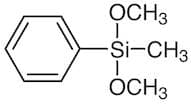
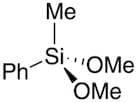
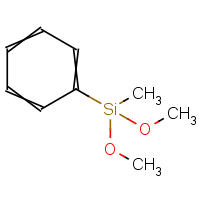
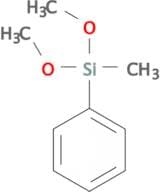
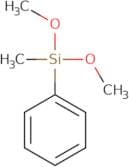
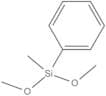
CAS 3027-21-2
:(Dimetossimetilsilil)benzene
- (Dimethoxymethylsilyl)benzene
- Benzene, (dimethoxymethylsilyl)-
- Dimethoxylmethylphenylsilane
- Dimethoxyphenylmethylsilane
- Fenyl-dimethoxy-methylsilan
- Kbm 102
- Kh 1621
- Ls 2720
- Methyl phenyl 2-methyl triethoxysilane
- Methylphenyldimethoxysilane
- NSC 93924
- Phenylmethyldimethoxysilane
- SM 2 (silane)
- Silane, dimethoxymethylphenyl-
- Sip 6740
- Sip 6740.0
- Z 6073
- Vedi altri sinonimi
Dimethoxymethylphenylsilane
CAS:Formula:C9H14O2SiPurezza:>98.0%(GC)Colore e forma:Colorless to Almost colorless clear liquidPeso molecolare:182.29Methylphenyldimethoxysilane, min. 97%
CAS:Methylphenyldimethoxysilane, min. 97%
Formula:(CH3)(C6H5)Si(OCH3)2Purezza:min. 97%Colore e forma:colorless liq.Peso molecolare:182.30DIMETHOXYMETHYLPHENYLSILANE
CAS:Formula:C9H14O2SiPurezza:98%Colore e forma:LiquidPeso molecolare:182.2918Dimethoxymethylphenylsilane
CAS:DimethoxymethylphenylsilaneFormula:C9H14O2SiPurezza:98%Colore e forma: liquidPeso molecolare:182.29g/molMethylphenyldimethoxysilane
CAS:S11550 - Methylphenyldimethoxysilane
Formula:C9H14O2SiPurezza:95%Colore e forma:LiquidPeso molecolare:182.294Dimethoxymethylphenylsilane
CAS:Dimethoxymethylphenylsilane is a chemical compound that can be used as a substrate film. It is commonly used in gravimetric analysis, thermal expansion, and electrochemical impedance spectroscopy. Dimethoxymethylphenylsilane has been shown to form cationic polymers when heated with fatty acids. This polymerization process requires hydrochloric acid for activation. Dimethoxymethylphenylsilane has also been shown to react with zirconium oxide at high temperatures and form a reactive surface layer of titanium dioxide on the surface of the zirconium oxide. The molecule consists of an oxygen atom, two methyl groups, and two phenyl groups. The solid catalyst has a diameter of approximately 1 nm and its NMR spectra are consistent with those expected for this type of molecule.Purezza:Min. 95%PHENYLMETHYLDIMETHOXYSILANE
CAS:Aromatic Silane - Conventional Surface Bonding
Aliphatic, fluorinated aliphatic or substituted aromatic hydrocarbon substituents are the hydrophobic entities which enable silanes to induce surface hydrophobicity. The organic substitution of the silane must be non-polar. The hydrophobic effect of the organic substitution can be related to the free energy of transfer of hydrocarbon molecules from an aqueous phase to a homogeneous hydrocarbon phase. A successful hydrophobic coating must eliminate or mitigate hydrogen bonding and shield polar surfaces from interaction with water by creating a non-polar interphase. Although silane and silicone derived coatings are in general the most hydrophobic, they maintain a high degree of permeability to water vapor. This allows coatings to breathe and reduce deterioration at the coating interface associated with entrapped water. Since ions are not transported through non-polar silane and silicone coatings, they offer protection to composite structures ranging from pigmented coatings to rebar reinforced concrete. A selection guide for hydrophobic silanes can be found on pages 22-31 of the Hydrophobicity, Hydrophilicity and Silane Surface Modification brochure.
Phenylmethyldimethoxysilane; Methylphenyldimethoxysilane; Dimethoxymethylphenylsilane
Viscosity, 20 °C: 1.65 cStAdditive to coupling agent systems, increasing interface flexibility, UV stabilityDialkoxy silaneFormula:C9H14O2SiPurezza:97%Colore e forma:Straw LiquidPeso molecolare:182.29Ref: 3H-SIP6740.0
Prodotto fuori produzione