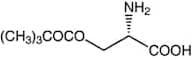
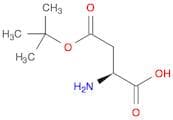
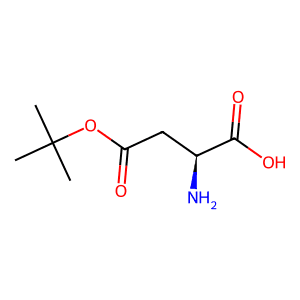
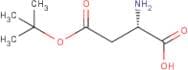
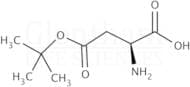
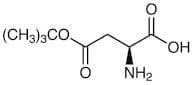
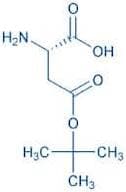
CAS 3057-74-7
:4-(1,1-Dimetiletil) idrogeno L-aspartato
Descrizione:
4-(1,1-Dimetiletil) idrogeno L-aspartato, noto anche con il suo numero CAS 3057-74-7, è un derivato di aminoacido che presenta un gruppo tert-butile attaccato al carbonio alfa dell'L-aspartato. Questo composto è caratterizzato dalla sua complessità strutturale, che include sia un gruppo amminico che un gruppo carbossilico, tipico degli aminoacidi. La presenza del voluminoso gruppo tert-butile influenza le sue proprietà steriche e può influenzare la sua solubilità e reattività. In generale, i derivati degli aminoacidi come questo sono di interesse nella ricerca biochimica e nelle applicazioni farmaceutiche a causa dei loro potenziali ruoli nella sintesi proteica e nelle vie metaboliche. Il composto può mostrare specifiche attività biologiche, sebbene siano necessari studi dettagliati per chiarire le sue funzioni e interazioni esatte nei sistemi biologici. Inoltre, la sua stabilità e comportamento in vari solventi possono essere influenzati dalla presenza del gruppo tert-butile, rendendolo un argomento di interesse sia nella sintesi organica che nella chimica medicinale.
Formula:C8H15NO4
InChI:InChI=1S/C8H15NO4/c1-8(2,3)13-6(10)4-5(9)7(11)12/h5H,4,9H2,1-3H3,(H,11,12)/t5-/m0/s1
InChI key:InChIKey=MXWMFBYWXMXRPD-YFKPBYRVSA-N
SMILES:C(C(OC(C)(C)C)=O)[C@@H](C(O)=O)N
Sinonimi:- (2R)-2-ammonio-4-tert-butoxy-4-oxobutanoate
- (2S)-2-Amino-4-(tert-butoxy)-4-oxobutanoic acid
- (2S)-2-Amino-4-[(2-methylpropan-2-yl)oxy]-4-oxobutanoic acid
- (2S)-2-ammonio-4-tert-butoxy-4-oxobutanoate
- (S)-2-Amino-4-tert-butoxy-4-oxobutanoic acid
- 2-Amino-4-Tert-Butoxy-4-Oxobutanoic Acid (Non-Preferred Name)
- 4-(1,1-Dimethylethyl) hydrogen <span class="text-smallcaps">L</span>-aspartate
- <span class="text-smallcaps">L</span>-Aspartic acid 4-tert-butyl ester
- <span class="text-smallcaps">L</span>-Aspartic acid β-tert-butyl ester
- <span class="text-smallcaps">L</span>-Aspartic acid, 4-(1,1-dimethylethyl) ester
- Aspartic acid β-tert-butyl ester
- Aspartic acid, 4-tert-butyl ester
- L-Aspartic acid-4-tert-butyl ester
- β-tert-Butyl <span class="text-smallcaps">L</span>-aspartate
- β-tert-Butyl aspartate
- 4-(1,1-Dimethylethyl) hydrogen L-aspartate
- L-Aspartic acid, 4-(1,1-dimethylethyl) ester
- Vedi altri sinonimi
Ordinare per
Purezza (%)
0
100
|
0
|
50
|
90
|
95
|
100
10 prodotti.
L-Aspartic acid 4-tert-butyl ester, 98%
CAS:This Thermo Scientific Chemicals brand product was originally part of the Alfa Aesar product portfolio. Some documentation and label information may refer to the legacy brand. The original Alfa Aesar product / item code or SKU reference has not changed as a part of the brand transition to Thermo SciFormula:C8H15NO4Purezza:98%Peso molecolare:189.21L-Aspartic acid 4-tert-butyl ester
CAS:Formula:C8H15NO4Purezza:98%Colore e forma:SolidPeso molecolare:189.2090Ref: IN-DA0037P3
1kgPrezzo su richiesta5kgPrezzo su richiesta1g26,00€5g27,00€10g36,00€25g68,00€100g166,00€500g556,00€(2S)-2-Amino-4-tert-butoxy-4-oxo-butanoic acid
CAS:(2S)-2-Amino-4-tert-butoxy-4-oxo-butanoic acidPurezza:98%Peso molecolare:189.21g/mol4-tert-Butyl L-Aspartate
CAS:Formula:C8H15NO4Purezza:>98.0%(T)Colore e forma:White to Almost white powder to crystalPeso molecolare:189.21L-Aspartic acid 4-tert-butyl ester
CAS:H-Asp(OtBu)-OH (L-Aspartic acid 4-tert-butyl ester) is an aspartic acid derivative that can be used for the synthesis of short peptides.Formula:C8H15NO4Purezza:99.77% - 99.87%Colore e forma:SolidPeso molecolare:189.21H-Asp(OtBu)-OH
CAS:M03010 - H-Asp(OtBu)-OH
Formula:C8H15NO4Purezza:98%Colore e forma:Solid, White powderPeso molecolare:189.211L-Aspartic Acid 4-tert-Butyl Ester
CAS:Prodotto controllatoStability Hygroscopic
Applications L-Aspartic acid 4-tert-butyl ester is a protected form of L-Aspartic acid (A790024). L-Aspartic acid is a nonessential amino acid that is used to biosynthesize other amino acids within the human body. L-Aspartic acid also increases membrane conductance of mammalian neurons by voltage-dependent means, causing depolarization and nerve impulses that travel to key areas of the central nervous system.
References Anderson, H., et al.: J. Nutr., 99, 82 (1969); Honey, C., et al.: Neurosci. Lett., 61, 135 (1985); MacDonald, J., et al.: Brain Res., 237, 248 (1982)Formula:C8H15NO4Colore e forma:NeatPeso molecolare:189.21H-Asp(OtBu)-OH
CAS:Bachem ID: 4002930.
Formula:C8H15NO4Purezza:> 99%Colore e forma:White PowderPeso molecolare:189.21