CAS 3061-91-4
:val-tir
Descrizione:
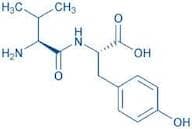
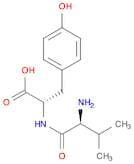
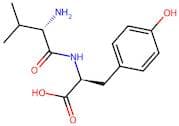
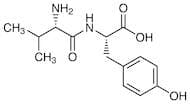
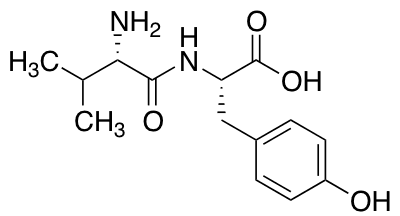
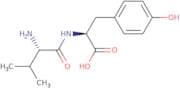
La sostanza chimica nota come "val-tir," con il numero CAS 3061-91-4, è un dipeptide composto dagli amminoacidi valina e tirosina. È classificata come un derivato di amminoacido non essenziale, il che significa che può essere sintetizzata dal corpo. val-tir presenta caratteristiche tipiche dei peptidi, inclusa la capacità di formare legami idrogeno e partecipare a varie interazioni biochimiche. La sua struttura include un legame peptidico che collega il gruppo carbossilico della valina al gruppo amminico della tirosina. Questo composto può svolgere un ruolo nella sintesi proteica e può essere coinvolto in vari percorsi metabolici. Inoltre, val-tir può mostrare attività biologiche specifiche, come proprietà antiossidanti, grazie alla presenza del residuo aromatico di tirosina. È solubile in acqua e può essere utilizzato in contesti di ricerca per studiare il comportamento dei peptidi e le interazioni nei sistemi biologici. Come molti peptidi, la sua stabilità e attività possono essere influenzate da fattori come pH e temperatura.
Formula:C14H20N2O4
InChI:InChI=1/C14H20N2O4/c1-8(2)12(15)13(18)16-11(14(19)20)7-9-3-5-10(17)6-4-9/h3-6,8,11-12,17H,7,15H2,1-2H3,(H,16,18)(H,19,20)/t11-,12-/m0/s1
InChI key:InChIKey=VEYJKJORLPYVLO-RYUDHWBXSA-N
SMILES:C([C@H](NC([C@H](C(C)C)N)=O)C(O)=O)C1=CC=C(O)C=C1
Sinonimi:- (2S)-2-{[(2S)-2-ammonio-3-methylbutanoyl]amino}-3-(4-hydroxyphenyl)propanoate
- 138: PN: WO2012013136 SEQID: 183 claimed protein
- 22: PN: WO03052099 PAGE: 84 claimed protein
- 23: PN: US20090239809 SEQID: 23 claimed protein
- 29: PN: WO2005081628 SEQID: 1029 claimed protein
- 99: PN: US20070066537 PAGE: 17 claimed protein
- <span class="text-smallcaps">L</smallcap>-Tyrosine, <smallcap>L</span>-valyl-
- <span class="text-smallcaps">L</smallcap>-Tyrosine, N-<smallcap>L</span>-valyl-
- <span class="text-smallcaps">L</smallcap>-Valyl-<smallcap>L</span>-tyrosine
- H-Val-Tyr-OH
- L-Valyl-L-tyrosine
- N-<span class="text-smallcaps">L</smallcap>-Valyl-<smallcap>L</span>-tyrosine
- Tyrosine, N-<span class="text-smallcaps">L</smallcap>-valyl-, <smallcap>L</span>-
- Tyrosine, N-valyl-
- Valyltyrosine
- L-Tyrosine, N-L-valyl-
- Tyrosine, N-L-valyl-, L-
- L-Tyrosine, L-valyl-
- (S)-2-((S)-2-Amino-3-methylbutanamido)-3-(4-hydroxyphenyl)propanoic acid
- VY
- Vedi altri sinonimi
Ordinare per
Purezza (%)
0
100
|
0
|
50
|
90
|
95
|
100
7 prodotti.
H-Val-Tyr-OH
CAS:Antihypertensive dipeptide. Acts as ACE inhibitor, IC₅₀ 0.02 mg/ml. Val-Tyr showed an antihypertensive effect when administered orally to spontaneously hypertensive rats for 28 days.Formula:C14H20N2O4Purezza:> 99%Colore e forma:White PowderPeso molecolare:280.32(S)-2-((S)-2-Amino-3-Methylbutanamido)-3-(4-Hydroxyphenyl)Propanoic Acid
CAS:(S)-2-((S)-2-Amino-3-Methylbutanamido)-3-(4-Hydroxyphenyl)Propanoic AcidPurezza:98%Peso molecolare:280.32g/molH-Val-Tyr-OH
CAS:Formula:C14H20N2O4Purezza:>98.0%(HPLC)Colore e forma:White to Light yellow powder to crystalPeso molecolare:280.32H-VAL-TYR-OH
CAS:Prodotto controllatoApplications H-VAL-TYR-OH (cas# 3061-91-4) is a useful research chemical.
Formula:C14H20N2O4Colore e forma:White To Off-WhitePeso molecolare:280.32H-Val-Tyr-OH
CAS:H-Val-Tyr-OH is an organic compound that is used as a research tool. It has been shown to inhibit angiotensin system and tubule cells in vitro. H-Val-Tyr-OH has also been shown to be active against Proteus aeruginosa, which is responsible for virulent sepsis in humans. The mechanism of action for H-Val-Tyr-OH is not known, but it may involve the hydroxyl group or the proximal tubules. H-Val-Tyr-OH can be synthesized from a variety of chemical reagents, including trifluoroacetic acid and hydrochloric acid. In addition, H-Val Tyr OH can be produced by using biological samples such as wheat germ and human test samples.Formula:C14H20N2O4Purezza:Min. 95%Colore e forma:PowderPeso molecolare:280.32 g/mol(S)-2-((S)-2-AMINO-3-METHYLBUTANAMIDO)-3-(4-HYDROXYPHENYL)PROPANOIC ACID
CAS:Purezza:97%Peso molecolare:280.3240051