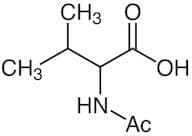
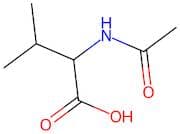
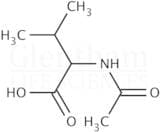
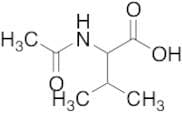
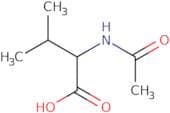
CAS 3067-19-4
:N-Acetilvalina
- 2-Acetamido-3-methylbutanoic acid
- <span class="text-smallcaps">DL</span>-N-Acetylvaline
- <span class="text-smallcaps">DL</span>-Valine, N-acetyl-
- Ac-DL-Val-OH
- Acetyl-<span class="text-smallcaps">DL</span>-valine
- N-Acetyl-<span class="text-smallcaps">DL</span>-valine
- N-Acetylvaline
- Nsc 122016
- Valine, N-acetyl-
- Valine, N-acetyl-, <span class="text-smallcaps">DL</span>-
- Valine, N-acetyl-, DL-
- N-Acetyl-DL-valine
- Vedi altri sinonimi
N-Acetyl-DL-valine
CAS:Formula:C7H13NO3Purezza:>98.0%(T)Colore e forma:White to Almost white powder to crystalPeso molecolare:159.19N-Acetyl-DL-valine
CAS:Formula:C7H13NO3Purezza:98.0 - 102.0 %Colore e forma:White to off-white crystalline powderPeso molecolare:159.19N-Acetyl-DL-Valine
CAS:Prodotto controllatoApplications N-Acetyl-DL-Valine is an amino acid.
References Hirschmann R., et al.: Science, 265, 234 (1994); Gu Z. T., et al.: J. Magn. Reson., 140, 340 (1999); Bodalo, A., et al.: Enzyme Microb. Technol., 24, 381 (1999)Formula:C7H13NO3Colore e forma:NeatPeso molecolare:159.183N-Acetyl-DL-valine
CAS:N-Acetyl-DL-valine is an amide that is used as a model system for studying enzyme reactions. It was found to have copper complex, which is a potent inhibitor of fatty acid synthase and proton receptors. It has been shown to be effective in the treatment of cancer due to its ability to inhibit the growth of tumor cells. In addition, this compound has been shown to be specific for cancer cells as it does not affect healthy cells. N-Acetyl-DL-valine also has the ability to inhibit the activity of enzymes that are involved in fatty acid synthesis, such as acetoacetate decarboxylase and beta-ketoacyl synthase.
Formula:C7H13NO3Purezza:Min. 95%Colore e forma:PowderPeso molecolare:159.18 g/mol