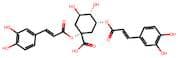
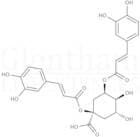
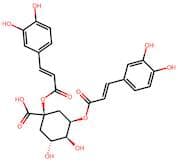
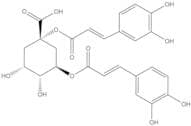
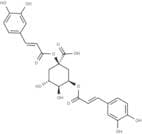
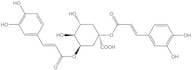
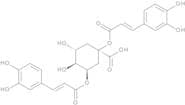
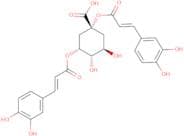
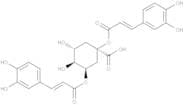
![2-allyl-1,4-bis[[3-(3,4-dihydroxyphenyl)-1-oxo]oxy]-3,5-dihydroxycyclohexanecarboxylic acid](/_next/image/?url=https%3A%2Fstatic.cymitquimica.com%2Fcas-image%2Fthumb-webp%2F49776-cynarin.webp&w=3840&q=75)
CAS 30964-13-7
:acido 2-allil-1,4-bis[[3-(3,4-diidrossifenil)-1-osso]ossi]-3,5-diidrossicicloesancarboxilico
Descrizione:
acido 2-allil-1,4-bis[[3-(3,4-diidrossifenil)-1-osso]ossi]-3,5-diidrossicicloesancarboxilico, con numero CAS 30964-13-7, è un composto organico complesso caratterizzato dalla sua struttura multifunzionale. Presenta un anello di cicloesano sostituito con più gruppi idrossilici, che contribuiscono alla sua potenziale solubilità in solventi polari e alla sua reattività. La presenza di gruppi alilici e fenolici suggerisce che potrebbe mostrare interessanti proprietà chimiche, inclusa la capacità di partecipare a varie reazioni come ossidazione o polimerizzazione. La struttura del composto indica una potenziale attività biologica, possibilmente come antiossidante o in altre applicazioni terapeutiche, grazie alla presenza di gruppi idrossilici che possono catturare radicali liberi. Inoltre, la presenza di legami esterei potrebbe influenzare la sua stabilità e reattività. In generale, le caratteristiche strutturali uniche di questo composto lo rendono un argomento di interesse sia nella chimica sintetica che nelle potenziali applicazioni medicinali. Ulteriori studi sarebbero necessari per chiarire completamente le sue proprietà e i suoi possibili usi.
Formula:C25H24O12
InChI:InChI=1/C25H24O12/c26-15-5-1-13(11-17(15)28)3-7-20(30)36-19-9-10-25(24(34)35,23(33)22(19)32)37-21(31)8-4-14-2-6-16(27)18(29)12-14/h1-8,11-12,19,22-23,26-29,32-33H,9-10H2,(H,34,35)/b7-3+,8-4+/t19-,22-,23+,25+/m1/s1
InChI key:InChIKey=YDDUMTOHNYZQPO-GCBRTHAASA-N
SMILES:O(C(C=CC1=CC(O)=C(O)C=C1)=O)[C@@]2(C(O)=O)C[C@@H](OC(C=CC3=CC(O)=C(O)C=C3)=O)[C@@H](O)[C@H](O)C2
Sinonimi:- (1R,3R,4S,5R)-1,3-Bis[[3-(3,4-dihydroxyphenyl)-1-oxo-2-propen-1-yl]oxy]-4,5-dihydroxycyclohexanecarboxylic acid
- (1R,3R,4S,5R)-1,3-Bis{[(2E)-3-(3,4-dihydroxyphenyl)-2-propenoyl]oxy}-4,5-dihydroxycyclohexancarbons?ure
- (1R,3R,4S,5R)-1,3-Bis{[(2E)-3-(3,4-dihydroxyphenyl)-2-propenoyl]oxy}-4,5-dihydroxycyclohexanecarboxylic acid
- (1R,3R,4S,5R)-1,3-Bis{[(2E)-3-(3,4-dihydroxyphenyl)prop-2-enoyl]oxy}-4,5-dihydroxycyclohexanecarboxylic acid
- (1S,2S,3S,4R)-1,4-bis{[(2E)-3-(3,4-dihydroxyphenyl)prop-2-enoyl]oxy}-2,3-dihydroxycyclohexanecarboxylic acid
- (1S,3R,4R,5R)-1,3-bis{[(2E)-3-(3,4-dihydroxyphenyl)prop-2-enoyl]oxy}-4,5-dihydroxycyclohexanecarboxylic acid
- (3R,5R)-1-acetyl-3,5-dihydroxycyclohexane-1,4-diyl (2E,2'E)bis[3-(3,4-dihydroxyphenyl)prop-2-enoate]
- 1,4-bis{[(2E)-3-(3,4-dihydroxyphenyl)prop-2-enoyl]oxy}-3,5-dihydroxycyclohexanecarboxylic acid
- 1,5-Dicaffeoylquinic Acid
- 1,5-Dicaffeylquinic Acid
- 1-Carboxy-4,5-dihydroxy-1,3-cyclohexylenebis-(3,4-dihydroxycinnamate)
- 3,4-Dihydroxycinnamic Acid 1-Carboxy-4,5-dihydroxy-1,3-cyclohexylene Ester
- 4-{[3-(3,4-dihydroxyphenyl)acryloyl]oxy}-1-{[(2E)-3-(3,4-dihydroxyphenyl)prop-2-enoyl]oxy}-3,5-dihydroxycyclohexanecarboxylic acid
- Acide (1R,3R,4S,5R)-1,3-bis{[(2E)-3-(3,4-dihydroxyphényl)-2-propènan-1-oyl]oxy}-4,5-dihydroxycyclohexanecarboxylique
- Caffeic Acid 1-Carboxy-4,5-dihydroxy-1,3-cyclohexylene Ester
- Cinarin
- Cinarine
- Cinnamic acid, 3,4-dihydroxy-, 1-carboxy-4,5-dihydroxy-1,3-cyclohexylene ester
- Cyclohexanecarboxylic acid, 1,3-bis[[3-(3,4-dihydroxyphenyl)-1-oxo-2-propen-1-yl]oxy]-4,5-dihydroxy-, (1R,3R,4S,5R)-
- Cyclohexanecarboxylic acid, 1,3-bis[[3-(3,4-dihydroxyphenyl)-1-oxo-2-propenyl]oxy]-4,5-dihydroxy-, (1R,3R,4S,5R)-
- Cyclohexanecarboxylic acid, 1,3-bis[[3-(3,4-dihydroxyphenyl)-1-oxo-2-propenyl]oxy]-4,5-dihydroxy-, [1R-(1α,3α,4α,5β)]-
- Cynarin
- Cynarin(1,3-Dicaffeoylquinic Acid)
- Cynarine
- Lynare Scolymusl P.E.
- [1R-(1a,3a,4a,5b)]-1,3-Bis[[3-(3,4-dihydroxyphenyl)-1-oxo-2-propenyl]oxy]-4,5-dihydroxycyclohexanecarboxylic Acid
- cyclohexanecarboxylic acid, 1,3-bis[[(2E)-3-(3,4-dihydroxyphenyl)-1-oxo-2-propen-1-yl]oxy]-4,5-dihydroxy-, (1R,3R,4S,5R)-
- CYNARIN(ARTICHOKE)(1,5-DICAFFEOYLQUINIC ACID)(P)
- CYNARIN(ARTICHOKE)
- CYNARIN(ECHINACEA)
- 1β,3β-Bis[3-(3,4-dihydroxyphenyl)propenoyloxy]-4β,5α-dihydroxycyclohexanecarboxylic acid
- CYNARIN(ECHINACEA)(1,3-DICAFFEOYLQUINIC ACID)(AHP)
- (1R)-1β,3β-Bis[[3-(3,4-dihydroxyphenyl)-1-oxo-2-propenyl]oxy]-4β,5α-dihydroxycyclohexanecarboxylic acid
- (1R,3R,4S,5R)-1,3-Bis[[3-(3,4-dihydroxyphenyl)propenoyl]oxy]-4,5-dihydroxycyclohexanecarboxylic acid
- 1,3-DICAFFEOYLQUINIC ACID
- CINARAN
- (1R)-1,5α-Bis[3-(3,4-dihydroxyphenyl)acryloyloxy]-3β,4α-dihydroxycyclohexane-1β-carboxylic acid
- Vedi altri sinonimi
Ordinare per
Purezza (%)
0
100
|
0
|
50
|
90
|
95
|
100
10 prodotti.
Cynarin
CAS:Cynarin analytical standard provided with w/w absolute assay, to be used for quantitative titration.Formula:C25H24O12Purezza:(HPLC) ≥98%Colore e forma:PowderPeso molecolare:516.46Cyclohexanecarboxylic acid,1,3-bis[[3-(3,4-dihydroxyphenyl)-1-oxo-2-propenyl]oxy]-4,5-dihydroxy-,(1R,3R,4S,5R)-
CAS:Formula:C25H24O12Purezza:98%Colore e forma:SolidPeso molecolare:516.4509(1R,3R,4S,5R)-1,3-Bis((3-(3,4-Dihydroxyphenyl)Acryloyl)Oxy)-4,5-Dihydroxycyclohexanecarboxylic Acid
CAS:(1R,3R,4S,5R)-1,3-Bis((3-(3,4-Dihydroxyphenyl)Acryloyl)Oxy)-4,5-Dihydroxycyclohexanecarboxylic AcidPurezza:98%Peso molecolare:516.45g/molCynarin
CAS:Formula:C25H24O12Purezza:≥ 98.0%Colore e forma:White to yellow powderPeso molecolare:516.45Cynarine
CAS:1,5-Dicaffeoylquinic acid (1,5-DQA), a caffeoylquinic acid derivative isolated from Aster scaber, has neuroprotective effects, can prevent Aβ(42)-induced neurotoxicity through the activation of PI3K/Akt followed by the stimulation of Trk A, then the inhibition of GSK3β as well as the modulation of Bcl-2/Bax.Formula:C25H24O12Purezza:95%~99%Peso molecolare:516.455Cynarin
CAS:Cynarin (1,5-Dicaffeoylquinic acid) has neuroprotective, and antioxidant effects, it can inhibition of GSK3β as well as the modulation of Bcl-2/Bax.
Formula:C25H24O12Purezza:99.48% - 99.88%Colore e forma:SolidPeso molecolare:516.45Cynarin
CAS:Carboxylic acid with additional oxygen functionsFormula:C25H24O12Purezza:≥ 98.0 % (HPLC)Colore e forma:PowderPeso molecolare:516.461,3-Dicaffeoylquinic acid
CAS:1,3-Dicaffeoylquinic acid is a bioactive compound, which is a type of caffeoylquinic acid. This compound is commonly found in various plant sources, including coffee, artichokes, and certain herbal extracts. It is part of a larger family of polyphenolic compounds that are notable for their diverse biological activities.
Formula:C25H24O12Purezza:Min. 95%Colore e forma:White PowderPeso molecolare:516.45 g/mol

![Cyclohexanecarboxylic acid,1,3-bis[[3-(3,4-dihydroxyphenyl)-1-oxo-2-propenyl]oxy]-4,5-dihydroxy-,(…](/_next/image/?url=https%3A%2Fstatic.cymitquimica.com%2Fproducts%2FIN%2Fthumb%2FDA00I5ST.jpg&w=3840&q=75)