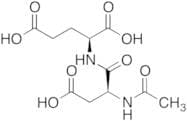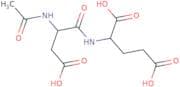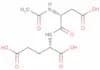
CAS 3106-85-2
:Acido N-acetilaspartilglutammico
Descrizione:
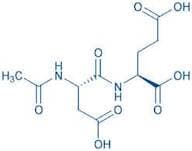
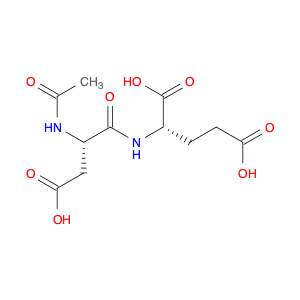
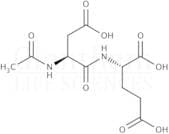
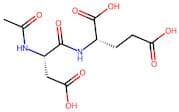
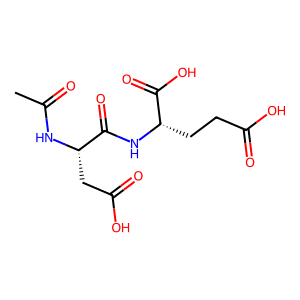
Acido N-acetilaspartilglutammico, comunemente noto come NAAG, è un dipeptide che si verifica naturalmente composto dagli aminoacidi N-acetilaspartato e glutammato. È classificato come un neurotrasmettitore e gioca un ruolo significativo nel sistema nervoso centrale, in particolare nella modulazione della trasmissione sinaptica e nella neuroprotezione. Si sa che il NAAG agisce sui recettori metabotropici del glutammato, influenzando vari processi fisiologici, inclusa la percezione del dolore e la neuroplasticità. La sostanza è solubile in acqua e presenta stabilità in condizioni fisiologiche, rendendola rilevante per la ricerca in neurobiologia e potenziali applicazioni terapeutiche. Il suo numero CAS, 3106-85-2, è utilizzato per l'identificazione nei database chimici. Il coinvolgimento del NAAG nelle malattie neurodegenerative e il suo potenziale come biomarcatore per determinate condizioni neurologiche sono aree di ricerca in corso, evidenziando la sua importanza nelle scienze di base e applicate.
Formula:C11H16N2O8
InChI:InChI=1S/C11H16N2O8/c1-5(14)12-7(4-9(17)18)10(19)13-6(11(20)21)2-3-8(15)16/h6-7H,2-4H2,1H3,(H,12,14)(H,13,19)(H,15,16)(H,17,18)(H,20,21)/t6-,7-/m0/s1
InChI key:InChIKey=OPVPGKGADVGKTG-BQBZGAKWSA-N
SMILES:[C@@H](C(N[C@@H](CCC(O)=O)C(O)=O)=O)(CC(O)=O)NC(C)=O
Sinonimi:- <span class="text-smallcaps">L</smallcap>-Glutamic acid, N-(N-acetyl-<smallcap>L</span>-α-aspartyl)-
- <span class="text-smallcaps">L</smallcap>-Glutamic acid, N-acetyl-<smallcap>L</span>-α-aspartyl-
- Ac-Asp-Glu-OH
- Acetyl-α-<span class="text-smallcaps">L</span>-aspartylglutamic acid
- Glutamic acid, N-(N-acetyl-<span class="text-smallcaps">L</smallcap>-aspartyl)-, <smallcap>L</span>-
- Isospaglumic Acid
- N-(N-Acetylaspartyl)glutamic acid
- N-Acetyl-<span class="text-smallcaps">L</smallcap>-aspartyl-<smallcap>L</span>-glutamic acid
- N-Acetyl-<span class="text-smallcaps">L</smallcap>-α-aspartyl-<smallcap>L</span>-glutamic acid
- N-Acetyl-α-<span class="text-smallcaps">L</smallcap>-aspartyl-<smallcap>L</span>-glutamic acid
- N-Acetyl-α-aspartylglutamic acid
- N-Acetylaspartylglutamic acid
- N-acetyl-D-alpha-aspartyl-L-glutamic acid
- N-acetyl-L-alpha-aspartyl-L-glutamic acid
- N-acetyl-alpha-aspartylglutamic acid
- α-Spaglumic acid
- L-Glutamic acid, N-acetyl-L-α-aspartyl-
- Glutamic acid, N-(N-acetyl-L-aspartyl)-, L-
- N-Acetyl-L-α-aspartyl-L-glutamic acid
- Vedi altri sinonimi
Ordinare per
Purezza (%)
0
100
|
0
|
50
|
90
|
95
|
100
11 prodotti.
Ac-Asp-Glu-OH
CAS:An endogenous dipeptide with high affinity for a brain glutamate receptor. NAAG is the most abundant peptide neurotransmitter in the mammalian central nervous system.Formula:C11H16N2O8Purezza:> 99%Colore e forma:White PowderPeso molecolare:304.26L-Glutamic acid, N-acetyl-L-α-aspartyl-
CAS:Formula:C11H16N2O8Purezza:95%Colore e forma:SolidPeso molecolare:304.2533N-Acetyl-Asp-Glu
CAS:Formula:C11H16N2O8Purezza:≥ 95.0%Colore e forma:White to off-white powderPeso molecolare:304.25(S)-2-((S)-2-Acetamido-3-Carboxypropanamido)Pentanedioic Acid
CAS:(S)-2-((S)-2-Acetamido-3-Carboxypropanamido)Pentanedioic AcidPurezza:95%Peso molecolare:304.25g/molSpaglumic acid
CAS:Spaglumic acid (N-Acetylaspartylglutamic acid) is a neuropeptide found in millimolar concentrations in the brain.Formula:C11H16N2O8Purezza:99.92%Colore e forma:White PowderPeso molecolare:304.25Spaglumic Acid-d3
CAS:Prodotto controllatoStability Hygroscopic
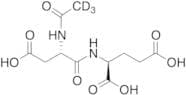
Applications Spaglumic Acid-d3 is the isotope labelled analogue of Spaglumic Acid, a marker of neuronal integrity and was used in the detection of therapeutic values of antidrepressant treatments.
References Taylor, M.J., et al.: Int. J. Neuropharmacol., 15, 1541 (2012); Shi, D.X., et al.: J. Neurochem., 123, 971 (2012); Sun,W., et al.: Science., 339, 197 (2013);Formula:C11H13D3N2O8Colore e forma:NeatPeso molecolare:307.27N-Acetyl-L-aspartyl-L-glutamic acid
CAS:N-Acetyl-L-aspartyl-L-glutamic acid is an amino acid that is used as a substrate in the biochemical assay for glutamate. It is also used to measure brain functions. NAAG is a low potency agonist of the NMDA receptor, which may contribute to neuronal death. NAAG is used as a model system to study bowel disease and eosinophil cationic protein. It has been shown to be effective in vitro against cancer cells and fungi. The structural analysis of NAAG has revealed that it contains an acidic group on its side chain, which can be detected with a pH indicator such as phenol red or bromocresol purple.Formula:C11H16N2O8Purezza:Min. 95 Area-%Colore e forma:White Off-White PowderPeso molecolare:304.25 g/molSpaglumic Acid
CAS:Prodotto controllatoApplications Spaglumic Acid is a marker of neuronal integrity and was used in the detection of therapeutic values of antidrepressant treatments.
References Taylor, M.J., et al.: Int. J. Neuropharmacol., 15, 1541 (2012); Shi, D.X., et al.: J. Neurochem., 123, 971 (2012); Sun,W., et al.: Science., 339, 197 (2013);Formula:C11H16N2O8Colore e forma:NeatPeso molecolare:304.25Ac-Asp-Glu • H2O
CAS:Ac-Asp-Glu • H2O is a water soluble molecule that belongs to the class of inhibitors. It has been shown to inhibit the polymerase chain reaction and is used as an analytical method for detecting DNA sequences. Ac-Asp-Glu • H2O induces neuronal death in the caudate putamen, thereby causing bowel disease, by inhibiting energy metabolism. This compound also inhibits the synthesis of proteins in the hippocampus, which leads to reduced locomotor activity and eosinophil cationic protein production. Ac-Asp-Glu • H2O is acidic and its concentration–time curve shows a bell shape. The half life of this compound is six hours.Formula:C11H16N2O8•H2OPurezza:Min. 95%Peso molecolare:322.28 g/mol