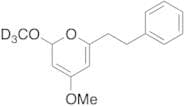
CAS 3155-51-9
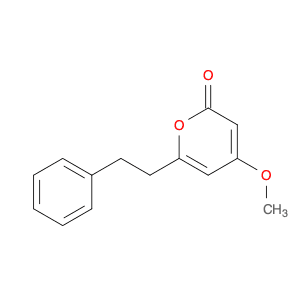
:5,6-Dideidro-7,8-diidrocavaina
Descrizione:
5,6-Dideidro-7,8-diidrocavaina, identificato dal suo numero CAS 3155-51-9, è un composto chimico appartenente alla classe dei prodotti naturali noti come calcone. È derivato da specie vegetali del genere *Kawain*, noto per le sue proprietà psicoattive. Questo composto presenta una struttura unica caratterizzata da un sistema coniugato di doppi legami, che contribuisce alla sua potenziale attività biologica. Mostra proprietà come effetti antiossidanti e anti-infiammatori, che hanno suscitato interesse nella ricerca farmacologica. Il composto è tipicamente studiato per i suoi effetti sul sistema nervoso centrale e può interagire con vari sistemi di neurotrasmettitori. Inoltre, la sua solubilità e stabilità possono variare a seconda delle condizioni ambientali, il che è importante per la sua applicazione sia nella ricerca che nei potenziali contesti terapeutici. Come molti prodotti naturali, sono necessari ulteriori studi per chiarire completamente i suoi meccanismi d'azione e i potenziali benefici per la salute.
Formula:C14H14O3
InChI:InChI=1/C14H14O3/c1-16-13-9-12(17-14(15)10-13)8-7-11-5-3-2-4-6-11/h2-6,9-10H,7-8H2,1H3
InChI key:InChIKey=OVXOWIKMOIVICB-UHFFFAOYSA-N
SMILES:C(CC1=CC=CC=C1)C2=CC(OC)=CC(=O)O2
Sinonimi:- 2,4-Heptadienoic acid, 5-hydroxy-3-methoxy-7-phenyl-, δ-lactone
- 2H-Pyran-2-one, 4-methoxy-6-(2-phenylethyl)-
- 2H-Pyran-2-one, 4-methoxy-6-phenethyl-
- 5,6-Dehydro-7,8-dihydrokavain
- 5,6-Didehydro-7,8-dihydrokawain
- Kawain, 5,6-dehydro-7,8-dihydro-
- 4-Methoxy-6-(2-phenylethyl)-2H-pyran-2-one
- 7,8-dihydro-5,6-dehydrokawain
Ordinare per
Purezza (%)
0
100
|
0
|
50
|
90
|
95
|
100
5 prodotti.
7,8-dihydro-5,6-dehydrokawain
CAS:Formula:C14H14O3Purezza:98.0%Colore e forma:SolidPeso molecolare:230.25925,6-dehydro 7,8-dihydrokavain
CAS:LactoneFormula:C14H14O3Purezza:≥ 95.0 % (HPLC)Colore e forma:PowderPeso molecolare:230.264-Methoxy-6-(2-phenylethyl)-2H-pyran-2-one
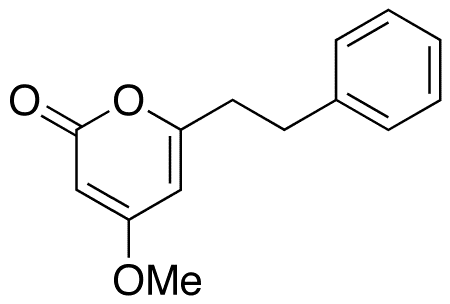
CAS:Prodotto controllatoApplications 4-Methoxy-6-(2-phenylethyl)-2H-pyran-2-one is a Kawain (K145490) derivative that is known to exhibit antimalarial and antituberculosis activities. 4-Methoxy-6-(2-phenylethyl)-2H-pyran-2-one has been identified as a lead compound for the dual treatment of malaria and leishmaniasis.
References McCracken, S.T., et al.: Bioorg. Med. Chem., 20, 1482 (2012); Elzaawely, A.A.. et al.: Food. Chem., 103, 486 (2007); Xuan, T.D., et al.: J. Natural. Med., 62, 188 (2008);Formula:C14H14O3Colore e forma:NeatPeso molecolare:230.264-Methoxy-6-(2-phenylethyl)-2H-pyran-2-one
CAS:4-Methoxy-6-(2-phenylethyl)-2H-pyran-2-one is a phosphorothionate insecticide that has been used in biotechnology and horticulture. It is effective against termites, ants, and plant pathogenic fungi. The mechanism of action for this compound is not well understood, but it has been shown to have antifungal activity against different species of fungi. 4-Methoxy-6-(2-phenylethyl)-2H-pyran-2-one can be synthesized from 2,4,6,-triisopropylbenzenesulfonyl chloride with alpine plants such as alpinia or corticium. This compound also has a pleasant odor reminiscent of the aromatic ethers found in speciosa leaves. The chemical structure of 4-methoxy-6-(2 phenylethyl)-2H pyran 2 one can beFormula:C14H14O3Purezza:Min. 95%Colore e forma:PowderPeso molecolare:230.26 g/mol4-Methoxy-6-(2-phenylethyl)-2H-pyran-2-one-d3
CAS:Prodotto controllatoFormula:C15D3H15O3Colore e forma:NeatPeso molecolare:249.32