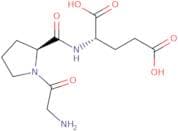
CAS 32302-76-4
:glicil-L-prolil-L-glutammico acido
Descrizione:
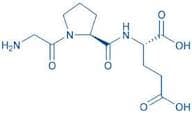
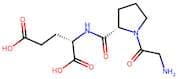
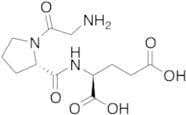
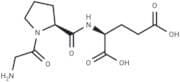
glicil-L-prolil-L-glutammico acido, noto anche con il suo numero CAS 32302-76-4, è un tripeptide composto da tre amminoacidi: glicina, prolina e acido glutammico. Questo composto presenta caratteristiche tipiche dei peptidi, inclusa la capacità di formare legami idrogeno e adottare conformazioni specifiche a causa della sua sequenza di amminoacidi. glicil-L-prolil-L-glutammico acido è noto per le sue potenziali attività biologiche, che possono includere ruoli nella segnalazione cellulare e nella modulazione dei processi fisiologici. La presenza di prolina nella sua struttura può conferire proprietà conformazionali uniche, influenzando la sua stabilità e interazione con altre biomolecole. Inoltre, il residuo di acido glutammico contribuisce alla carica complessiva del peptide e alla sua idrofobicità, il che può influenzare la sua solubilità in ambienti acquosi. Questo tripeptide può essere di interesse in vari campi, tra cui biochimica e farmacologia, per le sue potenziali applicazioni nello sviluppo di farmaci e come strumento di ricerca nello studio delle interazioni e delle funzioni dei peptidi.
Formula:C12H19N3O6
InChI:InChI=1/C12H19N3O6/c13-6-9(16)15-5-1-2-8(15)11(19)14-7(12(20)21)3-4-10(17)18/h7-8H,1-6,13H2,(H,14,19)(H,17,18)(H,20,21)/t7-,8-/m0/s1
SMILES:C1C[C@@H](C(=N[C@@H](CCC(=O)O)C(=O)O)O)N(C1)C(=O)CN
Sinonimi:- L-glutamic acid, glycyl-L-prolyl-
- Glycyl-Prolyl-Glutamic Acid
Ordinare per
Purezza (%)
0
100
|
0
|
50
|
90
|
95
|
100
5 prodotti.
IGF-I (1-3)
CAS:This N-terminal tripeptide of IGF-I facilitated the in vitro release of acetylcholine with a several hundredfold higher potency (10⁻¹⁰ – 10⁻⁶ M) than intact IGF-I (4 · 10⁻⁸ M), whereas truncated IGF-I lacking the tripeptide GPE, did not show any significant effect. This raises the possibility that GPE may be the active site of IGF-I. – Although the precise mode of action of GPE is still unknown, another study suggests that local administration of GPE is neuroprotective after brain HI injury via glial cells. In addition, systemic administration of GPE showed a more widespread neuroprotective effect. Therefore, GPE may represent a complementary pathway for central and systemic IGF-1’s antiapoptotic effects.Formula:C12H19N3O6Purezza:99.7%Colore e forma:White PowderPeso molecolare:301.3Gly-Pro-Glu
CAS:Prodotto controllatoApplications GLY-PRO-GLU (cas# 32302-76-4) is a useful research chemical.
Formula:C12H19N3O6Colore e forma:NeatPeso molecolare:301.296Glypromate
CAS:Glypromate (Gly-Pro-Glu) is a neuroprotective agent, is a weak NMDA receptor agonistFormula:C12H19N3O6Purezza:98%Colore e forma:SolidPeso molecolare:301.3IGF-I (1-3)
CAS:IGF-I (1-3) H-Gly-Pro-Glu-OH is a synthetic peptide that has been shown to be effective in treating neuronal death caused by glutamate. It binds to calcium ions and inhibits the activity of gamma-aminobutyric acid, which is an inhibitory neurotransmitter. IGF-I (1-3) H-Gly-Pro-Glu-OH also blocks fatty acid synthesis, leading to necrotic cell death. In vitro assays have shown that this drug can protect against blood group O erythrocytes from pyridoxal phosphate oxidation and protocatechuic acid binding. This drug has also been shown to increase locomotor activity in mice, as well as improve motor function in rats with experimental stroke. IGF-I (1-3) H-Gly-Pro-Glu-OH is synthesized using a polymerase chain reaction technique and consists of amino acids 1 through 3 ofFormula:C12H19N3O6Purezza:Min. 95%Peso molecolare:301.3 g/mol