CAS 32659-49-7
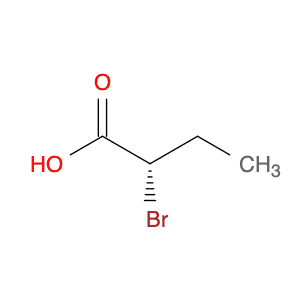
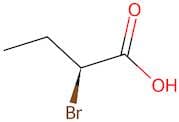
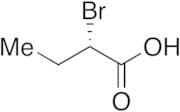
:Acido butanoico, 2-bromo-, (2S)-
Descrizione:
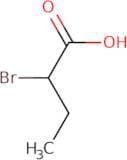
L'acido butanoico, 2-bromo-, (2S)-, con il numero CAS 32659-49-7, è un composto chirale caratterizzato dalla presenza di un atomo di bromo al secondo carbonio della catena dell'acido butanoico. Questo composto appartiene alla classe degli acidi carbossilici, noti per le loro proprietà acide grazie alla presenza di un gruppo carbossilico (-COOH). La designazione (2S) indica che ha una stereochimica specifica, rendendolo uno dei due enantiomeri. L'acido butanoico stesso è un acido grasso a catena dritta di quattro carboni, e l'introduzione dell'atomo di bromo può influenzare la sua reattività e le interazioni con altre molecole. La presenza dell'atomo di bromo può aumentare il suo carattere elettrofilo, rendendolo utile in varie reazioni chimiche, comprese le reazioni di sostituzione e accoppiamento. Inoltre, i derivati dell'acido butanoico sono spesso studiati per la loro attività biologica e potenziali applicazioni in prodotti farmaceutici e agrochimici. In generale, questo composto presenta proprietà uniche grazie alle sue caratteristiche strutturali e stereochimica.
Formula:C4H7BrO2
Sinonimi:- Butanoicacid, 2-bromo-, (S)-
- Butyric acid, 2-bromo-, (S)-
- (S)-2-Bromobutanoicacid
- (S)-2-Bromobutyric acid
- L-2-Bromobutanoic acid
- L-2-Bromobutyric acid
- L-a-Bromobutanoic acid
Ordinare per
Purezza (%)
0
100
|
0
|
50
|
90
|
95
|
100
6 prodotti.
(S)-2-Bromobutyric Acid
CAS:Prodotto controllatoApplications (S)-2-Bromobutyric Acid is a key intermediate for the introduction of a particular stereogenic unit into the structure of chiral active pharmaceutical compounds,
Not a dangerous good if item is equal to or less than 1g/ml and there is less than 100g/ml in the package
References Brenna, E. et al.: Org. Proc. Res. Dev., 16, 262 (2012);Formula:C4H7BrO2Colore e forma:ColourlessPeso molecolare:167.0(S)-2-Bromobutyric acid
CAS:(S)-2-Bromobutyric acid is a chiral compound. It is an enantiomer of the biologically inactive (R)-2-bromobutyric acid. The (S)-enantiomer has been shown to exhibit biological activity, with a kinetic and detectable activity that are similar to those of the parent molecule. This compound can be used as a precursor for pharmaceuticals, such as antibiotics, which would be useful in cases where bacteria have developed resistance to existing antibiotics. The dehalogenase enzyme catalyzes the hydrolysis of halogenated aromatic compounds in a way that produces an alcohol and hydrogen bromide. This reaction can be detected by changes in the chemical properties of the environment or by detecting changes in the optical rotation or fluorescence of the product.Formula:C4H7BrO2Purezza:Min. 95%Peso molecolare:167 g/mol