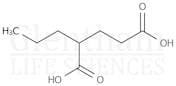
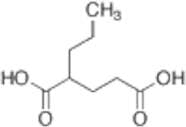
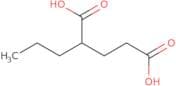
CAS 32806-62-5
:Acido 2-propilpentandioico
- 2-Propylglutaric acid
- 2-n-Propylglutaric acid
- Glutaric acid, 2-propyl-
- Pentanedioic acid, 2-propyl-
- 2-Propylpentanedioic acid
- 2-Propylglutarate
- 2-N-PROPYLGLUTARICACID
- 2-Propyl-pentanedioic Acid
- 2-Propyl-pentanedioic Aci
- 2-PROPYL GLUTARIC ACID
- 2-PGA
2-Propylglutaric acid
CAS:Formula:C8H14O4Purezza:≥ 98.0%Colore e forma:White to off-white powderPeso molecolare:174.19Ref: 4Z-G-184002
5mgPrezzo su richiesta10mgPrezzo su richiesta25mgPrezzo su richiesta50mgPrezzo su richiesta100mgPrezzo su richiesta2-Propylglutaric Acid
CAS:Prodotto controllatoApplications A metabolite of Valproic Acid.
References McLean, M.J., et al.: J. Pharmacol. Exp. Ther., 237, 1001 (1986), Lee, R.D., et al.: J. Pharm. Sci., 78, 667 (1989), Mergen, F., et al.: J. Pharm. Pharmacol., 43, 815, (1991)Formula:C8H14O4Colore e forma:NeatPeso molecolare:174.192-Propylglutaric acid
CAS:2-Propylglutaric acid (2PGA) is a metabolic byproduct of the metabolism of branched chain amino acids. It is found in urine samples and has been shown to cause liver lesions in rats. 2PGA is metabolized to propionic acid, which can be detected in urine as a marker for renal dysfunction. 2PGA also increases gamma-aminobutyric acid levels in the brain and may have an effect on GABAergic neurotransmission. The elimination rate of 2PGA is slower than that of propionic acid, which means that it persists longer in the body than other metabolites. This chemical ionization technique can be used to measure the concentration of 2PGA and other fatty acids in biological fluids.
Formula:C8H14O4Purezza:Min. 95%Colore e forma:PowderPeso molecolare:174.19 g/mol