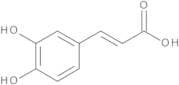
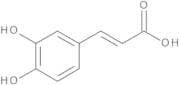
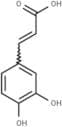
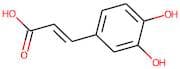
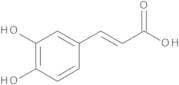
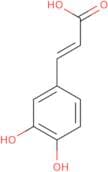
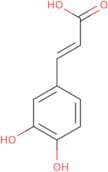
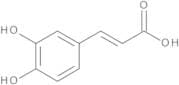
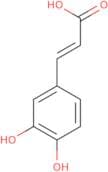
CAS 331-39-5
:Acido caffeico
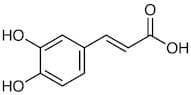
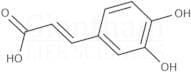
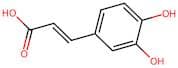
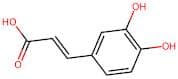
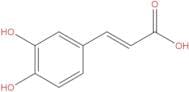
- (2E)-3-(3,4-dihydroxyphenyl)prop-2-enoate
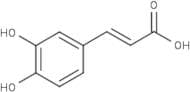
- (2E)-3-(3,4-dihydroxyphenyl)prop-2-enoic acid
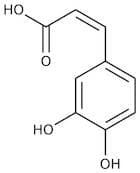
- (2Z)-3-(3,4-dihydroxyphenyl)prop-2-enoic acid
- 2-Propenoic acid, 3-(3,4-dihydroxyphenyl)-
- 3,4-Dihydroxybenzeneacrylic acid
- 3,4-Dihydroxyzimtsaure
- 3-(3,4-Dihydroxyphenyl)-2-propenoic acid
- 3-(3,4-Dihydroxyphenyl)Prop-2-Enoic Acid
- 3-(3,4-Dihydroxyphenyl)propenoic acid
- 4-(2'-Carboxyvinyl)-1,2-dihydroxybenzene
- 4-(2-Carboxyethenyl)-1,2-dihydroxybenzene
- Acide 3,4-dihydroxycinnamique
- Acido 3,4-Dihidroxicinamico
- Caffeic acid
- Cinnamic Acid, 3,4-Dihydroxy-
- Nsc 57197
- Nsc 623438
- Vedi altri sinonimi
Caffeic Acid
CAS:Formula:C9H8O4Purezza:>98.0%(T)(HPLC)Colore e forma:White to Orange to Green powder to crystalPeso molecolare:180.163,4-Dihydroxycinnamic acid, predominantly trans, 98+%
CAS:3,4-Dihydroxycinnamic acid, predominantly trans stimulates prostaglandin synthesis at high doses. It has antioxidant, anti-inflammatory, anti-tumor and immunomodulatory properties. This Thermo Scientific Chemicals brand product was originally part of the Alfa Aesar product portfolio. Some documentaFormula:C9H8O4Purezza:98+%Colore e forma:Powder, White to cream or yellow or pale brownPeso molecolare:180.16Caffeic acid
CAS:Caffeic acid analytical standard provided with w/w absolute assay, to be used for quantitative titration.Formula:C9H8O4Purezza:(HPLC) ≥99%Colore e forma:PowderPeso molecolare:180.16(E)-3,4-dihydroxycinnamic acid
CAS:Formula:C9H8O4Purezza:98%Colore e forma:SolidPeso molecolare:180.1574Caffeic acid
CAS:Formula:C9H8O4Purezza:≥ 98.5% (anhydrous basis)Colore e forma:Yellow to yellow-brown crystalline powderPeso molecolare:180.16Caffeic acid
CAS:Caffeic acidPurezza:98%Colore e forma:Light Yellow PowderPeso molecolare:180.15742g/molCaffeic Acid
CAS:Caffeic acid is a dual inhibitor of 5-lipoxygenase and TRPV1 ion channels. High-Quality, Low-Cost!Formula:C9H8O4Purezza:98.89% - 99.3%Colore e forma:Yellow Crystals From Concentrated Aqueous Solutions Alkaline Solns Turn From Yellow To Orange Alkaline Solutions Turn From Yellow To Orange (Ntp 1992)Peso molecolare:180.16Caffeic Acid
CAS:Stability Hygroscopic
Applications Caffeic Acid is a constituent of plants, probably occurs in plants only in conjugated forms. Caffeic acid is found in all plants because it is a key intermediate in the biosynthesis of lignin, one of the principal sources of biomass. Caffeic acid is one of the main natural phenols in argan oil.
References Neish, et al.: Can. J. Biochem Physiol., 37, 1431 (1959), Krasemann, et al.: Arch. Pharm., et al.: 293, 721 (1960), Wolfrom, et al.: J. Agric. Food Chem., 8, 58 (1960),Formula:C9H8O4Colore e forma:Off-WhitePeso molecolare:180.16Caffeic acid
CAS:Caffeic acid is naturally produced by the metabolism of plants and fungi. Caffeic acid has an antioxidant activity that can be higher than tocopherol in oil-in-water emulsions. Caffeic acid has proven antimicrobial activity against Staphylococcus aureus. In mice, caffeic acid inhibits the enzyme 5-lipoxygenase thus inhibititing the biosynthesis of the inflammatory mediators leukotrienes.
Formula:C9H8O4Purezza:Min. 98 Area-%Colore e forma:PowderPeso molecolare:180.16 g/molCaffeic acid
CAS:Caffeic acid is naturally produced by the metabolism of plants and fungi. Caffeic acid has an antioxidant activity that can be higher than tocopherol in oil-in-water emulsions. Caffeic acid has proven antimicrobial activity against Staphylococcus aureus. In mice, caffeic acid inhibits the enzyme 5-lipoxygenase thus inhibititing the biosynthesis of the inflammatory mediators leukotrienes.Formula:C9H8O4Purezza:Min. 98.0 Area-%Peso molecolare:180.16 g/molRef: 3D-C-1500
-Unit-ggPrezzo su richiesta1kgPrezzo su richiesta25gPrezzo su richiesta250gPrezzo su richiesta500gPrezzo su richiesta2500gPrezzo su richiesta3-(3,4-Dihydroxyphenyl)acrylic acid
CAS:Formula:C9H8O4Purezza:95%Colore e forma:Solid, Yellow powderPeso molecolare:180.159Caffeic Acid extrapure, 98%
CAS:Formula:C9H8O4Colore e forma:Pale yellow to Yellow to Brown, Powder, Very light yellow to Dark yellow to Dark Brown, Clear to very slight hazyPeso molecolare:180.16Caffeic acid - Natural
CAS:Caffeic acid is naturally produced by the metabolism of plants and fungi. Caffeic acid has an antioxidant activity that can be higher than tocopherol in oil-in-water emulsions. Caffeic acid has proven antimicrobial activity against Staphylococcus aureus. In mice, caffeic acid inhibits the enzyme 5-lipoxygenase thus inhibititing the biosynthesis of the inflammatory mediators leukotrienes.
Formula:C9H8O4Purezza:Min. 95%Peso molecolare:180.16 g/molRef: 3D-XC164210
Prodotto fuori produzione