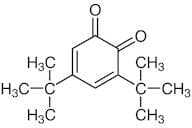
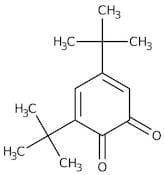
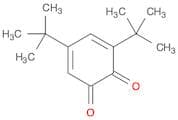
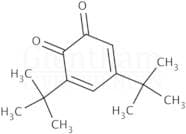
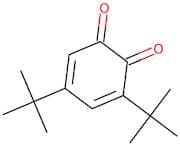
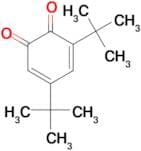
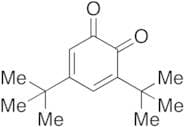
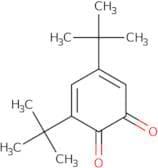
CAS 3383-21-9
:3,5-Di-terz-butil-1,2-benzochinone
- 3,5-Bis(1,1-dimethylethyl)-3,5-cyclohexadiene-1,2-dione
- 3,5-Cyclohexadiene-1,2-dione, 3,5-bis(1,1-dimethylethyl)-
- 3,5-Di-Tert-Butylcyclohexa-3,5-Diene-1,2-Dione
- 3,5-Di-t-butyl-o-quinone
- 3,5-Di-tert-butyl-1,2-benzoquinone
- 3,5-Di-tert-butyl-o-quinone
- 3,5-Di-tert-butylquinone
- 3,5-Ditert-butylcyclohexa-3,5-diene-1,2-dione
- 4,6-Di-tert-butyl-1,2-benzoquinone
- 4,6-Di-tert-butyl-o-benzoquinone
- Dibutylbenzoquinone
- NSC 149061
- o-Benzoquinone, 3,5-di-tert-butyl-
- 4,6-Ditert-butyl-3,5-cyclohexadiene-1,2-dione
- 3,5-DI-TERT-BUTYL-O-BENZOQUINONE 98+%
- 3,5-DI(TERT-BUTYL)BENZO-1,2-QUINONE
- 3,5-di-t-Butyl-o-benzoquinone
- 3,5-Ditert-butyl-3,5-cyclohexadiene-1,2-dione
- 3,5-Di-tert-butylbenzoquinone, 98+%
- 3,5-DI-TERT-BUTYL-O-BENZOQUINONE
- 3,5-di-tert-Butyl-ortho-benzoquinone
- Vedi altri sinonimi
3,5-Di-tert-butyl-1,2-benzoquinone
CAS:Formula:C14H20O2Purezza:>98.0%(GC)Colore e forma:Red to Dark blue to Black powder to crystalPeso molecolare:220.313,5-Di-tert-butyl-o-benzoquinone, 98+%
CAS:This Thermo Scientific Chemicals brand product was originally part of the Alfa Aesar product portfolio. Some documentation and label information may refer to the legacy brand. The original Alfa Aesar product / item code or SKU reference has not changed as a part of the brand transition to Thermo SciFormula:C14H20O2Purezza:98+%Colore e forma:Dark red to red to dark brown to brown or purple, Crystals or powder or crystalline powder or fused solid or needlesPeso molecolare:220.313,5-Di-tert-butyl-o-benzoquinone
CAS:Formula:C14H20O2Purezza:98%Colore e forma:SolidPeso molecolare:220.30743,5-Bis(tert-butyl)-1,2-benzoquinone
CAS:3,5-Bis(tert-butyl)-1,2-benzoquinonePurezza:98%Colore e forma:Red-Brown CrystalsPeso molecolare:220.30739g/mol3,5-Di-tert-butyl-o-benzoquinone
CAS:Prodotto controllatoApplications 4,6-Di-tert-butyl-1,2-benzoquinone is a Ortho-Quinone derivative is know to possess a number of biological properties such as antitumoral, antimicrobacterial and anti-cardiovascular disease.
References Singh, R., et al.: Res. J. Med. Plant., 6, 123 (2012); Sygmund. C., et al.: Microbiol., 157, 3203 (2011); Vidal, J.C., et al.: Electroanal., 20, 865 (2008); Kaizer, J., et al.: Food. Chem., 93, 425 (2005);Formula:C14H20O2Colore e forma:NeatPeso molecolare:220.313,5-Di-tert-butyl-1,2-benzoquinone
CAS:3,5-Di-tert-butyl-1,2-benzoquinone is a proton acceptor that has been found to be a kinetic intermediate in the transfer reaction of hydrogen atom abstraction from 1,2-dioxygen. It is an electron donor and can be used to activate other molecules. 3,5-Di-tert-butyl-1,2-benzoquinone also possesses a carbonyl group which coordinates with copper ions and activates amines. This compound is capable of catalyzing the oxidation of dehydroascorbic acid and the formation of copper complexes.
Formula:C14H20O2Purezza:Min. 95%Colore e forma:PowderPeso molecolare:220.31 g/molRef: 3D-FD161100
Prodotto fuori produzione