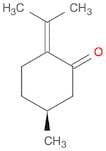
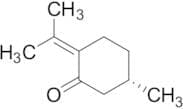
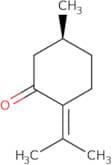
CAS 3391-90-0
:(-)-Pulegone
- (1S)-Pulegone
- (5S)-5-Methyl-2-(1-methylethylidene)cyclohexanone
- (5S)-5-Methyl-2-(propan-2-ylidene)cyclohexan-1-one
- (5S)-5-methyl-2-(propan-2-ylidene)cyclohexanone
- (S)-()-Pulegone
- Cyclohexanone, 5-methyl-2-(1-methylethylidene)-, (5S)-
- Cyclohexanone, 5-methyl-2-(1-methylethylidene)-, (S)-
- S-p-Menth-4(8)-en-3-one
- l-Pulegone
- p-Menth-4(8)-en-3-one, (S)-(-)-
(S)-Pulegone
CAS:Prodotto controllatoApplications (S)-Pulegone is the stereoisomer of (R)-Pulegone (P840140) which is a monoterpene, commonly found in the essential oils of Nepeta cataria (Catnip).
References Sonboli, A., et al.: Chem. Biodivers., 7, 1784 (2010), Ntalli, N., et al.: J. Agric. Food Chem., 58, 7856 (2010), Chun, M., et al.: Microchem. J., 95, 25 (2010)Formula:C10H16OColore e forma:NeatPeso molecolare:152.233(S)-(-)-Pulegone
CAS:Pulegone is a fumigant that has been shown to have moderate toxicity in humans and animals. It is metabolized in vivo to piperitone, which can be detected in urine samples. Pulegone is used as an insecticide on cotton and rice crops, and as a rodenticide. The metabolism of pulegone is stereoselective, with the (S)-enantiomer being more reactive than the (R)-enantiomer. Pulegone has been shown to cause lung damage in rats when it is inhaled or ingested orally. Pulegone also has carcinogenic effects on many animal species, including humans.
Formula:C10H16OPurezza:Min. 95%Colore e forma:Clear LiquidPeso molecolare:152.23 g/mol