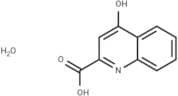
CAS 345909-35-5
:Acido 4-idrossichinolina-2-carbossilico idrato
Descrizione:
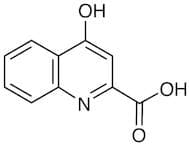
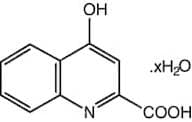
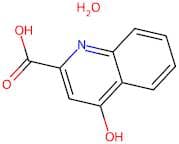
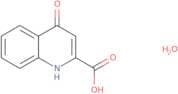
Acido 4-idrossichinolina-2-carbossilico idrato è un composto organico caratterizzato dalla sua struttura di chinolina, che presenta un gruppo idrossile e un gruppo funzionale acido carbossilico. Questo composto appare tipicamente come un solido cristallino ed è noto per le sue potenziali applicazioni in farmacologia e biochimica, in particolare come mattoncino nella sintesi di varie molecole bioattive. La presenza del gruppo idrossile contribuisce alla sua solubilità in solventi polari, mentre il gruppo acido carbossilico può partecipare a legami idrogeno e altre interazioni, migliorando la sua reattività. La forma idratata indica che contiene molecole d'acqua nella sua struttura cristallina, il che può influenzare le sue proprietà fisiche, come il punto di fusione e la solubilità. Inoltre, Acido 4-idrossichinolina-2-carbossilico idrato può mostrare attività biologica, rendendolo di interesse in chimica medicinale e nella ricerca relativa a proprietà antimicrobiche o antinfiammatorie. Come molti composti organici, una corretta manipolazione e conservazione sono essenziali per mantenere la sua stabilità ed efficacia.
Formula:C10H6NO3
InChI:InChI=1/C10H7NO3/c12-9-5-8(10(13)14)11-7-4-2-1-3-6(7)9/h1-5H,(H,11,12)(H,13,14)/p-1
SMILES:c1ccc2c(c1)c(=O)cc(C(=O)[O-])[nH]2
Sinonimi:- 4-hydroxy-Quinaldate
- 4-Hydroxyquinaldate
- 4-Hydroxyquinaldinate
- 4-Hydroxyquinoline-2-carboxylate
- Kynurenate
- 4-Oxo-1,4-Dihydroquinoline-2-Carboxylate
Ordinare per
Purezza (%)
0
100
|
0
|
50
|
90
|
95
|
100
6 prodotti.
Kynurenic Acid
CAS:Formula:C10H7NO3Purezza:>98.0%(T)(HPLC)Colore e forma:White to Gray to Brown powder to crystalPeso molecolare:189.174-Hydroxyquinoline-2-carboxylic acid hydrate, 98%
CAS:Broad spectrum excitatory amino acid antagonist4-Hydroxyquinoline-2-carboxylic acid hydrate is used as an intermediate in synthetic chemistry. It acts as an antiexcitotoxic and anticonvulsant. It finds application in certain neurobiological disorders therapy. This Thermo Scientific Chemicals brandFormula:C10H7NO3Purezza:98%Colore e forma:Dark cream to cream to yellow to green to pale brown to pale gray to gray, PowderPeso molecolare:189.174-HYDROXYQUINOLINE-2-CARBOXYLIC ACID, HYDRATE, 98
CAS:Formula:C10H9NO4Purezza:95%Colore e forma:SolidPeso molecolare:207.18284-Hydroxyquinoline-2-carboxylic acid hydrate
CAS:4-Hydroxyquinoline-2-carboxylic acid hydrateFormula:C10H7NO3·H2OPurezza:≥95%Colore e forma: faint yellow/ green solidPeso molecolare:207.18g/mol4-Hydroxyquinoline-2-carboxylic acid hydrate
CAS:4-Hydroxyquinoline-2-carboxylic acid hydrate is a neuroprotective agent that has been shown to be effective in the treatment of neurodegenerative diseases. It is a solvate, which means that it can form crystals with water molecules and is capable of hydrogen bonding. The quinolinecarboxylic acid moiety of 4-hydroxyquinoline-2-carboxylic acid hydrate has been shown to have neuroprotective effects against neurotoxicity induced by kynurenic acid, an endogenous compound. 4-Hydroxyquinoline-2-carboxylic acid hydrate has broad spectrum activity and can be used as a broad spectrum neuroprotective agent. The molecule also displays polymorphism with tautomeric behaviour and diffraction properties.Formula:C10H7NO3·H2OPurezza:Min. 95%Peso molecolare:189.17 g/molKynurenic Acid hydrate
CAS:Kynurenic acid, an active metabolite of tryptophan, is synthesized through a kynurenine intermediate by kynurenine aminotransferases (KATs). It acts as an antagonist of both NMDA and AMPA receptors, as well as α7 nicotinic acetylcholine receptors (nAChRs; EC50s = 235, 101, and 7 µM, respectively), and functions as an agonist for the aryl hydrocarbon receptor (AhR) and G protein-coupled receptor 35 (GPR35; EC50s = 1.4 and 39 µM, respectively). In a neonatal rat model of cerebral hypoxic-ischemia, induced by carotid artery ligation, administration of kynurenic acid at 300 mg/kg prevents weight loss in the lesioned hemisphere. Additionally, at concentrations of 1 and 5 mg/ml, it protects against neurodegeneration in the rhabdomere of the eye in an Htt93QtransgenicDrosophila model of Huntington's disease. Elevated levels of kynurenic acid in the cerebrospinal fluid have been observed in patients with schizophrenia.Formula:C10H9NO4Colore e forma:SolidPeso molecolare:207.185